
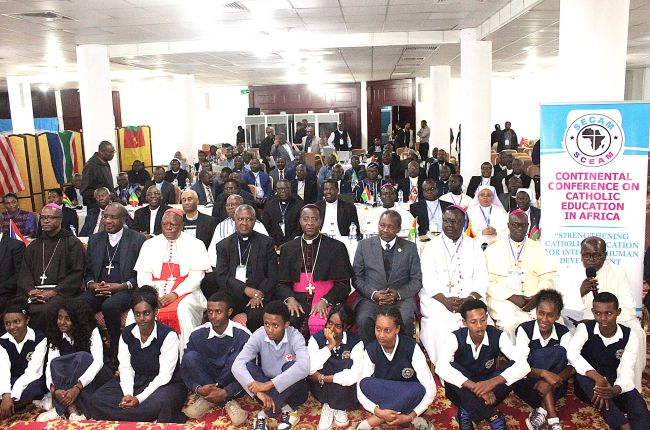
ADDIS ABABA, August 11, 2026— Catholic bishops, educators, university and school leaders from across Africa and Madagascar have adopted a declaration calling for major reforms and increased investment in Catholic education, including stronger safeguarding, greater access for vulnerable communities and responsible use of artificial intelligence.
The Addis Ababa Declaration on Catholic Education was adopted on August 7, 2026 at the conclusion of the First Continental Conference on Catholic Education, held in Addis Ababa from August 5-8.
The four-day conference brought together presidents of Episcopal Conferences, bishops, Catholic educators, leaders of Catholic universities and schools, members of Institutes of Consecrated Life and Societies of Apostolic Life, clergy, lay faithful, young people and partners in Catholic education from across Africa and Madagascar.
The participants reaffirmed Catholic education as an essential ministry of the Church and an instrument of evangelisation, character formation and integral human development.
The declaration says Catholic educational institutions have a responsibility that goes beyond academic instruction, including the formation of ethical leaders and responsible citizens capable of contributing to peace, social transformation and Africa’s development.
The participants identified poverty, conflict, forced migration, unemployment, inequality, digital transformation, climate change, declining moral values and inadequate educational resources among the major challenges facing education on the continent.
At the same time, they identified technology, research, innovation, artificial intelligence and greater continental collaboration as opportunities that could strengthen Catholic education.
The declaration calls on Catholic educational institutions to strengthen their Catholic identity while promoting academic excellence alongside spiritual, moral, intellectual, social and ecological formation.
It also calls for increased investment in recruiting, training and providing continuing professional development for Catholic educators and leaders.
A major focus of the declaration is the protection of children and vulnerable people. Catholic educational institutions are urged to ensure that schools and other institutions are safe, inclusive and accountable, with effective safeguarding measures in place.
The leaders further called for expanded access to quality Catholic education, particularly for poor, physically challenged, marginalised and displaced people and vulnerable communities.
On technology, the declaration calls for investment in new technologies and responsible and ethical use of artificial intelligence in teaching, learning, research and administration.
The Catholic leaders also want greater collaboration between Catholic schools, universities, seminaries, religious congregations and Episcopal Conferences across Africa and Madagascar.
They called for more research, innovation, entrepreneurship and skills development tailored to Africa’s realities and aspirations, with Catholic educational institutions expected to contribute to job creation.
Ecological education and care for creation were also identified as priorities, alongside the wellbeing of teachers and educators and the sharing of expertise and resources between institutions and countries.
Call for stronger national structures
The declaration calls on Episcopal Conferences to make Catholic education a pastoral priority and establish functional national structures responsible for Catholic education.
Governments, meanwhile, are urged to recognise and support the contribution of Catholic educational institutions to national development.
Catholic universities, schools and formation institutions are called upon to strengthen quality assurance, good governance and accountability, while religious congregations and Catholic organisations are encouraged to maintain their investment in education.
The declaration also calls on parents and families to take an active role in the education and faith formation of their children.
Development partners, the African Union and other international bodies are urged to collaborate with the Catholic Church in strengthening Catholic education across the continent.
Proposed continental body
To coordinate implementation of the commitments, the conference recommended establishing a SECAM Episcopal Commission for Catholic Education.
The proposed commission would develop a continental framework for Catholic education, establish mechanisms for collaboration, monitoring, evaluation and reporting, and encourage individual Episcopal Conferences to prepare national implementation plans.
It would also convene periodic continental meetings to assess progress, exchange best practices and renew commitments.
The declaration places the family at the centre of education, reaffirming the Church’s teaching that parents are the primary educators of their children.
It also highlights the historical contribution of Catholic schools, colleges, universities, seminaries and formation centres to education and development across Africa and Madagascar, while recognising the sacrifices made by bishops, priests, religious, teachers, parents and lay collaborators.
The conference participants said Catholic education should remain rooted in the dignity of every human person while responding to the changing social, technological and economic realities of the continent.
They committed themselves to forming generations of faithful disciples, competent professionals, ethical leaders, innovative entrepreneurs and responsible citizens.
The declaration concludes with a call for Catholic education to remain a “beacon of hope, faith, knowledge, justice, and peace” for Africa and Madagascar.
https://thecooperator.news/african-catholic-church-celebrates-pope-leo-xivs-first-year-as-pontiff/
Buy your copy of thecooperator magazine from one of our country-wide vending points or an e-copy on emag.thecooperator.news


