
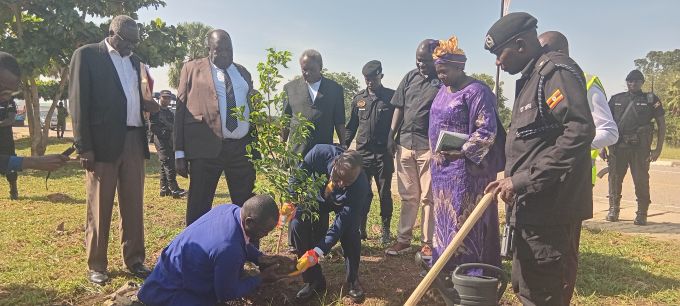
SOROTI, November 9, 2026 – The Minister of State for Science, Technology and Innovation, Eng. Jonard Asiimwe Akiiki, has challenged public universities to translate research findings into marketable products and businesses that can create jobs and drive economic growth.
Asiimwe said government investment in university research should deliver tangible results, urging researchers to develop practical solutions to community challenges rather than spend public funds without producing viable innovations.
“If you are a researcher, your mandate is to produce a product, but eating the money and lying to people will be killing generations,” he said.
He was speaking during a recent visit to Soroti University as part of an assessment of research and innovation projects at four public universities: Soroti University, Lira University, Muni University and Gulu University.
The minister said his team would assess innovations developed by the institutions to identify those that qualify for additional technical support and funding to advance their development.
“The innovations here are still under mentorship, and the team will assess them to see how we can add knowledge and fund those that are eligible,” he said.
Asiimwe said investment in science, technology and innovation was critical to improving production, strengthening working methods and making services and processes more efficient.
He urged universities to ensure their research addresses practical challenges and contributes to the country’s economic transformation, pledging continued government support for research and innovation.
“I pledge government support towards strengthening research and innovation at the institution,” he added.
During the visit, researchers and students at Soroti University highlighted several challenges affecting their efforts to transform ideas into marketable products, including inadequate research facilities and limited access to modern technology.
Mishail Jude Matova, a third-year Electronics and Computer Engineering student, said students faced difficulties accessing advanced artificial intelligence [AI] tools that could accelerate the development of innovations.
He said technology was evolving rapidly, particularly with the growing application of AI, but students lacked access to tools that could simplify software development and product design.
Matova appealed to government to support universities in acquiring modern AI tools, including cloud-based AI agents that assist with software development.
He explained that completing a single project without such tools could take considerable time, while access to AI-powered technology would enable students to develop their innovations more quickly.
“So we are requesting to have those tools so that we can also develop our programmes very fast,” Matova said.
“To be able to make a product, we need agents and tools that can help us come up with projects in time,” he added.
Prof. Patrick Ogwang, head of the university’s Department of Pharmacology, called for government support for research into medicinal plants, particularly in documenting, testing and preserving findings.
He said the department was exploring the potential of natural medicines in pain management, with the long-term goal of developing products that could be commercialised.
The university’s Vice-Chancellor, Prof. John Robert Ikoja, said the institution had received Shs2 billion in research funding during the current financial year, marking the first time the money had been allocated directly to it.
He said the university had previously accessed research funding through sister institutions, a process that made it difficult to secure the resources required to undertake research.
“It took us a lot of explaining in order to access the funds,” Ikoja said.
He, however, said the university continued to face challenges, including inadequate research infrastructure, limited funding and transport constraints that hinder researchers from collecting samples from different parts of the country.
Ikoja also appealed for government support to equip and expand the university’s histopathology laboratory, saying it needed additional space and specialised equipment before it could be registered to provide services.
He said the facility would help serve patients from areas including Karamoja and Jinja.
Meanwhile, student Levi Nakasala said increased support for research would enable students to develop their ideas and advance their careers, despite the setbacks some encounter in their projects.
“I have tried a number of projects but have all failed, and that’s the unfortunate bit, but I will not stop at that,” Nakasala said.
The assessment is expected to identify promising innovations requiring further technical support and funding as government seeks to bridge the gap between university research and the development of marketable goods and services that can benefit communities, create jobs and expand economic opportunities.
Buy your copy of thecooperator magazine from one of our country- wide vending points or an e-copy on emag.thecooperator.news


