
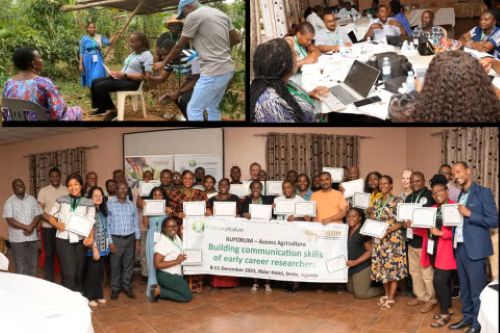
KAMPALA, February 17, 2026 — Twenty-five young university researchers from eight Anglophone African countries have praised a hands-on communication workshop in Uganda for equipping them with practical skills to make agroecological research more accessible to farmers.
The four-day training, held recently in Seeta, brought together participants from Ethiopia, Ghana, Kenya, Nigeria, South Africa, Tanzania, Uganda and Zimbabwe. The group comprised 15 women and 10 men.
Organised by Access Agriculture in collaboration with the Regional Universities Forum for Capacity Building in Agriculture [RUFORUM], the workshop focused on strengthening researchers’ ability to communicate complex agroecological knowledge in clear, engaging and practical ways. It followed a similar training for Francophone early-career researchers in Benin in November 2025.
Participants welcomed the highly interactive format, particularly field visits that enabled them to learn directly from farmers about agroecological practices and the importance of co-constructing knowledge.
“The field exercises helped us connect theoretical teaching with real-world farmer experiences,” one participant said. “We will carry these skills forward in our work.”
Sessions covered writing for non-specialist audiences, storytelling techniques, blog development and publishing, and strategies to avoid knowledge bias in communication. Participants also received practical training in scriptwriting, filming, interviewing and video editing.
Nearly all attendees successfully wrote and published blog posts on their research, creating personal blog sites during the workshop.
The video production component included preparing scripts, conducting farmer interviews and editing footage. The training concluded with participants uploading their completed videos to EcoAgtube, a platform for sharing agricultural training videos, and reflecting on lessons learned.
Organisers provided each participant with a DJI Osmo Pocket camera and Bluetooth microphone to support their outreach efforts. Participants said the equipment would enable them to immediately apply the skills acquired during the training.
Practical guidance was also offered on integrating farmer training videos from Access Agriculture and EcoAgtube into university curricula to enhance agricultural education and help bridge language barriers.
The workshop ended with the award of certificates and the distribution of the publication Agroecology in Practice: From Local Initiatives to Global Scaling and related manuals.
The closing ceremony was attended by Prof. Majaliwa Mwanjalolo of the RUFORUM Secretariat and Josephine Rodgers, Executive Director of Access Agriculture.
Josephine commended the researchers for their commitment and progress. “Making good videos with farmers requires lifelong learning,” she said. “The skills you have learnt at this workshop will help you translate vital research into tangible benefits for farmers.”
She acknowledged RUFORUM’s support and the participation of its communication professionals, as well as the contribution of the Slow Food Uganda team in Mukono for facilitating engagement with local farmers.
The Uganda and Benin workshops were funded by the International Foundation for Science [IFS, Sweden]. Resource persons from Access Agriculture included Sylvia Nakanyike, Kevin Mutonga, R Raman, Blessings Flao, Savitri Mohapatra and Phil Malone.
Buy your copy of thecooperator magazine from one of our country-wide vending points or an e-copy on emag.thecooperator.news


