
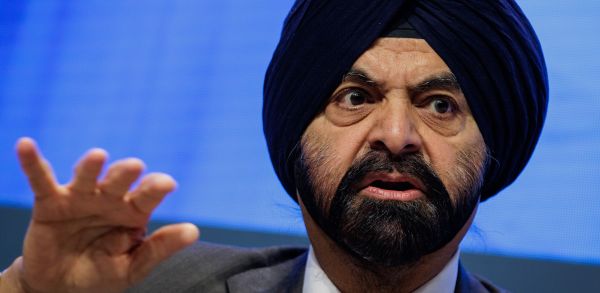
BANGKOK, October 17, 2026 — World Bank Group President Ajay Banga has called for urgent action to address a projected global jobs gap of about 800 million, warning that 1.2 billion young people are expected to enter the labour market over the next 10 to 15 years when only about 400mln jobs are projected to be available.
Banga made the remarks on Friday while delivering his address at the 2026 Annual Meetings Plenary in Bangkok, Thailand, where he said the World Bank Group must help countries create jobs at scale while making increasingly scarce development resources go further.
“Over the next 10 to 15 years, 1.2bln young people will arrive at a job market projected to offer only about 400mln jobs,” Banga said.
“This generation will shape the next century. The choices we make today will help determine how.”
He said conflicts, tighter fiscal space, rising debt burdens and high costs of essentials such as energy and fertiliser were making the development challenge more difficult.
According to Banga, the twin challenges of mobilising limited resources and creating employment opportunities must be addressed together.
“The future of development will depend on bringing public finance, private investment, philanthropy, and technology together around what each country needs,” he said.
Banga said the World Bank Group had undertaken major reforms over the past three years to increase its development impact, including reducing project preparation time from 19 months to nine months and cutting 153 scorecard measures to 22 focused on impact.
The institution has also increased pay-for-results financing from about one-third to half of its financing and restructured its balance sheet to create more than US$ 100bln in additional International Bank for Reconstruction and Development [IBRD] lending capacity over a decade.
Banga said greater collaboration among multilateral development banks was also helping to increase financing, with the co-financing pipeline tripling in two years to about 250 projects seeking US$ 138bln in financing.
He said the World Bank’s jobs strategy was built around three priorities: physical and human infrastructure, regulatory and policy certainty, and mobilising private investment at scale.
“Employers need electricity, water, transport, and digital connections. People need health, education, and skills,” he said, adding that the World Bank committed US$ 40bln last year, nearly one-third of its financing, to these foundations.
Banga said the institution’s efforts to mobilise private capital were beginning to yield results, with private capital mobilisation rising from about US$ 35bln in the 2022 financial year to US$ 112bln last year.
“Alongside our own financing, total financing exceeded US$ 230bln,” he said.
However, he acknowledged that attracting commercial capital remained particularly difficult in low-income countries, where mobilisation stood at about US$ 3bln.
He said the World Bank’s new strategy for micro, small and medium-sized enterprises [MSMEs] would seek to address the financing constraints faced by smaller businesses, which are particularly important in fragile and conflict-affected economies.
Banga said the World Bank Group was also expanding investment in sectors capable of raising productivity and creating employment, including infrastructure and energy, agribusiness, health, tourism and value-added manufacturing.
He said about 55 percent of the institution’s financing and the private capital it mobilised went into these sectors.
Climate financing was also growing, with total World Bank Group climate co-benefits reaching US$ 96bln, including US$ 48bln mobilised from private capital, Banga said.
He highlighted several initiatives aimed at delivering development outcomes at scale.
Through Mission 300, a partnership with the African Development Bank, the World Bank Group aims to connect 300mln people in Africa to electricity by 2030. Banga said 59mln people had so far gained access, with the pace increasing from 12mln in the 2024 financial year to 18mln in 2025 and 28mln last year.
He said the initiative would support a mix of energy sources, including renewables, hydropower, gas where appropriate and nuclear power where suitable, alongside investment in transmission networks, grids and storage.
On water, Banga said the World Bank Group and its partners aim to improve water security for up to one billion people by 2030, with the World Bank committed to reaching 400mln people.
He said 20 country compacts were already designed to reach 150mln people with clean water, with another 20 planned.
In agriculture, the World Bank Group and its partners aim to help 300mln smallholder farmers move from subsistence to surplus by 2030, with the bank committed to supporting 200 million farmers.
Banga said the institution’s AgriConnect initiative had established a pipeline to support 82 million farmers during its first full year.
In health, the HealthWorks initiative aims to reach 1.5bln people with quality and affordable health services by 2030. About 600mln people have already been reached, he said.
The World Bank Group is also seeking to increase its involvement in critical minerals, with Banga saying the institution plans to quintuple its business in the sector within five years.
He said the bank had launched its first country compacts with other multilateral development banks to help countries build local industries and retain more jobs and value from their mineral resources.
Banga said the institution had also expanded its work on economic corridors, launching 52 new projects last year compared with 20 three years earlier.
He cited the Lobito corridor as an example of how infrastructure initially designed to support mineral exports could also create opportunities for farmers and communities by connecting them to markets.
On technology, Banga said artificial intelligence could help developing countries improve productivity even if they could not immediately access the computing power and infrastructure required to develop frontier AI models.
“Practical, or ‘small,’ AI can help a farmer improve yields, a teacher tailor instruction, a health worker make better-informed decisions, or an entrepreneur reach new customers,” he said.
He said the World Bank was therefore helping countries build the electricity, connectivity, access to devices, skills and safeguards required to use AI effectively.
Banga also called for a greater role for pension funds, insurers and sovereign wealth funds in financing development, arguing that multilateral development banks needed to recycle their capital more efficiently.
He said six multilateral development banks were developing common approaches to assess, document, package and transfer investments so that projects initially financed by development banks could later be held by other investors.
“If we get this right, the size of our balance sheet no longer defines the scale of our ambition—and we will bend the curve of development forever,” Banga said.
Reflecting on the origins of the World Bank, Banga said the institution was founded in 1944 when delegates from 44 countries gathered in Bretton Woods, New Hampshire, while the Second World War was still under way.
He said the founding vision was based on the understanding that economic recovery and prosperity were shared responsibilities.
Banga warned that the projected jobs deficit should not be treated simply as an economic statistic.
“A job is not a statistic. A job is dignity,” he said.
“It is the difference between a young person who can build a future… and a young person awaiting one.”
He said failure to create opportunities for young people could have consequences that crossed national borders, while expanding employment and economic opportunity would generate benefits beyond individual countries.
“The jobs gap is a projection. It does not have to be our future,” Banga said.
“We have begun to show what this model can deliver. Now we must give it the scale and pace the next generation demands.”
He said the World Bank Group’s future development model would combine public financing where markets could not yet reach, private capital where it could create jobs and scale, philanthropy to absorb early risks and technology to make development resources more effective.
“That is the future of development we are working toward,” Banga said.
Buy your copy of thecooperator magazine from one of our country-wide vending points or an e-copy on emag.thecooperator.news


