
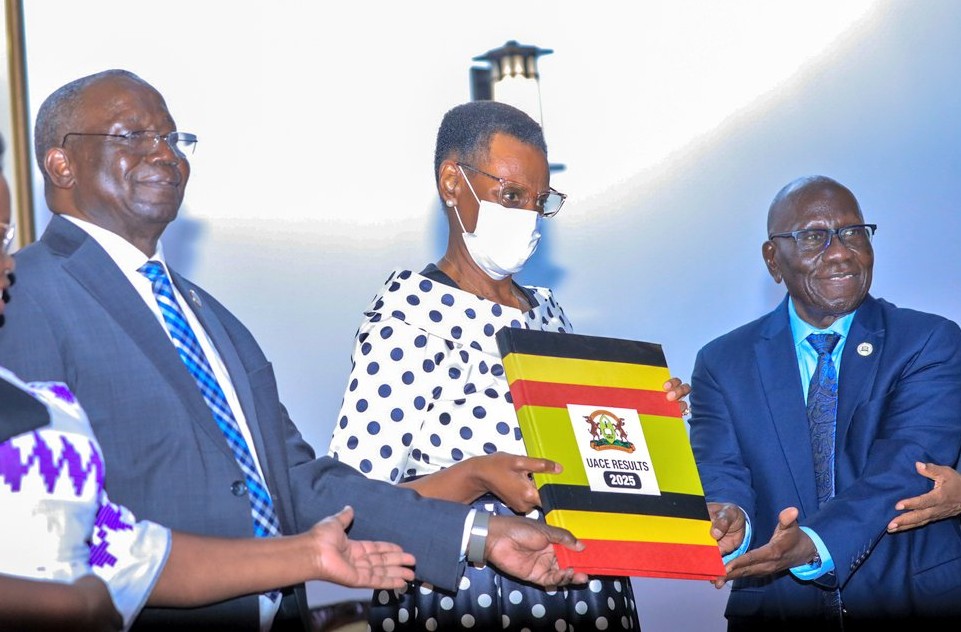
KAMPALA, March 13, 2026 — The First Lady and Minister of Education and Sports, Janet Kataha Museveni, has officially released the 2025 Uganda Advanced Certificate of Education [UACE] examination results at State House, Nakasero.
Speaking at the release, the First Lady urged parents and guardians to take a more active role in the lives of their children.
“Parents and guardians, I intentionally call upon you to embrace your God-given roles, be present and actively involved in your children’s lives. Play a key role in nurturing your children,” she said.
She emphasised that education should go beyond the mere acquisition of knowledge and instead equip learners with the ability to solve real-life challenges.
“Education must not be about the acquisition of knowledge per se, but about how knowledge helps us to be creative, productive, and able to find solutions to the problems in our communities and country,” she said.
The First Lady also thanked God for the learners who completed the three national examinations in 2025. “We thank God for 1,402,434 of our children who completed the three levels of our basic and secondary education,” she said.
She further commended the strong performance of girls in the latest UACE examinations.
“I am pleased to note the good performance by girls, and I congratulate them on this remarkable achievement. I am particularly impressed by the steady increase in the number of girls taking on science subjects and that they have done very well,” she said.
Girls maintain stronger overall performance
According to the Executive Secretary of the Uganda National Examinations Board [UNEB], Dan N. Odongo, who presented the latest results female candidates continued to perform better overall than their male counterparts, particularly in the Humanities.
Odongo noted that female candidates maintained stronger performance grades in several Humanities subjects and recorded lower overall failure rates.
“Female candidates have continued to perform commendably better than their male counterparts, maintaining stronger performance grades at several subject levels in the Humanities and demonstrating lower overall failure proportions,” he said.
He explained that the trend reflects the positive impact of sustained investment in girl-child education, although subject selection patterns remain gendered.
“There is still a higher concentration of female candidates in the Humanities than in the Sciences. Broader participation of both male and female candidates in Science subjects will enhance equity and balance across future professional fields,” Odongo added.
At the principal level pass [A–E], female candidates outperformed males in most Humanities subjects, as well as in Mathematics, General Paper, Subsidiary Mathematics and Subsidiary ICT.
However, at the highest grade level of A passes, male candidates performed better in Mathematics and Science subjects. Female entries in these subjects remain lower than those of male candidates.


Increased candidature and examination centres
A total of 166,400 candidates registered for the 2025 UACE examination, compared to 141,996 candidates in 2024, representing an increase of 24,404 candidates [17.2 percent]. Of those registered:72,764 were female while 93,636 were male.
The number of candidates who actually sat the examinations was 165,172, up from 140,884 in 2024, reflecting the same 17.2 percent increase. Among those who sat the examinations, 72,374 were females while 92,798 were males.
Odongo observed that female candidature at this level remains significantly lower than that of males.
Meanwhile, the number of examination centres rose by 8.7 percent, from 2,255 in 2024 to 2,452 in 2025.
Special Needs candidates increase
Registration among Special Needs Education [SNE] candidates also increased.
A total of 540 SNE candidates [274 males and 266 females] registered for the 2025 UACE examinations, compared with 437 candidates [249 males and 188 females] in 2024.
Subject performance trends
UNEB reported improvements in performance in several subjects, including:
Mathematics; Chemistry; Agriculture; Geography; Economics; Biology; and Literature in English.
However, declines were recorded in:
Entrepreneurship Education; Christian Religious Education; Fine Art; and Physics.
Overall, performance in Science subjects has improved compared with the Humanities.
In the Sciences, examiners reported persistent challenges such as limited practical exposure, misinterpretation of experimental procedures, poor graphical data presentation, and difficulty in drawing conclusions from observations. Errors in writing correct chemical equations were also common.
Candidates also struggled to apply scientific concepts to real-life situations, while some teachers were reported to skip certain topics, particularly in Physical Chemistry.
In the Humanities, performance challenges were largely attributed to poor interpretation of questions and weak understanding of key concepts. For instance, in History, candidates showed weak analytical and evaluative skills and often failed to provide relevant examples. In Religious Education, many struggled with questions requiring the application of teachings from holy texts to everyday life situations.
Over 113,000 qualify for university
For admission to degree programmes, candidates must obtain at least two Principal passes.
Based on this criterion, 113,291 candidates [68.6 percent] qualify for university admission, compared to 92,273 candidates [65.5 percent] in 2024.
“This improvement aligns with the significant increase in entries for the 2025 examination, indicating that an additional 21,018 university places may be required to accommodate the increased number of qualifying candidates,” Odongo said.
For other tertiary institutions such as Technical and Vocational Education and Training [TVET] institutions offering diploma programmes, candidates require one Principal pass and two Subsidiary passes. Under this category, 145,129 candidates [87.9 percent] qualify.
UNEB registers over 1.4 million candidates across exams


The Chairperson of UNEB, Celestino Obua, said the Board assessed 1,402,434 candidates across the three national examinations — Primary Leaving Examination [PLE], Uganda Certificate of Education [UCE] and UACE.
This represents an increase from 1,294,731 candidates in 2024.
Specifically, UACE candidature rose by 17.2 percent, from 141,996 candidates in 2024 to 166,400 in 2025.
Obua said the continued increase reflects expanded access to post-O’ Level education and growing public confidence in national examinations.
“As candidature expands, the Board remains mindful of its responsibility to safeguard standards, ensure comparability over time and maintain fairness in assessment,” he said.
He added that the proportion of candidates who register but fail to sit examinations has continued to decline, signalling improved completion rates and stronger supervision at school level.
Low cases of examination malpractice
According to Odongo, cases of examination malpractice remain relatively low.
In line with Section 5[2][b] of the UNEB Act, the results of candidates suspected of malpractice have been withheld pending investigations.
A total of 351 candidates (0.2 percent) from 47 of the 2,452 examination centres were implicated.
The reported cases mainly involved receiving assistance during Science practical papers, possession of unauthorised materials, and impersonation.
Odongo added that UNEB is currently handling malpractice hearings for Primary Leaving Examination cases and will begin hearings for Uganda Certificate of Education cases from March 16, 2026.
The 2025 UACE results pave the way for thousands of successful candidates to proceed to universities and other institutions of higher learning across the country.
https://thecooperator.news/uneb-99-percent-of-candidates-excel-in-2025-uce/
Buy your copy of thecooperator magazine from one of our country-wide vending points or an e-copy on emag.thecooperator.news


