
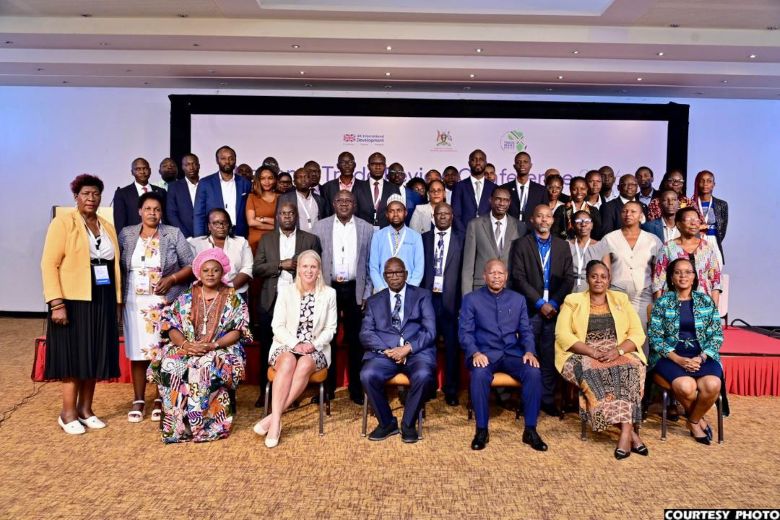
KAMPALA, March 4, 2026 — Uganda has reaffirmed its ambition to build a US$500 billion economy by 2040, with trade and manufacturing positioned at the centre of the country’s transformation agenda, as leaders gathered for the National Trade Review Conference 2026 at Speke Resort Munyonyo in Kampala.
Speaking at the two-day conference, the Minister of Trade, Industry and Cooperatives [MTIC], Francis Mwebesa, outlined Uganda’s manufacturing targets under the Fourth National Development Plan [NDP IV].
He said government aims to increase manufacturing value added [MVA] from 16 percent to 20 percent of gross domestic product [GDP] by the 2029/30 financial year, raise capacity utilisation to 60 percent, and grow manufactured exports to 13.5 per cent of total exports.
By expanding domestic market share and encouraging new manufacturers to enter the sector, Mwebesa said Uganda is strengthening the scale, competitiveness and resilience of its industrial base to drive export-led growth.


He revealed that both the National Trade Policy and the National Export Development Strategy have been revised to align with regional and global realities, shifting focus from the export of raw materials to processed, high-value goods.


Mwebesa said, Uganda’s trade landscape has undergone significant transformation, with exports growing to US$ 13.4 billion, laying the foundation for the country’s long-term economic vision.
The minister noted that government is prioritising import substitution in key sectors such as cement, steel, pharmaceuticals, textiles, edible oils and dairy. “Our products are now competing with imports and winning. More jobs, less foreign exchange leakage, and stronger value chains, this is the strategy in action,” he said.
He added that government’s current focus includes deepening regional integration, leveraging the African Continental Free Trade Area [AfCFTA], strengthening standards infrastructure, formalising micro, small and medium enterprises [MSMEs] for export, and attracting investment into export-oriented industries.
“What is powering Uganda’s trade growth?” Mwebesa asked. “Strengthened standards infrastructu


re, deeper regional diplomacy, and expanded market access in the UAE, the Middle East, China and Europe. The architecture for transformation is being built.”
Speaking at the conference, State Minister for Trade Wilson Mbadi said that with export promotion reinforced through the Uganda Free Zones and Export Promotions Authority [UFZEPA] and related institutions, the country is transitioning into the next phase under the Ten-Fold Growth Strategy.
“Trade remains central to our country’s transformation agenda and is a critical driver of the Ten-Fold Growth Strategy aimed at expanding Uganda’s economy to US$500 billion in the medium term,” Mbadi said.
The British High Commissioner to Uganda, Lisa J. Chesney, emphasised the importance of embedding standards at the production stage rather than treating them as barriers at export points.
“Standards should not be a roadblock at the border. They should be part of the process from the beginning,” she said, noting that with support from the UK government, testing facilities are being decentralised to Arua, Mbale and Gulu to ease access for exporters outside Kampala.
Addressing delegates, the Permanent Secretary at MTIC, Lynette Bagonza, highlighted Uganda’s macroeconomic stability as a foundation for trade expansion. She said the economy grew by 6.1 per cent in FY2023/24, inflation remained stable at between 3 and 5 per cent, and the fiscal deficit had reduced to 5 percent of GDP.


“No country can expand trade without economic stability,” she said.
Bagonza noted that exports have increased from US$ 4.5 billion to US$13.4 billion over the past five years, while imports have grown from US$7.5 billion to US$ 15.7 billion. She explained that the bulk of imports comprise machinery, fuel and raw materials, investments that expand Uganda’s productive capacity.
She said 38 per cent of Uganda’s exports are destined for African markets, 26 percent for the Middle East, 20 percent for Asia and 13 percent for the European Union, with over 70 percent of manufactured goods exported within the region.
Citing global trends, Bagonza observed that world trade reached US$ 33 trillion in 2024, with services trade growing by 9 percent, faster than trade in goods, while South-South trade expanded by 4–5 percent. She said these trends reinforce Uganda’s need to participate actively in regional and continental trade frameworks.
Also speaking at the conference, Anna Nambooze, Country Director of TradeMark Africa, the organisers of the conference alongside MTIC, and UK International Development, underscored the importance of standards awareness.
“Standards are not a roadblock at the border; they are a process,” she said. “That is why we are training the media to communicate standards better, so farmers, suppliers and logistics providers understand trade rules upfront, not at the last mile.”
She added that TradeMark Africa is establishing a real-time non-tariff barriers monitoring system to report and resolve trade obstacles swiftly.
The conference, attended by ministers, Members of Parliament, heads of government agencies, development partners and private sector leaders, is expected to deliver a stocktake of Uganda’s trade performance, review policy reforms and value addition initiatives, launch an Online Trade Permit System, and adopt a time-bound communiqué and implementation matrix, all geared towards accelerating progress towards the US$500 billion economy target


https://thecooperator.news/mtic-partners-to-convene-national-trade-review-conference-2026/
Buy your copy of thecooperator magazine from one of our country-wide vending points or an e-copy on emag.thecooperator.news
-

-

-

-

