
KAMPALA, July 8, 2026 — Finance Minister Henry Musasizi has directed the Uganda Development Bank [UDB] to prioritise financing for the country’s key growth sectors, saying the institution’s interventions should support the country’s ambition of building a US$ 500 billion economy by 2040.
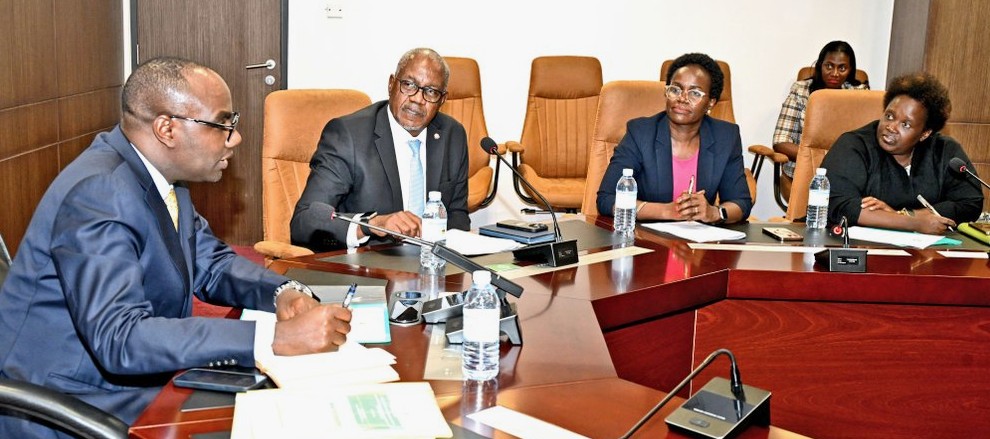
Musasizi made the remarks yesterday during a meeting with the UDB Board of Directors and management at the Ministry of Finance, Planning and Economic Development.
He was accompanied by the State Minister for Planning, Amos Lugoloobi, and the State Minister for Privatisation and Investment, Aminah Mukasa.
The ministers, who represent government as shareholders in UDB, met the bank’s leadership, led by Board Chairman Geoffrey Kihuguru and Managing Director Patricia Ojangole, to review the institution’s performance and strategic direction.
“UDB’s support must enable the people and government of Uganda to achieve the goal of building a US$500 billion economy by 2040,” Musasizi said, urging the bank to continue directing its resources towards sectors with the greatest potential to drive economic transformation.
UDB, Uganda’s national development finance institution, has positioned itself as a key partner in financing private sector-led projects and commercially viable government initiatives that contribute to national development priorities.
Board Chairman Geoffrey Kihuguru said the bank’s sectoral focus and interventions are aligned with the Fourth National Development Plan [NDP IV] and the Government’s ten-fold growth strategy.
“We remain grateful for the confidence placed in UDB and for the sustained capitalisation, strategic guidance and enabling environment that have allowed the Bank to deepen its development impact across the country,” Kihuguru said.
Managing Director Patricia Ojangole said the bank is transforming into a catalytic institution that mobilises and deploys long-term capital, including private sector financing, towards projects capable of generating sustainable economic value.
“The Bank is positioning itself as a catalytic institution that mobilises and deploys long-term capital, including private capital, into private sector-led projects, as well as commercially viable Government-led projects with clear cash-flow potential,” Ojangole said.
She added that UDB is embracing technology, innovation and human capital development to improve efficiency, strengthen institutional resilience and ensure effective implementation of its strategy.
Ojangole further revealed that the bank has introduced specialised financing programmes targeting small and medium-sized enterprises [SMEs], women and young entrepreneurs, with funding ranging from Shs 50 million to Shs 720 million.
According to UDB records, the bank has recorded significant growth in recent years, with total assets nearly doubling from Shs 1.22 trillion in 2021 to Shs 2.39 trillion by May 2026.
Gross loans and advances also more than doubled over the same period, rising from Shs 840 billion to Shs 1.84 trillion, supported by cumulative loan disbursements totalling Shs 3.1 trillion.
Between 2021 and May 2026, the bank mobilised Shs1.38 trillion in funding, comprising Shs800 billion in government capitalisation, Shs 390 billion in borrowings from development partners, and Shs 189 billion in retained earnings reinvested to strengthen its capital base.
UDB’s cumulative capitalisation has now reached Shs 1.96 trillion, reflecting continued Government support, confidence from development partners, and the bank’s strategy of retaining earnings to reinforce its financial position.
Government has identified agriculture, manufacturing, tourism, minerals and other productive industries as the key drivers of Uganda’s economic transformation, with development finance institutions expected to play a central role in expanding access to affordable long-term capital.
Buy your copy of thecooperator magazine from one of our country-wide vending points or an e-copy on emag.thecooperator.news
-

-

-

-


