
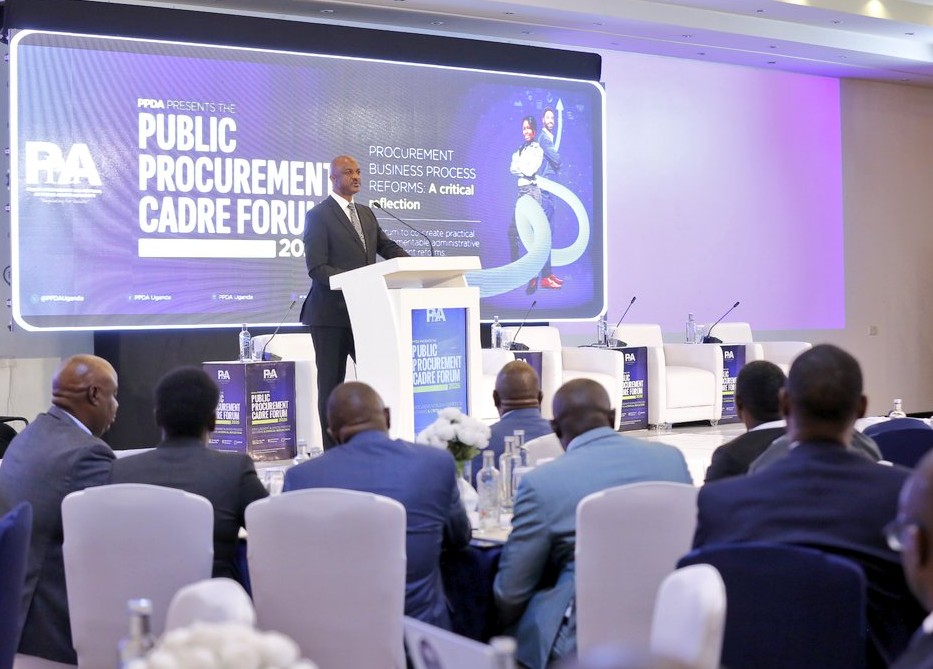
KAMPALA, May 8, 2026 — The Permanent Secretary and Secretary to the Treasury, Ramathan Ggoobi, has said Uganda’s transformation agenda under the Fourth National Development Plan [NDP IV] and the Tenfold Growth Strategy to expand the economy to US$ 500 billion by 2040 will largely depend on the effective execution of public investments.
Ggoobi noted that public procurement is central to achieving this goal.
He made the remarks on Thursday while officiating at the PPDA Public Procurement Cadre Forum 2026 held at Speke Resort Munyonyo.
“Public procurement must therefore stop being viewed merely as a compliance process. It must become a strategic tool for delivering faster growth, better services, stronger local industries and value for money for Ugandans,” Ggoobi said.
He added that procurement plays a decisive role in determining whether government projects are delivered on time, within budget and to the required standards.
However, the PSST expressed concern over persistent challenges affecting the procurement system, including lengthy procurement timelines, delayed projects, weak contract management, cost overruns, fragmented systems and corruption risks.
“These delays are costly to government, costly to taxpayers and costly to national development,” he said.
Ggoobi noted that government is accelerating the rollout of e-government procurement systems across Ministries, Departments and Agencies [MDAs] to improve transparency, efficiency, accountability and traceability.
He added that the latest reforms are focused on reducing procurement lead times and unnecessary bureaucracy, standardising procurement processes, strengthening contract management and promoting local content.
“We need a procurement system that is faster, cleaner, smarter and more professional. A system that delivers projects. A system that inspires public confidence. A system aligned to Uganda’s development agenda,” he said.
Earlier, the Executive Director of the PPDA [Public Procurement and Disposal of Public Assets Authority], Canon Benson Turamye, said effective and efficient public procurement can drive Uganda’s national growth strategy.
Turamye emphasised the need to transform public procurement through practical and implementable reforms.
He noted that 65 per cent of the national budget is spent through public procurement, which contributes between 15 and 20 per cent of Uganda’s Gross Domestic Product [GDP].
Opportunities for grain commodities in Uganda
Meanwhile, Ggoobi said that under the Tenfold Growth Strategy, government aims to increase exports from 12 per cent to 50 per cent of GDP.
He said the target will partly be achieved by increasing the export value of agro-industrial products to US$ 20 billion, raising manufacturing’s share of exports from 16 per cent to 20 per cent, and doubling the share of medium and high-tech products in manufactured exports from 21 per cent to 50 per cent.
The PSST made the remarks on Thursday afternoon while meeting private sector stakeholders in Kampala to discuss off-take opportunities for grain commodities in Uganda.
“As part of the effort to boost the knowledge content of the ATMS [Agro-industrialisation; Tourism development; Mineral-based development (including Oil & Gas]; Science, Technology, and Innovation, including ICT]; there is need for processing agricultural commodities into finished goods that meet global market standards,” Ggoobi said.
He added that government is working towards establishing mechanisms to ensure adequate production and supply of raw materials to sustain manufacturing in the country.
Ggoobi also revealed that government, through the Parish Revolving Fund [PRF], had disbursed Shs3.78 trillion by April 2026 to about 3.7 million beneficiaries.
According to him, beneficiaries have invested in livestock production, including goats, beef cattle, dairy cattle and sheep, as well as maize and cassava production, which are key raw materials for the manufacture of animal feed for livestock and fish farming.
He further said that government, in partnership with the Grain Council of Uganda, Pearl Bank, Pride Bank and Housing Finance Bank, has established a Shs176 billion Large-Scale Commercial Farmers Facility.
The facility is intended to provide subsidised loans to large-scale commercial farmers to boost the production of maize, beans, sorghum and animal fodder.
Buy your copy of thecooperator magazine from one of our country- wide vending points or an e-copy on emag.thecooperator.news


