
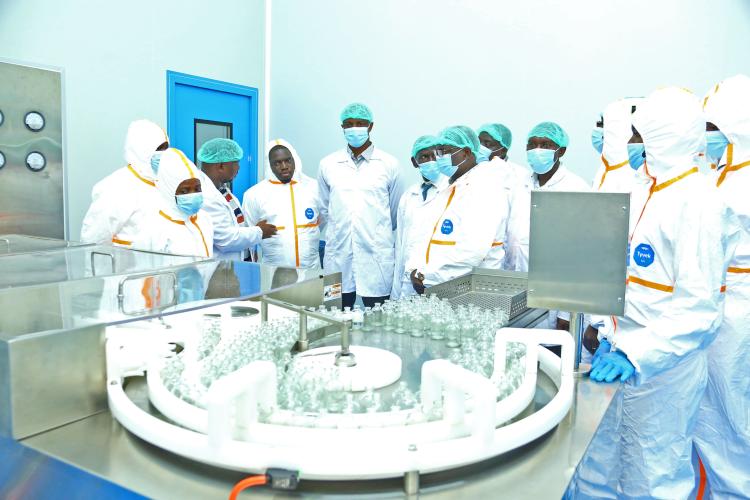
WAKISO, December 9, 2025 — The Permanent Secretary and Secretary to the Treasury [PSST] Ramathan Ggoobi recently visited the National Agricultural Research Organisation [NARO] anti-vaccine facility at Nakyesasa, Namulonge in Wakiso district to establish their preparedness and requirements ahead of commercial production in the coming months.
Ggoobi was taken on a guided tour of the facility by NARO Director General Dr. Yona Baguma, his Deputy Dr. Swidiq Mugerwa and other officials.
He lauded NARO for changing the dynamics of research and development in agriculture.
“You are actively solving real life problems we have been facing as a country,” Ggoobi said.
He said Uganda is on a mission to grow the economy tenfold, adding that under Tourism development, Mineral-based industrialisation, and Science, Technology & Innovation [ATMS], agro-industrialisation is expected to contribute US$ 20 billion annually for the next 15 years to ensure Uganda becomes a US$ 500 billion economy by 2040.
Ggoobi who was accompanied by the Acting Director Debt and Cash Policy Maris Wanyera and Commissioner Paul Mwanja pledged to support NARO to complete this investment, adding that NARO has already demonstrated accountability with results.
Baguma on his part extended gratitude to President Yoweri Museveni and the Finance ministry for supporting the anti-tick vaccine research and construction of the facility in preparation for the anti-tick vaccine rollout.
He said NARO is now ready to deliver the product to the market, adding that Uganda is now a global competitive leader in the field of cattle research.
This anti-tick vaccine facility is the largest in the whole world with capacity to produce 42 million doses annually.
Experts say ticks and tick-borne diseases [TBDs] cost Uganda’s economy over US$ 1.1 billion annually, with massive financial losses from cattle mortality, reduced milk/meat, high acaricide use often ineffective due to resistance, and decreased productivity, severely impacting smallholder farmers whose livelihoods depend on livestock. Key costs involve buying acaricides, treating sick animals, and losses from diseases like East Coast Fever [ECF], which can kill up to 100 percent of exotic breeds.
https://thecooperator.news/govt-to-expand-soroti-fruit-factory-to-enhance-productivity/
Buy your copy of thecooperator magazine from one of our country-wide vending points or an e-copy on emag.thecooperator.news
-

-

-

-

