
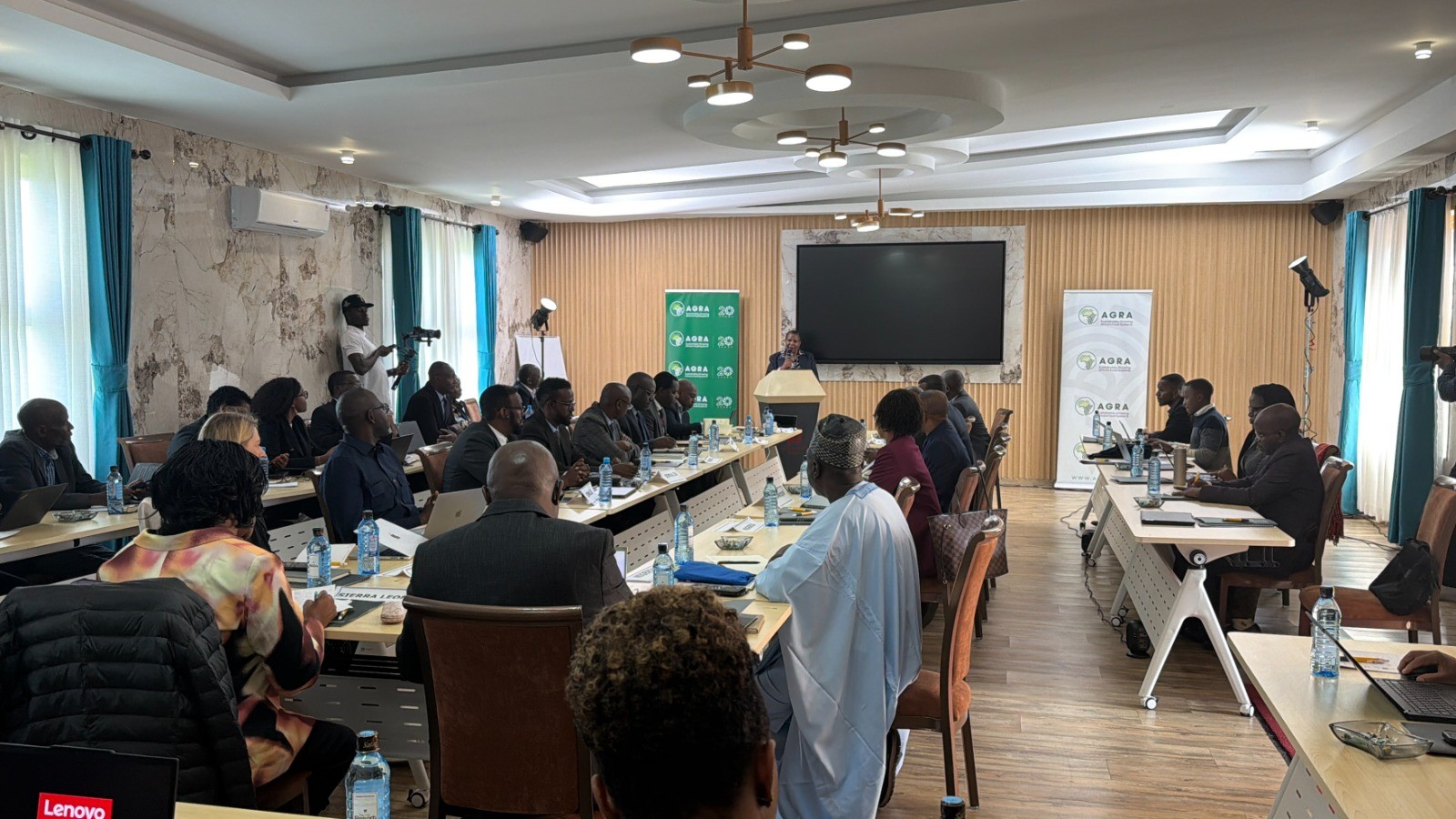
KAMPALA, April 4, 2026 — Permanent Secretaries and senior decision-makers across Africa’s service ministries have been challenged to deliver measurable improvements in farmer incomes, with a renewed focus on results-driven action in the agricultural sector.
Alice Ruhweza, President of AGRA [formerly the Alliance for a Green Revolution in Africa], issued the challenge to Permanent Secretaries from the ministries of Agriculture, Finance and Trade across the continent, noting their critical role in shaping decisions that affect farmers.
She was speaking at a recent high-level retreat held in Limuru, Kenya, attended by officials from Uganda, Kenya, Ethiopia, Rwanda, Tanzania, Nigeria, Sierra Leone, Mali, Burkina Faso and Senegal, as well as Zambia, Mozambique, Malawi and Somalia.
Ruhweza urged the civil servants to deliver tangible improvements in farmer incomes within the next three agricultural seasons, translating policy commitments into real gains for communities that largely feed Africa.
“What can you, as Permanent Secretaries, do within the next three farming seasons to materially improve farmer prosperity?” she asked.
Her remarks come amid mounting pressure on African food systems from climate shocks, rising input costs and persistent market inefficiencies, which continue to constrain productivity and farmer earnings.
The retreat brings together senior officials responsible for agriculture, finance, trade and planning—portfolios considered central to unlocking reforms needed to transform agriculture into a commercially viable and investment-attractive sector.
Ruhweza emphasised that while policy frameworks in many countries are largely in place, implementation remains the key constraint.
“Over the next two days, I encourage a spirit of candour and a shared focus on advancing what we must do differently, together, for agriculture to become Africa’s next truly investable opportunity,” she said.
Participants are expected to identify and develop practical, time-bound actions that can be implemented within three farming cycles. These include improving access to quality inputs, strengthening extension services, expanding farmer financing, and addressing bottlenecks in aggregation and structured trade.
The three-season timeline reflects a shift towards short-term accountability, with governments under increasing pressure to demonstrate visible impact on farmer incomes, rather than relying solely on long-term policy ambitions.
Discussions are also focused on repositioning agriculture as a bankable sector capable of attracting private investment, particularly in value chains such as maize, beans and rice, which underpin regional food security and trade.
Analysts say improving farmer profitability is critical not only for rural livelihoods but also for broader economic stability, given agriculture’s central role in employment across African economies.
The participation of Permanent Secretaries, who oversee day-to-day policy implementation, signals a deliberate focus on strengthening coordination across ministries—often cited as a major constraint in past reform efforts.
“We know that when farmers prosper, Africa prospers,” Ruhweza said.
The retreat is expected to generate concrete country-level commitments, with follow-up mechanisms likely to track progress over the coming planting seasons.
Buy your copy of thecooperator magazine from one of our country-wide vending points or an e-copy on emag.thecooperator.news


