
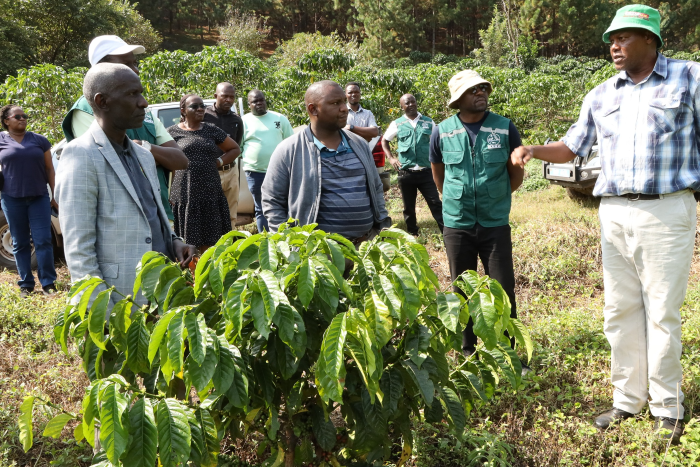
KYENJOJO, February 6, 2026 — In a move aimed at advancing government’s agro-industrialisation agenda, the National Agricultural Research Organisation [ NARO ] has begun actively engaging agro-industrialists to deliver research-based solutions that address bottlenecks in scaling agribusinesses and expanding farmer participation.
NARO’s visits to selected agro-industrialisation sites began earlier this week. Riding on Memoranda of Understanding [MoUs] signed with several sector players, the organisation is strengthening partnerships with private-sector investors to unlock productivity, value addition and inclusive growth across key agricultural value chains, NARO management revealed.
This commitment was underscored during a business visit led by the NARO Director General, Dr. Yona Baguma, to Amafh Farms Ltd in Mityana District, and Clarke Farm and Njojo Agro-based Industries Ltd in Kyenjojo district.
The three large-scale agribusinesses are spearheading macadamia, coffee, and Hass avocado/maize production respectively. The visits also sought to identify practical areas where agricultural research can support private investment to overcome production challenges, enhance productivity and deepen value addition.
Positioning macadamia as Uganda’s next high-value export crop
At Amafh Farms, the NARO team was hosted by Morvi Asim, Managing Director of the 1,200-acre enterprise that has pioneered macadamia farming in Uganda since 2003. More than 700 acres are currently under macadamia cultivation, positioning the farm as a trailblazer in the emerging value chain.
Amafh Farms specialises in the production and processing of high-quality macadamia nuts for both local and international markets, integrating sustainable farming practices and innovative processing technologies along the entire value chain, from seed to finished product.
“Our vision is to transform Uganda into a leading macadamia producer,” Asim said while speaking to NARO officials, noting that global demand for macadamia far outstrips supply. “If you have 100 tonnes, the market demands 1,000 tonnes. This is a product that is hugely undersupplied.”
Five years ago, Amafh launched the Macadamia Outgrower Extension Project [MOGEP], an ambitious initiative aimed at transforming the livelihoods of more than 250,000 small-scale farmers nationwide. In its initial phase, the project targets the planting of 25 million macadamia trees, with the potential to create employment for over 2.5mln people while strengthening national food security.
Currently, the programme works with approximately 25,000 farmers, providing highly subsidised seedlings, farmer training and a guaranteed buy-back arrangement.
According to Asim, Amafh is also investing heavily in value addition, with plans to establish production lines for 12 macadamia-based products, including cooking oil, green-energy briquettes, honey and bio-fertilisers.
The company promotes integrated farming systems by encouraging farmers to keep bees for pollination and honey production, while all processing waste is recycled into bio-fertiliser, an approach that supports environmental sustainability.
In 2024, Amafh signed an MoU with NARO, a partnership Asim described as critical to industrial growth.
“NARO’s visit to our farm demonstrates their commitment to supporting industrialisation and increasing farmer incomes,” he said, adding that the company is establishing a nursery capable of supplying between three and four million seedlings annually.
Addressing stakeholders at Amafh Farms, Dr Baguma emphasised the transformative income potential of macadamia for Ugandan farmers.
“On one acre, a farmer can plant about 100 macadamia trees. With an average yield of 75 kilogrammes per tree and a farm-gate price of Shs 3,000 per kilogramme, a farmer can earn up to Shs 22mln annually from one acre,” Baguma explained. “Given that a macadamia tree can live for more than 100 years, this crop offers a lifetime source of stable income.”
He noted that NARO and Amafh would jointly address key constraints limiting productivity, including the absence of a reliable national seed system, sub-optimal plant populations, and emerging pests and diseases.
NARO will also support product diversification and value addition through its laboratories at the National Agricultural Research Laboratories [NaRL] in Kawanda, Wakiso district.
Through the National Forestry Resources Research Institute [NaFORRI], NARO plans to develop a breeding programme to adapt macadamia to different agro-ecological zones, particularly drought-prone regions such as Karamoja and West Nile.
“Macadamia thrives in sandy soils and is suitable for intercropping, which enhances food security and farmer incomes,” Baguma said. “By introducing this crop to climate-vulnerable regions, we will not only boost livelihoods but also contribute to climate change adaptation.”
He reaffirmed NARO’s commitment to working with Amafh and other stakeholders to ensure macadamia becomes a game-changer in Uganda’s fight against poverty.
Supporting innovation in coffee and Hass avocado production
The NARO delegation also visited Clarke Farm Ltd in Katambale, Kyarusozi Sub-county, Kyenjojo district, a 2,200-acre mixed farm with a strong focus on coffee production. Currently, 750 acres are under coffee, with plans to expand to 1,200 acres within the next four years.
Farm Manager Sylvester Kyendi described the engagement with NARO as timely and productive, particularly in addressing market-driven production needs.
“One of the key areas we agreed on is the development of a lowland Arabica coffee variety that can be grown in non-traditional areas,” he said. “Arabica commands premium prices on the global market due to its superior cup quality, and we have buyers who specifically demand it.”
Clarke Farm supplies coffee to buyers in the United Kingdom, the United Arab Emirates, major companies in Kampala, and other local markets. Beyond commercial production, the farm also supplies planting materials to smallholder farmers and provides technical support on good agronomic practices.
The partnership with NARO is expected to strengthen research on varieties, productivity and climate adaptation, further supporting Uganda’s coffee export ambitions.
At Njojo Agro-based Industries, which specialises in avocado and maize processing, Dr Baguma said the visit formed part of NARO’s follow-up on President Yoweri Kaguta Museveni’s directive to use innovation as a driver of socio-economic transformation.
The Founder and Managing Director, Rtd Gen. Robert Rusoke, Uganda’s Head of Mission to Rwanda, said the engagement aligned strongly with his vision of building agro-industrial value chains to transform livelihoods in the Rwenzori region.
He disclosed that Njojo is currently the only processor of virgin oil from Hass avocado in Uganda.
NARO and Njojo agreed to collaborate on managing emerging pests and diseases and on expanding the out-grower model to improve productivity and farmer incomes.
https://thecooperator.news/naro-embarks-on-revamping-livestock-production-research-programmes/
Buy your copy of thecooperator magazine from one of our country-wide vending points or an e-copy on emag.thecooperator.news
-

-

-

-

