
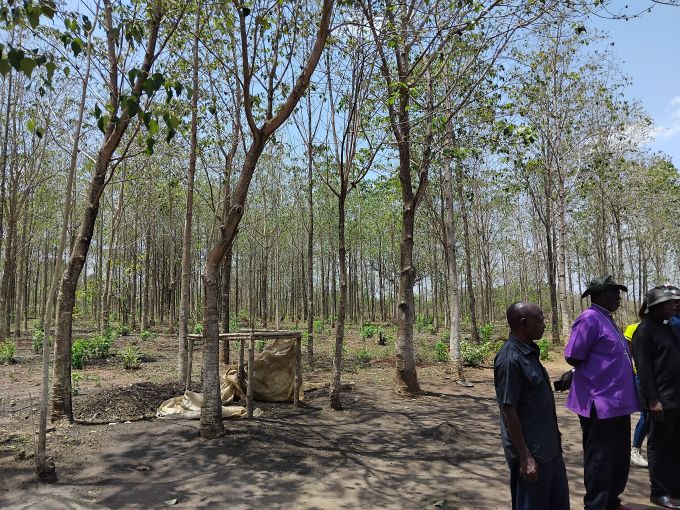
GULU CITY, March 3, 2026 — Kijani Forestry Limited, a social enterprise focused on combating climate change in Northern Uganda, has begun engaging government through the Ministry of Energy and Mineral Development for authorisation to commence sustainable charcoal production.
Since 2020, the company says it has worked with more than 65,000 smallholder farmers across 30 districts in the subregions of Acholi, Lango, Karamoja and Bunyoro to plant trees specifically for charcoal production. The trees have now matured and are ready for harvesting.
However, Presidential Executive Order No. 3, issued in May 2023 by President Yoweri Museveni banning commercial charcoal production in Northern Uganda, has delayed the company’s plans. The directive followed concerns from leaders over widespread forest depletion caused by indiscriminate cutting of trees for charcoal, firewood and timber.
David Labeja, Communications and Public Relations Manager at Kijani Forestry Limited, said the Executive Order was issued when the trees planted under the company’s programme were still young.
“The trees have now matured, and we are engaging the relevant government authorities to demonstrate that Northern Uganda has the potential to farm trees specifically for charcoal. In the coming months, the Energy ministry will verify that the charcoal we intend to produce is farmed charcoal,” Labeja said.
He explained that the company plans to enter into public-private partnerships with local governments at sub-county level, where warehouses will be constructed to store charcoal.
Kijani also intends to change how charcoal is marketed in Uganda.
“We are going to sell charcoal by weight rather than by volume. Currently, charcoal is sold in heaps, with prices estimated by size. Our charcoal, produced with both smallholder and large-scale farmers, will be packaged, branded, weighed and sold in supermarkets, roadside outlets, shops and at sub-county headquarters,” Labeja said.
He cited research indicating that 94 percent of Ugandan households rely on charcoal or firewood for cooking, noting that previous producers often cut down trees indiscriminately, sometimes uprooting them entirely and burning the roots.
Kijani says it is scaling up tree production to ensure a sustainable cycle in which farmers can harvest and convert trees into charcoal annually, with technical support from the company.
Through the introduction of improved kilns, Labeja said farmers can achieve charcoal yields of between 50 and 60 per cent of the wood used, compared with 10 to 20 per cent under traditional methods.
Tree species and farmer incentives
Smallholder farmers under the programme are cultivating indigenous species such as acacia, albizia, Nile tulip, cassod, white teak and velvet tamarind, all of which regenerate after harvesting. These species produce high-calorific charcoal that burns for longer periods.
Farmers are also growing gmelina, mahogany and msizi for timber.
Joyce Ataro, a member of the Lacac Pe Lony farmers’ group in Ajanyi Village, Cwero Subcounty, Gulu district, said she is in her third year of growing trees for both charcoal and timber under Kijani’s guidance.
“In the first year, I planted one acre of trees. In the second year, I planted another acre, and I will plant a third acre this year. We were taught to plant in batches so that we can harvest sustainably while still using part of the land for food crops,” Ataro said.
She added that Kijani provides a tree survival incentive of Shs100 per tree after the first year and Shs200 per tree from the second year onwards.
Research and partnerships
Kijani Forestry has also become a centre for research and learning on sustainable tree growing and climate change mitigation.
Last week, a team from the Directorate of Household and Community Transformation of the Church of Uganda visited Kijani’s tree planting and afforestation sites.
The delegation toured the company’s seed bank and backup nursery at Elephante Commons, a 400-acre tree farm in Pakuba Village, Paicho Subcounty, Gulu District, as well as restoration sites in Oloro village, Pogo Subcounty, Amuru District, where Kijani is restoring 1,000 acres of forest.
The visit came ahead of the Church of Uganda’s planned launch of a 15-million-tree planting initiative across 39 dioceses.
Rev. Andrew Agaba, Director of Household and Community Transformation, Church of Uganda Province, said the visit followed a resolution of the Provincial Assembly in August 2024, in which the Archbishop called on the church to take a leading role in environmental conservation.
“We are keen to collaborate with Kijani Forestry Limited to increase forest cover in Uganda as we prepare to launch our vision of planting 15 million trees,” Agaba said.
He added that the church is also advocating alternative energy sources, including modern cooking stoves, solar power and gas, to reduce reliance on charcoal and firewood.
Bishop James William Ssebagala, Chairperson of the Board of Directors at the directorate, said Kijani’s approach could help address charcoal shortages in parts of the country.
“In Mukono, where I come from, there are instances where people have food but lack energy to cook it,” Ssebagala said.
Paul Mukiibi, co-founder of Kijani Forestry Limited, said that beyond charcoal and timber, the company is also supporting farmers to grow trees for carbon credits.
Kijani, which aims to plant 30 million trees, is set to supply two million carbon credits to Microsoft through Rubicon Carbon.
Buy your copy of thecooperator magazine from one of our country-wide vending points or an e-copy on emag.thecooperator.news
-

-

-

-

