
MASINDI, May 11, 2026 — The health and education departments in Masindi District Local Government are facing a significant challenge due to severe understaffing, which is hindering the delivery of essential services to the community.
District authorities have attributed the crisis to the absence of a functional District Service Commission [DSC], which is responsible for recruiting civil servants, as well as insufficient wage allocations to facilitate the recruitment of new staff.
The DSC is currently non-functional following the expiry of the terms of its chairperson, Benjamin Byaruhanga, and another member.
During the last council meeting held in March, the district LCV Chairperson, Cosmas Byaruhanga, proposed Shamim Kasemire and David Kyetume Kasanga for council approval. However, the District Speaker, Moses Kiirya, and councillors declined to approve them, insisting that Benjamin Byarugaba be retained as DSC Chairperson — a proposal the district chairperson opposed.
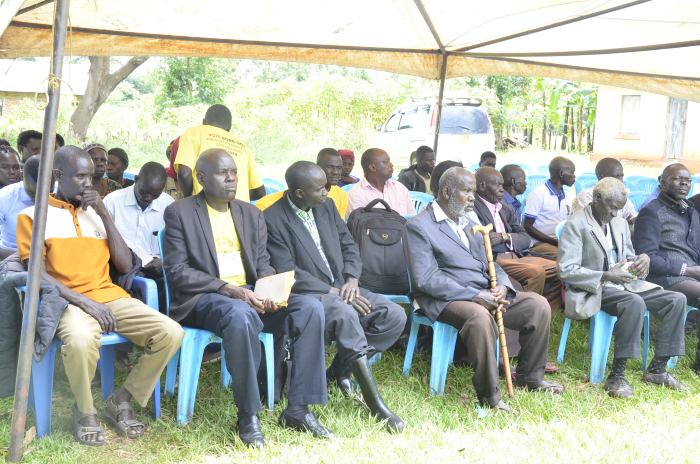
On Thursday, May 7, 2026, the Office of the Prime Minister [OPM] conducted a public accountability meeting [Baraza)] in Pakanyi Sub-county, Masindi District, where civil servants had an opportunity to address community members and engage in discussions.
Monica Kiiza, the Acting District Education Officer [DEO], presented a concerning report indicating that Masindi District has 69 government-aided primary schools, but only 43 substantive teachers, leaving a staffing gap of 25 teachers.
Furthermore, out of the required 69 deputy head teachers, only 30 are in place, while only 61 senior education assistants are available out of the required 207. She noted that the staffing gaps are severely affecting the smooth running of educational activities.
Secondary schools staffing
Kiiza explained that Masindi District has nine government secondary schools with an enrolment of 4,632 learners.
The schools are supposed to have 366 teachers, but currently only 160 substantive teachers are in place, leaving a shortfall of 206 teachers.
She further noted that the challenges extend beyond staffing to infrastructure development. In the 69 government-aided primary schools, only 464 out of the required 782 classrooms are available.
Similarly, only 721 out of the required 1,037 latrine stances exist, while the district has only 8,942 desks out of the required 13,821. Of the required 69 staff houses, only 33 are available.
“These challenges greatly affect teaching. For instance, the lack of desks affects a learner’s sitting posture, while overcrowding inconveniences learners. Effective teaching cannot take place under such conditions,” she said, urging relevant authorities to address the wage issue to facilitate recruitment.
Health department
The situation in the health department mirrors that of the education sector, with the district operating at only 38 per cent staffing under the revised staffing norms.
“We are missing key cadres, including special grade medical officers, midwives, specialists, physicians, gynaecologists, paediatricians and a surgeon, especially at Masindi General Hospital,” said Brian Mugisha, the Assistant District Health Officer in charge of maternal health, who represented District Health Officer Nicolas Kwikiriza Magambo during the Baraza meeting.
He added that the shortage of health workers has resulted in a heavy workload, leading to delays at health facilities.
Mugisha noted that the absence of critical health personnel has increased referrals, which are costly for both government and patients.
“It inconveniences patients and their families, and increased waiting times lead to poor health outcomes,” he said.
“Our request to Masindi District Council is to expedite the process of establishing the District Service Commission so that recruitment can proceed,” he appealed.
He further explained that five sub-counties lack a Health Centre III, contributing to inadequate health services at Health Centre II facilities.
“We also face inadequate supplies of essential medicines and other health commodities. Many mothers are delivering from home, contributing to deaths due to poor management of labour by Traditional Birth Attendants. Some parents are still hiding their children from immunisation, increasing the likelihood of future disease outbreaks if the number of unimmunised children rises,” he explained.
Commenting on why many women deliver from home, Mugisha attributed the problem to ignorance, poverty, lack of family support, long waiting times and poor reception from some health workers.
Samuel Kaija Ruhweza, the Chief Administrative Officer of Masindi, said funds for recruitment are available, but the process remains stalled due to the non-functional DSC.
He added that where wage allocations are insufficient, the district has written to relevant ministries seeking additional funding for critical positions.
Emmanuel Turyatunga, the Assistant Commissioner from OPM representing the Minister for General Duties, Kasule Lumumba, said Barazas are a government initiative aimed at enhancing accountability and improving livelihoods.
He noted that, in line with OPM’s mandate to monitor and evaluate government performance, assessments conducted in Masindi District in 2024 and 2025 revealed a worrying decline in the district’s performance that leaders need to urgently address.
According to the Local Government Management of Service Delivery [LGMSD] Performance Assessment Report for 2024, Masindi District ranked 73rd out of 176 local governments with a score of 63.87 per cent. In 2025, the district dropped to 160th position with a score of 48.71 per cent.
He explained that infrastructure assets, water and sanitation services, and microscale irrigation services were among the worst-performing sectors.
Turyatunga added that the poor performance was partly attributed to non-adherence to guidelines.
“We also observed that gaps in service delivery still exist, with several critical positions remaining vacant. Notably, the positions of District Engineer, District Production Officer, District Health Officer and District Education Officer remain unfilled,” he said.
Darius Nandinda, the Resident District Commissioner for Masindi, commended OPM for organising Baraza meetings, saying they help communities hold their leaders accountable.
Buy your copy of theCooperator magazine from one of our countrywide vending points or an e-copy on emag.thecooperator.news


