
MASINDI, April 6, 2026 — Leaders in Masindi district have been urged to champion a shift towards a “money economy” mindset by mobilising communities to take full advantage of government programmes aimed at improving household incomes.
Jona Jackson Balikwira, Senior Presidential Advisor on Special Duties and Commissioner for National Guidance at the Ministry of ICT and National Guidance, called on religious and political leaders to take the lead in driving socio-economic transformation.
“With the support of technocrats, you must lead this effort. People need to engage in meaningful production by tapping into government initiatives such as the Parish Development Model [PDM], Emyooga, Uganda Women Entrepreneurship Programme [UWEP], and Youth Livelihood Programme [YLP], among others. This will not only improve livelihoods but also benefit institutions such as churches,” Balikwira said.
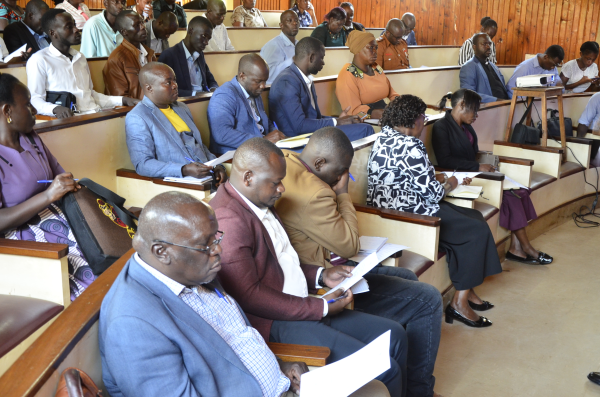
He made the remarks during a one-day ideological orientation training on mindset change for local government leaders organised recently at the district headquarters.
Speaking on democracy in a multiparty system, Balikwira emphasised the need for leaders across all sectors to help citizens understand the ideological foundations of nation-building, noting that this would enhance service delivery.
“Leaders must dedicate time to promoting mindset change if communities are to transform meaningfully. Identify people’s potential and harness it productively. Approach society with realism and avoid ideological manipulation,” he advised, adding that “a society without ideology is like a household without God.”
He further encouraged leaders to empower citizens to think independently, become economically secure, and remain ideologically grounded. According to him, this would enable voters to consistently elect capable leaders and reduce susceptibility to manipulation.
“I want to see real change among the people of Masindi. It is achievable, and everyone has a role to play in driving socio-economic transformation. Public trust is essential for building a healthy society,” he added.
John Oyambi, a Project Officer at the Ministry, urged both elected and appointed leaders to work collaboratively in order to improve service delivery.
“Coexistence fosters strong working relationships, promotes positive thinking, and encourages teamwork. We aim to nurture leaders who are mentally resilient, cooperative, and capable of creating opportunities,” Oyambi said.
He noted that the training is expected to strengthen teamwork, harmony, and a culture of consultation among leaders.
“I encourage religious, political and cultural leaders, as well as technocrats, to work together and engage in continuous self-reflection to ensure effective service delivery,” he added.
The training brought together incumbent and elected leaders, technocrats, and representatives from religious and cultural institutions.
Some participants welcomed the initiative, describing it as timely and necessary.
Patrick Wobusobozi, the LCV Chairperson-elect for Masindi District, said such programmes should be sustained and extended to grassroots communities.
“We are committed to advancing the message of mindset change and mobilising citizens to utilise available government programmes,” Wobusobozi said.
Rogers Amanyire, Mayor-elect for Masindi Municipality, also commended the initiative, suggesting it should be institutionalised.
“The time spent here has been valuable. The knowledge gained will influence how we address various issues,” he noted.
Jane Akiroru, Deputy Chief Administrative Officer for Masindi, said the training would strengthen collaboration between technocrats and political leaders.
“We are going to improve our approach to governance and address the challenge of poverty more decisively. Embracing socio-economic transformation is critical, as it is difficult to govern a poor population,” she said.
The Ministry of ICT and National Guidance is currently conducting a nationwide campaign to train local government leaders on ideological orientation and mindset change.
In Masindi, participants were also taken through key national frameworks, including Vision 2040, the ideological principles of the National Resistance Movement [NRM], civic education, citizens’ duties, and the functioning of democracy in a multiparty system.
The training aims to enhance awareness of national values and responsibilities, strengthen leadership capacity, and equip participants with practical approaches to behavioural and attitudinal change.
Buy your copy of thecooperator magazine from one of our country-wide vending points or an e-copy on emag.thecooperator.news


