
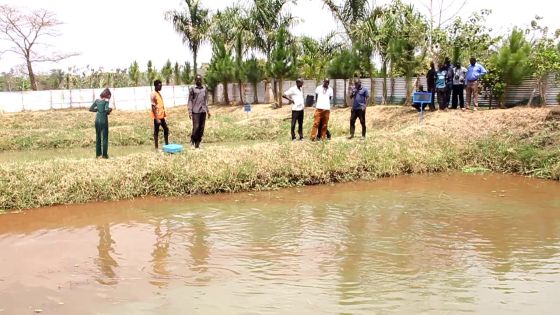
KOLE, January 23, 2026 — Fish farmers in Kole district have appealed for the establishment of a regional fish hatchery to address the shortage of fingerlings and improve productivity in the sector.
The call was made earlier this week by Boniface Okot, the Northern Youth Member of Parliament and MP-elect for Kole South Constituency. Okot said a regional hatchery would help increase the supply of fingerlings and encourage more residents to take up fish farming.
“We request that a regional fish hatchery be established in Kole district to increase the production of fingerlings and attract more farmers into fish farming,” Okot said.
According to Richard Opio, the Kole district Production and Marketing Officer, the district has about 230 registered fish farmers operating on approximately 50 acres of land. Opio welcomed the proposal, describing it as timely and necessary.
“It is a good move. We have already started innovating a small hatchery, but we are constrained by finances,” Opio said. “We are trying to address some of the challenges using the limited development budget provided by government, particularly to secure clean water sources, which are critical for hatchery operations.”
Despite the availability of clean water, Opio said fish farmers continue to struggle with limited access to fingerlings and fish feed, which has affected production and profitability.
“The two major challenges affecting fish production and productivity are limited fingerlings and feeds,” he said. “Water is not a problem here, although marketing can sometimes be a challenge.”
He added that the district is currently training fish farmers to improve their skills and coordinate production in order to access better markets.
“We are building their capacity to synchronise production so that, for example, if 50 farmers stock at the same time, their fish mature together. This allows buyers to access large quantities at once and helps to strengthen the market,” Opio explained.
Meanwhile, Lira district has a fish hatchery that is currently non-operational after it was earmarked for privatisation. According to officials, the facility includes tank systems capable of producing close to 100 fingerlings per batch, as well as an electricity-powered system provided by the Food and Agriculture Organization [FAO], which failed due to lack of power supply. The structures, however, remain intact.
Michael Okello, the Lira District Fisheries Officer, confirmed that the hatchery is not functional after several failed attempts to secure a private contractor.
“We have one hatchery, but it is not operational,” Okello said. “It was constructed with support from the World Food Programme, while FAO also contributed on condition that it be privatised. The first contractor abandoned the project, the second also left, and the third time we advertised, we failed to attract anyone.”
Okello said limited access to quality fingerlings continues to discourage fish farming in the district.
“What we need is a nearby hatchery that farmers can easily access,” he said. “The demand for fingerlings is high, and fish farming has not flourished in Lira largely because fingerlings are sourced from far away and are sometimes of poor quality.”
Hopes for the establishment of a regional fish hatchery in Kole district remain high following President Yoweri Kaguta Museveni’s re-election for another five-year term. During a campaign visit to the district, Museveni pledged to address requests contained in a memorandum, including the establishment of a regional fish hatchery and the elevation of Aboke Health Centre IV to district hospital status.
“I have the memorandum with me, and I will attend to all the pledges, including the school bus, the hatchery and the district hospital,” Museveni said.
Robert Owiny, a fish farmer from Oyam Town Council in Oyam district, said farmers are forced to travel long distances to obtain fingerlings.
“I usually get my fingerlings from Ngetta Zonal Agricultural Research and Development Institute, which is not easy,” Owiny said. “I would be very happy if a hatchery were brought closer to us farmers.”
Owiny also cited limited access to fish feed as a major challenge.
“The request for a regional fish hatchery should be coupled with a fish feed processing machine,” he said. “At the moment, poultry feed is more readily available than fish feed, which is difficult to find.”
https://thecooperator.news/govt-to-inject-shs-30bln-into-local-fishing-communities/
Buy your copy of thecooperator magazine from one of our country-wide vending points or an e-copy on emag.thecooperator.news


