
KIRYANDONGO, September 20, 2026 — Despite government efforts to discourage home births, a significant number of mothers in Kiryandongo district are opting to use traditional birth attendants [TBAs], with 33 percent reportedly delivering outside health facilities amid persistent challenges in the public health system.
Statistics show that only 67 percent of mothers in Kiryandongo district deliver at health facilities, while fewer than 30 percent seek antenatal care during their first trimester.
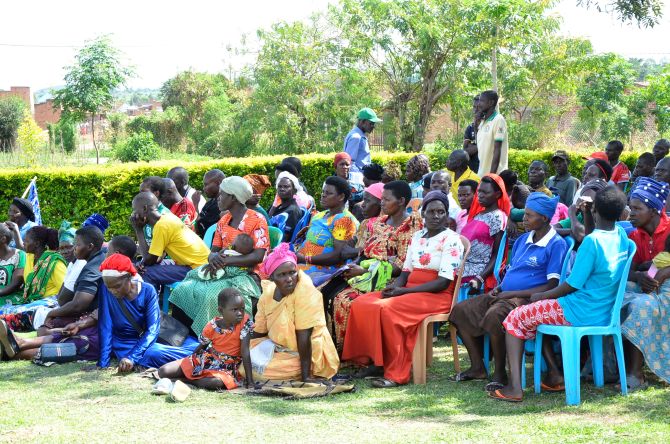
Recent community meetings, known as health barazas, organised by Kiryandongo Woman Member of Parliament Jovia Katusiime have brought to light a range of challenges affecting healthcare delivery in the district.
Mothers openly shared their grievances, explaining why they continue to rely on TBAs.
“We wish to give birth in the hands of professionals, but we are deterred by many factors, including mistreatment by midwives, tribalism and the rude language used by some nurses and midwives,” said Gloria Awekumungu, a resident of Apodorwa village, during a baraza at Apodorwa Health Centre II.
She added: “Imagine a midwife asking you why you are ‘overproducing’. Producing is my right, and a professional health worker should not speak like that.”
Awekumungu said some midwives and nurses are perceived as arrogant and untouchable.
Other reasons cited by mothers for choosing TBAs include alleged extortion by some health workers, who they claim sell government medical supplies within public health facilities.
Additional concerns include long distances to health facilities, segregation, midwives’ refusal to work at night, frequent drug stockouts, closure of facilities at night and a lack of transport to distant health centres.
Mothers also raised concerns about the absence of health facilities in some sub-counties.
Even at facilities such as Mpumwe Health Centre II, where essential items such as soap are provided to mothers who deliver there, many women still prefer TBAs.
For instance, mothers from Hangamakweri Village and 23 other villages in Kicwabugingo Subcounty have to walk more than 10 kilometres or spend Shs 30,000 on a return trip to access essential health services.
Kicwabugingo Subcounty, which was established five years ago, has a population of 39,000 people but does not have a health centre.
Edith Asuru, a resident of Hangamakweri, said many mothers do not attend antenatal care, some children are not immunised, and many women give birth at home.
“Many opt for traditional birth attendants because they have no other option. What can save us is establishing a strategically located and well-equipped Health Centre III,” she said.
Currently, the Kicwabugingo community rents a small house where health officials from Kiryandongo General Hospital provide services only on Fridays.
The arrangement costs the community Shs60,000 a month in rent.
“This is neither sustainable nor reliable because health workers only come on Fridays. Sickness doesn’t come on schedule. If a mother needs to deliver, will she also wait for Friday when a TBA is available?” Asuru asked.
Doreen Achiro said most households in the area have limited financial means, making transport to health facilities in Bweyale Town Council and Kiryandongo General Referral Hospital unaffordable.
“We are losing people here because sometimes they arrive late at health facilities. Imagine an expectant mother reaching the facility late; what happens? We are surviving only on God’s mercy,” she said, while also condemning alleged extortion and frequent drug stockouts.
Maxwell Omara, a medical clinical officer attached to Kiryandongo Hospital, confirmed that the hospital conducts weekly outreach services in Kicwabugingo, while acknowledging the challenges involved.
“Everything we bring here isn’t in the budget, and what we bring isn’t enough because we are always overwhelmed by the numbers. If a health centre is permanently established for this place, that would be good,” Omara said.
Godfrey Kumakech, the LCIII Chairperson of Kicwabugingo Subcounty, said the area’s 24 villages do not have a single health centre, forcing residents to travel between 10 and 20 kilometres to access health services.
“Mothers deliver in the villages. One has to spend between Shs20,000 and Shs 30,000 on a boda-boda. Remember, our road network is also not good, leading to high transport fares,” he said.
Mike Samson, the officer in charge of Apodorwa Health Centre II, which serves 12,000 people from 31 villages, said mothers often come to the facility only after complications have developed following deliveries assisted by TBAs, increasing the risk of maternal deaths.
Most health centres in Kiryandongo district are Health Centre IIs operating beyond their designated mandate, with severe understaffing, inadequate infrastructure, congestion and a lack of equipment.
The Kiryandongo Chief Administrative Officer said staffing in the health sector stands at only 34 percent, significantly hampering service delivery.
He appealed to area Members of Parliament to focus on upgrading existing Health Centre IIs to enable the recruitment of more staff and the acquisition of appropriate equipment.
“Let’s team up and lobby for the wage bill. I have a deficit of over 1,300 vacancies in different departments. If I have the wage bill, these people will be recruited,” he said.
Dr Godfrey Kisembo, the Medical Superintendent of Kiryandongo General Hospital, acknowledged the continuing challenge of mothers delivering with TBAs.
“The only way to address this is by making the services reachable and available, and also mobilising the communities to embrace giving birth in health facilities. We also still have some communities with bad practices that do not believe in giving birth in health centres, are against immunisation and do not attend antenatal care,” he said.
Katusiime, who is also a member of Parliament’s Committee on Health, is currently touring the district to assess challenges in healthcare delivery.
She condemned alleged extortion at health facilities and called on district authorities to intervene and take the necessary action.
“I am going to sit with the LCV Chairperson, the CAO, technocrats and my fellow MPs and compile a single report, which I will present to Parliament,” she said.
https://thecooperator.news/uganda-us-sign-shs-6-42-trillion-health-sector-agreement/
Buy your copy of thecooperator magazine from one of our country-wide vending points or an e-copy on emag.thecooperator.news
-

-

-

-


