
KAMPALA, October 2, 2026 — Ssese Palm Oil Growers Cooperative Society Limited in Kalangala District has asked the government to consider including palm oil farmers in the ongoing programme of distributing free fertilisers to boost agricultural production across Uganda.
Through the Ministry of Agriculture, Animal Industry and Fisheries [MAAIF], government recently launched the distribution of fertilisers to coffee and cocoa farmers as part of efforts to restore soil fertility, enhance productivity and support farmers across Uganda’s strategic crop value chains.
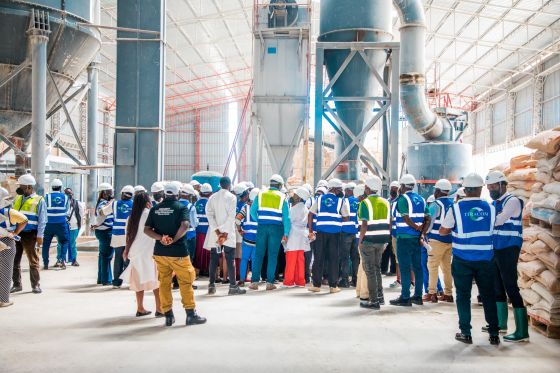
During a benchmarking tour of factory for Itracom Fertilizers in Nala Industrial Park in Dodoma, Tanzania, aimed at establishing the availability and accessibility of crop-specific organo-mineral fertilisers for oil palm, cooperative members said they had identified the solution to their soil fertility challenges in the government’s free fertiliser distribution programme.
The cooperative’s members visited Nala Industrial Park in Dodoma, Tanzania, which manufactures organo-mineral fertilisers, during a benchmarking visit that the growers described as beneficial and informative.
Ssalongo Balilonda Mukasa, a renowned oil palm farmer and one of the leaders of Ssese Palm Oil Growers Cooperative Society, called for government intervention, similar to the support provided to farmers growing coffee, cocoa and tea, which are among Uganda’s strategic crops.
“It is a good thing to travel and learn. We have seen this as a solution to our challenge at home, but not many farmers can afford this fertiliser,” he said.
He suggested that if the government could provide half of each farmer’s fertiliser requirement, the cooperative would meet the remaining need by providing its members with additional fertiliser to enable them to increase production.
The visit followed research conducted by the Makerere University Department of Soil Science and Land Use Management, which established that soils in Kalangala are deficient in potassium.
Deogratiuos Luyima, the lead investigator in the research, noted that the soils in the island district could not support oil palm production sustainably for many years because of their characteristics.
“The solution to the challenge of deteriorating soil fertility in Kalangala is a specific crop organo-mineral fertiliser that would address the actual deficiencies in the soil,” he said.
He added that several fertilisers on the market are generic in their composition, which has affected farmers who purchase products that do not address their specific soil fertility challenges.
Kiggundu Mukasa from Operation Wealth Creation, who was also part of the delegation to Dodoma, welcomed the cooperative members’ call for free fertiliser, arguing that palm oil has also become a strategic crop for the country.
“The communities in Kalangala no longer depend entirely on the lake, but rather diversify into palm oil growing. This has given them an opportunity to improve their incomes, hence the need to help them sustain their farms better,” he said.
A kilogramme of harvested palm oil costs at least Shs 1,100, with a single bunch weighing up to 70 kilogrammes. After bulking, the cooperative sells more than 14,000 tonnes annually.
Palm oil growing in Kalangala was launched in 2002 as a public-private partnership involving the Government of Uganda, the International Fund for Agricultural Development [IFAD], the World Bank and Wilmar International through Oil Palm Uganda Limited [OPUL] and BIDCO Uganda Limited.
The project covers more than 6,500 hectares and involves at least 5,000 individual out-growers, bringing the total area under oil palm to more than 11,000 hectares in Kalangala, mainly on Bugala Island.
Oil palm is a perennial crop that starts producing fruit after about four years and can be harvested every 10 days for up to 30 years.
On average, farmers earn up to US$ 390 per month per hectare from mature plantations, with a dividend of up to 10 per cent in OPUL shares.
The government has also facilitated an expansion project for the crop on Buvuma Island in Buvuma District, covering at least 5,000 hectares in Buvuma, Mayuge, Masaka and Sango Bay.
The project has contributed to reducing the country’s reliance on imported vegetable oils and has also transformed Kalangala from a largely fishing-based district into one with improved household incomes, road networks and ferry infrastructure.
Buy your copy of thecooperator magazine from one of our country-wide vending points or an e-copy on emag.thecooperator.news
-

-

-

-


