
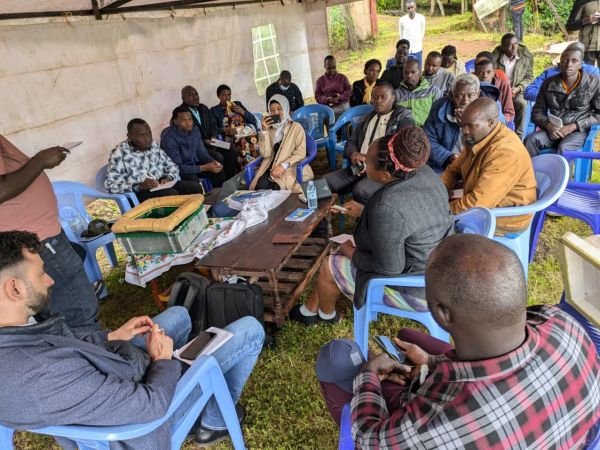
KABALE, May 1, 2026 – Residents of Nyabumba Parish in Kamuganguzi Sub-county, Kabale District, have welcomed the establishment of the first-ever Living Lab by Kabale University, aimed at strengthening climate action and promoting sustainable living.
A living lab is a community-based platform that builds knowledge on green growth and the reduction of greenhouse gas [GHG] emissions through co-creation, co-learning, experimentation and continuous adaptation to local needs. It places communities at the forefront, enabling them to design and implement solutions tailored to their everyday realities.
In this model, the community leads the set-up based on its own priorities and challenges, working towards clean energy use and reduced emissions in the day-to-day running of a typical homestead.
The initiative is a key community-based research approach spearheaded by Makerere University in partnership with other institutions. It aims to strengthen collaboration between academia and communities in fostering a green economy and a healthy environment through innovation, applied research and partnerships.
Speaking at the launch in Nyabumba, the project’s Principal Investigator, Dr Patrick Musinguzi, urged learning institutions to support communities with practical solutions that progressively reduce greenhouse gas emissions while enhancing resilience and productivity.
“The project is about greenhouse gas emissions. We must find ways to steadily reduce or cut them,” Dr Musinguzi said.
He emphasised that universities have a responsibility to generate knowledge that addresses real community challenges while contributing to sustainable national development. He added that climate change is no longer a distant threat but a present-day reality affecting sectors such as agriculture, health, energy and livelihoods.
The Kabale Living Lab has already identified several priority technologies based on the needs of local farming households. According to Project Coordinator Associate Professor Phelix Mbabazi Busingye, at least four technologies were prioritised following consultations with the host household and the wider community.
Among these is biogas technology, which enables the conversion of animal and organic waste into clean cooking fuel. This reduces reliance on firewood, lowers emissions and produces nutrient-rich slurry for use as organic fertiliser.
The community also requested support for traditional energy-efficient baskets that retain heat in cooked food, thereby reducing the need for reheating and cutting fuel consumption. In addition, a water harvesting system is being introduced to improve access to clean and safe water, particularly during dry spells.
“The implementation of these technologies is progressing steadily, and the host farmer has already expressed satisfaction with the project’s impact,” Prof. Busingye said.
The host farmer, Charles Byaruhanga, described the Living Lab as transformative. He noted improvements in his household income and savings on essential costs such as cooking fuel, lighting and fertilisers.
“Previously, my farming and business activities were unplanned, and we often made losses. Since joining the TORCH Project, things have improved,” he said.
Byaruhanga added that the project has equipped him with better planning skills, enterprise management and more sustainable farming practices.
“Beyond my home, the Living Lab offers the entire community an opportunity to learn improved practices that can reduce poverty, enhance nutrition and create more reliable incomes,” he added.
Makerere University is implementing the TORCH Project in partnership with the Institute of Development Research at BOKU University in Austria. Andreas Bauer, a representative of BOKU, said the project enables communities to drive research by defining key questions and leading implementation.
“Before formulating research questions, we engage with communities to understand their livelihoods and challenges. We ask what needs to be done to make a meaningful difference,” he said.
He added that this approach ensures research outputs are relevant, inclusive and responsive to the real needs of farmers and households.
The Living Lab model places communities at the centre of innovation, encouraging them to co-create practical solutions suited to their environment. It has also attracted young people, who are actively involved in research and community-led innovations.
Through the Youth Go Green initiative, young people have been mobilised around environmental conservation, entrepreneurship and community development.
The Living Lab initiative is hosted by Makerere University in Luwero, Busitema University in Soroti and Kabale University in Kabale district. The TORCH Project is being implemented in Uganda, South Sudan and Austria.
https://thecooperator.news/combating-climate-change-mak-pilots-first-living-lab-in-luweero/
Buy your copy of thecooperator magazine from one of our country-wide vending points or an e-copy on emag.thecooperator.news
-

-

-

-


