
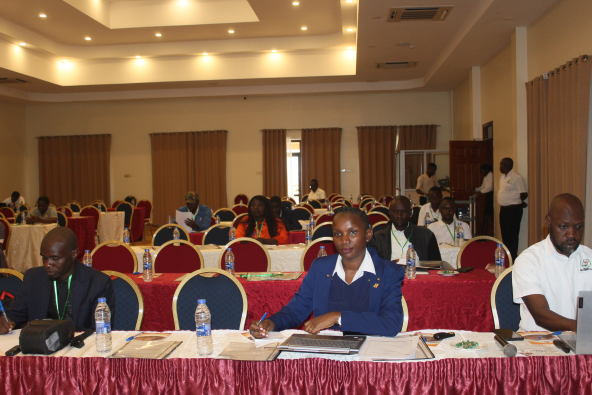
MBARARA CITY, May 22, 2026 – The Chief Executive Officer and Secretary to the Atomic Energy Council [AEC], Natharius Nimbashabira, has urged journalists to exercise professionalism and deepen their understanding when reporting on atomic energy applications.
Speaking during a regional sensitisation workshop on the regulation of atomic energy applications in Uganda, Nimbashabira encouraged media practitioners to read widely on nuclear science to ensure accurate and responsible reporting.
“You must be knowledgeable in all areas of human interest. By training, journalists may not fully understand nuclear science, agriculture and other technical subjects, but you are expected to report on them professionally,” Nimbashabira said.
The AEC is a statutory government agency under the Ministry of Energy and Mineral Development. It was established in 2008 to regulate the peaceful use of ionising radiation in sectors such as medicine, agriculture, industry, education, research and security.
Nimbashabira said the council’s mandate is to protect the public and the environment from harmful radiation while ensuring maximum benefits from atomic energy applications.
He linked nuclear energy to Uganda’s long-term development agenda under the Fourth National Development Plan [NDP IV] and Vision 2040.
“As Uganda embraces modern technologies for socio-economic transformation, the role of the Atomic Energy Council becomes increasingly important,” he said.
He added that Uganda plans to generate about 52,000 megawatts of electricity by 2040, with at least 40 per cent expected to come from nuclear energy.
“If this is to be realised, we must have a strong framework to ensure nuclear energy is generated and used peacefully,” he noted.
Nimbashabira also addressed widespread misconceptions surrounding nuclear science, saying fear and misinformation often delay important government projects.
“The media plays a critical role in shaping public understanding, perceptions and attitudes through accurate and balanced reporting,” he said.
“Your platforms can educate communities, promote awareness, support compliance with safety requirements and build public confidence in the peaceful applications of atomic energy.”
He explained that the workshop was intended to strengthen journalists’ understanding of atomic energy and its applications.
“We are confident that this training will enhance your knowledge and skills and improve your capacity to report objectively and professionally on radiation and nuclear safety issues,” he added.
Nimbashabira warned that misinformation has contributed to delays in implementing nuclear-related projects.
“Some government projects stall because of inaccurate reporting and misinformation. In the nuclear sector, this becomes even more critical,” he said.
He stressed that atomic energy is already part of everyday life and cannot be ignored.
“Our responsibility is to embrace it and ensure it is used peacefully and safely,” he added.
Nimbashabira revealed that government is focusing on nuclear energy projects in Buyende District, where 8,400 megawatts of electricity are projected to be generated.
He also disclosed plans to establish a centre for science and technology at Soroti University to promote teaching, learning and research in nuclear science.
He said Uganda currently lacks sufficient local expertise in nuclear technology, forcing many professionals to seek training abroad.
“Nuclear technology will play a significant role in national transformation. It is therefore important for the media to understand these technologies and communicate responsibly about their benefits, risks and regulatory safeguards,” he said.
Lydia Khalayi, the Senior Communications Officer at the AEC, said building media capacity is essential in promoting public safety and awareness.
“Apart from ensuring the safety of people and the environment, we also want the public to understand developments in the atomic energy sector,” Khalayi said.
She added that the council seeks to strengthen collaboration with journalists through continuous engagement and dialogue.
“Once journalists understand these applications, they can conduct independent research and better educate the public about the benefits and risks associated with ionising radiation,” she noted.
Susan Nalumansi, a Senior Radiation Protection Officer at the AEC, explained that radiation technology is widely used in medicine, infrastructure development, manufacturing and security.
She said radiation tools help engineers test soil and road density during construction, assist manufacturers in monitoring liquid levels in beverage production and support national security operations.
Nalumansi also highlighted the use of mobile X-ray units in diagnosing fractures and other medical conditions.
“These machines can easily be moved from one place to another, especially in mobile medical services. The images obtained help doctors provide proper diagnosis and treatment,” she said.
She further explained that radiation is also used in specialised cancer treatments such as brachytherapy for prostate cancer.
However, Nalumansi cautioned that radiation can be harmful if poorly managed.
“Radiation contributes greatly to socio-economic transformation, but if misused, it can harm human health. That is why the Atomic Energy Council exists to ensure safety standards are followed,” she said.
She added that the council does not permit facilities to operate without licences and requires all licences to be displayed publicly.
“We want the public to know that a licensed facility meets the minimum safety requirements,” she noted.
Another Senior Radiation Protection Officer, John Kisakye, urged medical workers and administrators to prioritise the use of protective gear during diagnostic imaging procedures.
“Radiation safety and nuclear security are critical to public health. Protective equipment must always be used to shield other parts of the body during scans,” Kisakye said.
He emphasised the need for teamwork and cooperation from hospital administrators to help control radiation risks.
Kisakye also dismissed public fears about telecommunication masts, explaining that they emit non-ionising radiation, which is generally harmless.
“There is no need to fear telecommunication masts. What is important is ensuring the radiation levels remain within acceptable standards,” he said.
https://thecooperator.news/mcs-and-media-panellists-receive-shs-100mln-to-boost-sacco/
Buy your copy of thecooperator magazine from one of our country-wide vending points or an e-copy on emag.thecooperator.news
-

-

-

-


