
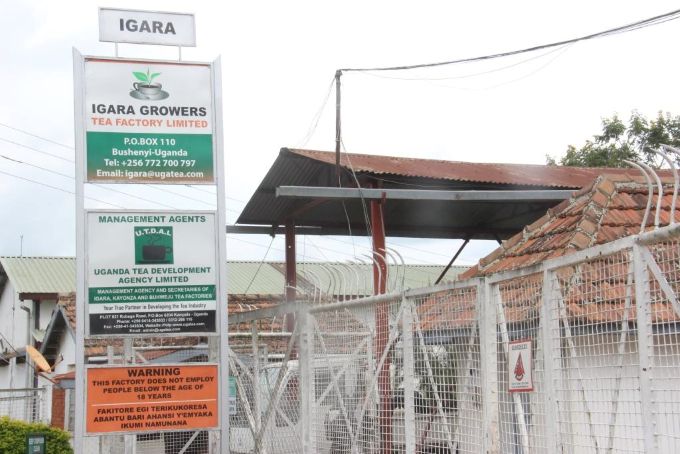
BUSHENYI, October 9, 2026 — Igara Growers Tea Factory Limited is facing a public auction over unpaid debts, with commercial recovery lawyers issuing a formal notice to sell its land, processing plants and other assets to recover outstanding liabilities.
According to a public auction notice published on October 7, 2026, S&L Advocates, acting on the instructions of a financial institution and registered mortgagee, said the factory’s properties in Bushenyi and Buhweju districts would be auctioned unless all outstanding loan balances, interest and legal costs were paid within 30 days.
“Upon instructions from our client, a financial institution and registered mortgagee, we shall proceed to sell the undermentioned properties together with developments thereon by public auction unless the debtor pays to us all outstanding loan balances, fees, costs and disbursements before the expiry of 30 days from the date of this publication,” the notice published in one of the leading dailies reads in part.
The lawyers also directed all occupants to vacate the properties within seven days to allow prospective buyers to inspect the assets.
Historic enterprise weighed down by Shs 25 billion debt
Established in 1969 under government poverty-alleviation initiatives and later privatised to smallholder farmers between 1995 and 2000, Igara Growers Tea Factory has been an economic anchor for more than 7,000 smallholder tea farmers in Bushenyi, Buhweju and Sheema districts.
However, the factory is now facing financial liabilities reportedly exceeding Shs 25 billion, with its operations severely disrupted.
The properties listed for auction include Plot 46 Igara Block 25 in Kabingo, Bushenyi, where the main processing plant is located; Plot 14 Buhweju Block 29 in Burere, measuring 11.9 hectares; the 80.5-hectare Kakombe Tea Estate; and the 65.5-hectare Nyarugote Estate.
Other properties are located in Butare, Rwantaratambi and Kigoma.
The assets include processing facilities, vacant land, firewood yards, guesthouse structures, generator facilities, boiler plants and staff housing.
The financial crisis has coincided with severe operational and labour disputes. Factory operations were disrupted after hundreds of employees staged sit-down strikes over several months of unpaid wages.
Workers have also raised concerns over more than Shs 1.6 billion in unremitted National Social Security Fund [NSSF] contributions reportedly accumulated since 2022.
“Landlords have chased us out and banks are taking our property. We do not know what to do anymore,” said Joseph Barugahare, a factory employee, during a recent industrial action.
“We question why tea continued to be loaded for sale while management claimed there was no money to pay workers,” he added.
Paddy Twesigaomwe, the Trade Secretary in charge of the tea sector, said workers were losing hope.
“We have given management and the board a 14-day ultimatum to meet and provide a clear roadmap for payment,” he said.


Court battles deepen governance crisis
The auction notice comes amid months of legal battles over the factory’s governance.
A ruling by the High Court in Bushenyi, delivered by Justice Amos Kwizera, declared corporate decisions made by the sitting Board of Directors after August 2025 null and void on grounds that the board’s mandate had expired.
The court also ordered an Extraordinary General Meeting [EGM] to establish new leadership.
However, attempts to elect new board members at previous general assemblies were reportedly frustrated by conflicting court orders, including an interim injunction issued by Justice Simon Peter Kinobe in Company Cause No. 36 of 2025.
Administrative interventions by the Uganda Registration Services Bureau [URSB] have further complicated the process.
An official roadmap agreed between URSB and the factory management for the election of a substantive Board of Directors extends to January 6, 2027, leaving the company without a substantive board during the critical 30-day auction period.
Willis Bashasha, head of an Interim Farmers’ Committee and director of the NRM Manifesto Implementation Unit, said farmers had resumed supplying tea after being encouraged to support the factory, but had not been paid.
“When we met last year, we unanimously resolved to rally farmers to resume supplying leaf to the factory because the challenge then was low business,” Bashasha said.
“The farmers responded positively and brought the leaf, but, to our shock, they have never been paid.”
Bashasha said farmers subsequently went to court to challenge what they considered poor governance at the factory.
“The reason we were throwing them out was because of bad governance. The auction is a result of what we were fighting. These debt obligations had never been disclosed to shareholders,” he said.
Franco Turyahabwe, a workers’ representative, said the absence of a substantive board had further complicated efforts to address the crisis.
“We currently do not have a substantive board because elections were halted by conflicting factions,” he said.
“We have leaders in this region, but when we are in danger like this, they are nowhere to be seen.”
Farmers and workers face uncertain future
The crisis at Igara reflects wider challenges facing Uganda’s tea industry, where depressed black tea prices at the Mombasa auction, rising fertiliser costs and high energy expenses have placed pressure on processors.
The Government has previously announced measures aimed at supporting the tea industry, including plans to write off more than Shs 35 billion in tax arrears owed by tea processors and a Shs 212 billion sector investment package.
There have also been plans for a Shs 152 billion presidential bailout, subject to verification by the Auditor General.
However, access to government support has been linked to verified governance structures and operational stability.
With the auctioneers requiring occupants to vacate the properties within seven days to facilitate inspections by prospective buyers, and the URSB electoral roadmap extending into early 2027, thousands of smallholder tea farmers and workers in south-western Uganda face an uncertain future.
The impending auction has heightened calls for urgent government intervention to prevent the possible loss of one of the region’s oldest farmer-owned tea enterprises.
https://thecooperator.news/igara-growers-tea-factory-holds-28th-agm-amid-tight-security/
Buy your copy of thecooperator magazine from one of our country-wide vending points or an e-copy on emag.thecooperator.news


