
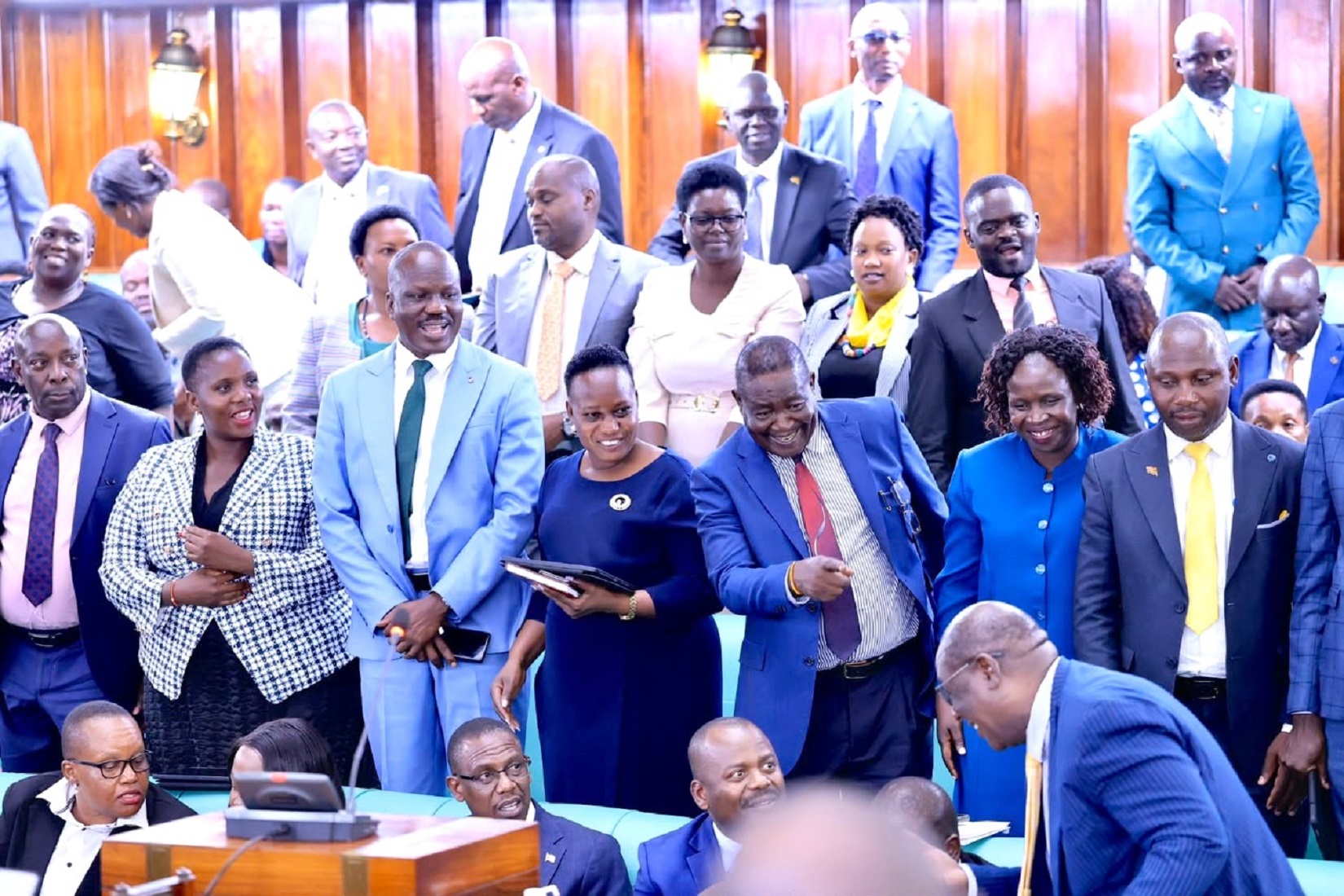
KAMPALA, August 5, 2026 — Parliament has adopted President Yoweri Museveni’s recommendations on the Excise Duty [Amendment] Bill, 2026 and the Income Tax [Amendment] Bill, 2026, retaining a lower excise duty on single-use plastics and removing an exemption from withholding tax on winnings from land-based casinos.
The proposals were contained in two separate Bills returned by the President to Parliament for reconsideration.
Under the Excise Duty [Amendment] Bill, Parliament approved the President’s recommendation to retain the excise duty on single-use plastics at 2.5 percent or US$ 70 per tonne, whichever is higher, instead of the previously approved rate of 25 percent or US$ 1,500 per tonne.
Presenting the report of the Committee on Finance, Planning and Economic Development during plenary on Tuesday, chaired by Deputy Speaker Thomas Tayebwa, committee member James Kakooza said MPs agreed with the President that the higher tax should only be considered after a comprehensive study on its impact on the plastics industry.
“The committee agrees with the President [Museveni] that an increase in the excise duty on single-use plastics from 2.5 per cent or US$ 70 per tonne, whichever is higher, to 25 per cent or US$1,500 per tonne, whichever is higher, should be stayed until a thorough study is undertaken to ascertain its impact on the industry,” Kakooza said.
He said the committee supported expanding the tax to cover more single-use plastic products while maintaining exemptions for multiple-use plastics, sanitary pad packaging, vacuum food packaging and pharmaceutical products.
The committee also recommended that the Ministry of Finance, Planning and Economic Development undertake a comprehensive study on plastic taxation and report back to Parliament within six months.
However, Gyaviira Lubowa, the Nyendo-Mukungwe Division Member of Parliament [MP], opposed reconsideration of both Bills, arguing that the 12th Parliament lacked the legal authority to revisit legislation passed by the dissolved 11th Parliament.
He said the Bills should instead have been reintroduced through a fresh First Reading.
“It is, therefore, irregular to consider Bills that were already passed by the 11th Parliament before it was dissolved,” Lubowa said.
Lubowa also criticised the Government’s shifting position on plastics taxation, saying it had sent mixed signals without conducting sufficient studies. He argued that adopting the President’s proposal would result in Shs 208 billion in foregone revenue.
In a separate minority report, Karim Masaba, the Mbale City Industrial Division MP, supported retaining the lower tax rate but rejected the expanded exemptions.
“I agree with the President’s proposed rate of 2.5 percent or US$ 70 per tonne. Additionally, this minority report sets out my divergent position on the tax exemptions created by the President’s proposal and the significant revenue loss that would result from its adoption,” Masaba said.
He argued that while the lower rate was acceptable, widening exemptions for multiple-use plastics and pharmaceutical packaging would reduce expected revenue from Shs 208bln to Shs 3bln, costing the Government about Shs 205bln.
The Minister of Finance, Planning and Economic Development, Henry Musasizi, disputed the minority report’s revenue estimates, saying the loss would be only about Shs 7bln.
“In a nutshell, I am of the considered opinion that the President’s proposal is in the right direction. The process of arriving at this decision evolves; we can have a position today as a Government but when new information comes, another position can be formed,” Musasizi said.
Patrick Nsamba, the Kassanda County North legislator, argued that after evicting people from wetlands in the name of environmental protection, the Government should not appear to be relaxing its stance on plastics.
Parliament nevertheless adopted the President’s recommendations.
The House also approved the Museveni’s proposal on the Income Tax [Amendment] Bill, 2026, removing the exemption from withholding tax for winnings from land-based casinos while retaining the exemption for winnings paid under the national lottery.
Maximus Ochai, chairperson of Parliament’s Committee on Finance, Planning and Economic Development, said exempting casino winnings would create tax loopholes.
“The committee examined the Income Tax [Amendment] Bill, 2026 and the President’s request and agrees with the President that the exemption granted to land-based casinos will create unnecessary opportunities for tax avoidance and revenue leakage since it establishes different tax treatment for substantially similar gaming activities solely on the platform through which they are conducted,” he said.
He added that removing the exemption would protect the projected Shs 65bln in revenue by ensuring equal tax treatment for all betting and gaming operators.
Despite the objections, Parliament adopted the committee’s majority reports and the President’s recommendations, maintaining the lower excise duty on single-use plastics while ensuring that winnings from land-based casinos remain subject to withholding tax alongside other betting and gaming activities.
For the Financial Year [FY] 2026/2027, the Uganda Revenue Authority [URA] is tasked to collect tax revenue of Shs 40.16 trillion as part of a total domestic revenue target of Shs 45.96trn, which is expected to cover part of the national budget. Uganda’s national budget for the FY 2026/27 totals Shs 84.39trn, the largest in the country’s history.
Buy your copy of thecooperator magazine from one of our country-wide vending points or an e-copy on emag.thecooperator.news
-

-

-

-


