
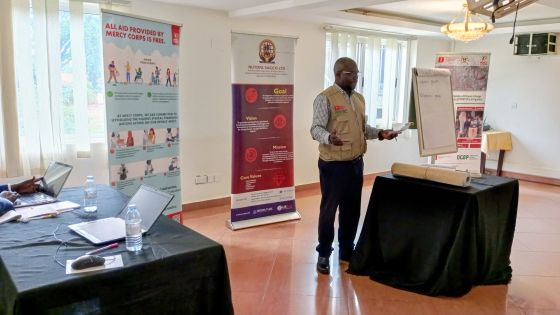
GULU CITY, March 13, 2026 — The Gulu District Commercial Officer, Alfred Ocen, has urged cooperatives in the city and other areas in Acholi Subregion to align their budgets with the visions they set when they were established, warning that failure to do so undermines their growth and sustainability.
According to some experts, a vision statement is a concise, inspirational and long-term declaration outlining what an organisation ultimately aspires to achieve. It acts as a strategic compass that guides decision-making, motivates stakeholders and defines the desired future state of the organisation.
Ocen said more than 70 percent of cooperative budgets in Gulu City and across the Acholi sub-region currently do not generate income because they are not aligned with the original vision of the cooperatives.
Ocen was speaking last Wednesday at Bomah Hotel in Gulu City during a training session for cooperative management committee members drawn from West Acholi Cooperative Union, Northern Uganda Tractor Owners, Operators, Mechanics and Farmers SACCO [NUTOFA], and Kei Cooperative in Yumbe district.
The two-day training aimed to strengthen governance, financial management, record-keeping, resource mobilisation and seasonal planning. It was organised by Mercy Corps, a non-profit organisation promoting solar irrigation to mitigate climate change under the Powering the Uptake of Climate Change Mitigating Pumps [PUMP-UP] programme.
“We should focus on delivering services to our members and ensure that we satisfy their interests. For you to provide adequate services, your operations must generate returns,” Ocen said.
“A cooperative is a business entity and it must make profits. These profits can then be reinvested into services for members or distributed as dividends at the end of the year as value for the shares held in the cooperative.”
He urged cooperatives to conduct profitability analyses before venturing into any enterprise to ensure it can generate sustainable income.
“For example, there are cooperatives that own tractors. They must ensure the fees charged for tractor services cover operational and maintenance costs. Otherwise, they will not be able to repair the equipment when it breaks down,” he explained.
“Some cooperatives charge very little, which cannot cover expenses. That is why we have many tractors that have broken down and cannot be repaired.”
Samuel Alupai, chairperson of Kei Subcounty Rice Producers Cooperative Limited in Yumbe District, said the training was the first formal opportunity members had received to learn about cooperative management despite the group having existed for four years.
“This is my first time learning how to manage a cooperative even after four years of existence. We have many challenges, including leaders not knowing their roles. When meetings are called, some members fail to attend,” Alupai said.
He added that the cooperative, which currently has 75 active members mainly engaged in rice production, plans to transform into a multipurpose cooperative following the training.
Godfrey Oryem, a board member and chairperson of the Production Committee at West Acholi Cooperative Union, said the training had prompted leaders to take governance issues more seriously.
“This training has helped us to see things differently, including making the Cooperative Act our key reference and addressing issues such as land belonging to the cooperative that has been encroached on by squatters,” Oryem said.
Robert Achac Okok, chairperson of NUTOFA, said the biggest challenge facing cooperatives in Northern Uganda is the knowledge gap in key concepts related to cooperative management.
“I believe this training will benefit our leaders so that they understand these concepts better, including bookkeeping and managing group dynamics. Running a cooperative involves many responsibilities and cannot be handled by one person alone,” Okok said.
He added that cooperatives in rural areas often lack expert guidance, but interacting with the district commercial officer, who represents the Ministry of Trade, Industry and Cooperatives at the district level, had helped clarify many issues.
Lawrence Otim, manager of the PUMP-UP programme at Mercy Corps, said the training was designed to address specific gaps identified within the cooperatives.
“We believe that after this training the cooperatives will be stronger. They have developed work plans with key activities they intend to implement, and the commercial officers will follow up to ensure the identified gaps are addressed,” Otim said.
He added that Mercy Corps plans to engage farmer members of the three cooperatives to intensify sensitisation on climate-smart agriculture in Acholi and Yumbe districts to improve production.
“We want to support and guide them on enterprise selection and identify value chains that can be developed. We also need to start linking farmers to markets, but that can only happen after production increases,” Otim explained.
“Because of climate change, we are encouraging farmers to acquire solar irrigation kits. We have also partnered with financial institutions to enable farmers access the pumps through pay-as-you-go arrangements, allowing them to repay gradually as they use the equipment.”
So far, 510 farmers in Acholi and Yumbe have purchased solar irrigation pumps.
https://thecooperator.news/gulu-shs-40-7mln-emyooga-funds-disbursed-to-beneficiaries/
Buy your copy of thecooperator magazine from one of our country-wide vending points or an e-copy on emag.thecooperator.news


