
KAMPALA, September 10, 2026 — The Government of Uganda has set a five-year plan to reduce Uganda’s fiscal deficit, contain commercial borrowing and gradually lower public debt under a new Charter for Fiscal Responsibility [CFR] for the financial years 2026/27 to 2030/31.
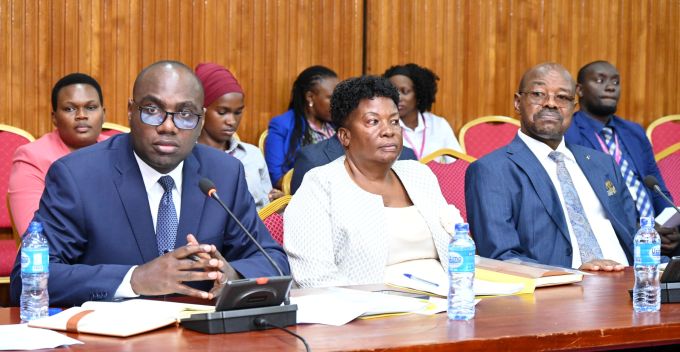
The Minister of Finance, Planning and Economic Development Henry Musasizi presented the third CFR to the Parliamentary Committee on Budget, chaired by Amos Kankunda, outlining fiscal measures intended to maintain macroeconomic stability, ensure debt sustainability and create room for strategic public investment and private-sector-led growth.
Under the Charter, public debt is projected to peak at 55.1 percent of non-oil gross domestic product [GDP] in 2027/28 financial year [FY] before declining to 50 percent by FY2030/31.
Government will retain the debt rule as its main fiscal anchor for budget decisions.
The Charter presented on Wednesday also targets a reduction in commercial borrowing relative to domestic non-oil revenue from 33.7 percent in FY2026/27 to 19.3 percent by FY2030/31.
Over the same period, total interest payments are projected to decline from 32.5 percent to 20 percent of domestic non-oil revenue.
Government also plans to reduce the fiscal deficit, excluding oil revenue, from 6.6 percent of non-oil GDP in FY2026/27 to 1.5 percent by FY2030/31.
The targets are aligned with the National Resistance Movement Manifesto, the Fourth National Development Plan [NDP IV], the Ten-Fold Growth Strategy and the East African Monetary Union convergence criteria.
Minister of State for Planning Amos Lugoloobi said meeting the targets would depend heavily on the performance of government-funded projects.
“Achieving the fiscal targets will depend significantly on the performance of government projects,” Lugoloobi said, adding that macroeconomic indicators are ultimately affected by the performance of public investments.
He said government had consequently placed project performance at the centre of the new fiscal period.
“Project performance has therefore been placed at the forefront during the new fiscal period,” Lugoloobi said.
According to the minister, the Ministry of Finance is reviewing projects under the Integrated Bank of Projects individually to establish their progress and ensure they generate the expected economic returns.
The new Charter follows the expiry of the second CFR at the end of FY2025/26 and will guide Government’s fiscal policy and budget decisions for the next five years.
It was developed following consultations with key institutions, including the Bank of Uganda, Auditor General’s Office, Uganda Bureau of Statistics, Parliamentary Budget Office, Petroleum Authority of Uganda, National Planning Authority, Uganda Revenue Authority and civil society organisations.
The Charter also sets out rules for the management of petroleum revenues.
Under the framework, a maximum of 0.8 percent of the preceding year’s non-oil GDP outturn in oil revenue will be transferred to the Consolidated Fund to support budget operations.
The remaining oil revenue will be transferred to the Petroleum Revenue Investment Reserve, which is managed by the Bank of Uganda.
Government says the overall objective of the five-year fiscal framework is to support socioeconomic transformation while maintaining macroeconomic stability, sustainable public debt and prudent management of petroleum resources.
https://thecooperator.news/ugandas-public-debt-remains-sustainable-says-finance-minister/
Buy your copy of thecooperator magazine from one of our country-wide vending points or an e-copy on emag.thecooperator.news


