
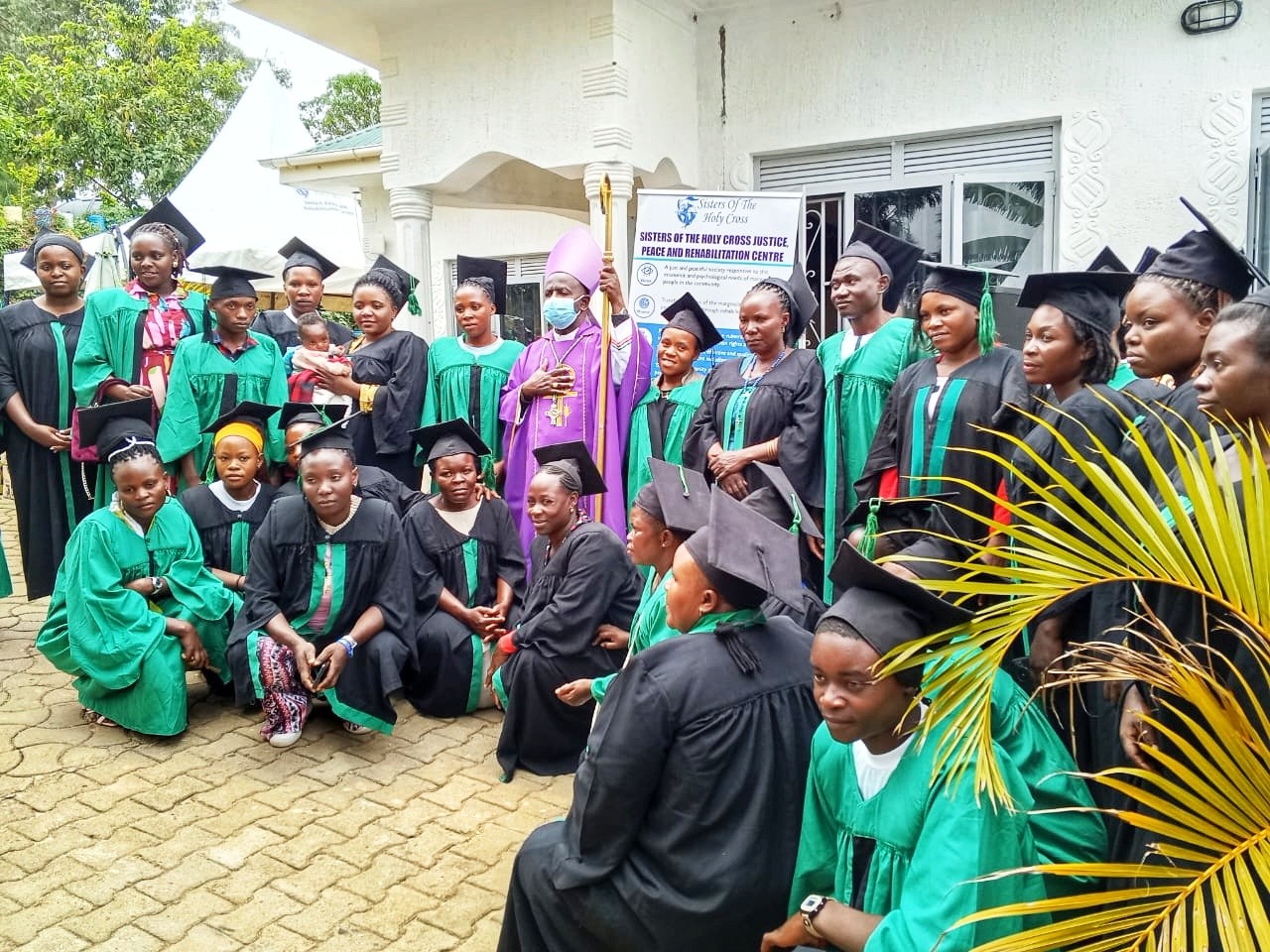
FORT PORTAL CITY, March 6, 2026 — The atmosphere at the Sisters of the Holy Cross Justice, Peace and Rehabilitation Centre in Kitumba, Fort Portal City, was filled with quiet triumph and renewed hope over the weekend as 33 survivors of human trafficking graduated with vocational skills certificates.
What made the ceremony remarkable was not simply the certificates handed out, but the powerful journeys behind them, journeys marked by deception, suffering, resilience and, ultimately, restoration.
The graduates, both young women and men, completed practical training in tailoring, knitting, hairdressing, juice processing and other hands-on trades.
For many, the training represented far more than the acquisition of skills; it was a second chance at life. Each graduate received a start-up kit, both a symbolic and practical tool intended to help them begin the path towards self-reliance.
Presiding over the ceremony, the Bishop of the Fort Portal Catholic Diocese, Rt. Rev. Dr. Robert Muhiirwa, congratulated the graduates for their courage and determination.
“You are no longer victims; you are ambassadors in the fight against human trafficking,” he told them.
His message was both pastoral and cautionary. Bishop Muhiirwa warned Ugandans against being lured by promises of lucrative jobs abroad, particularly in the United Arab Emirates and other Middle Eastern countries, where many Ugandans have reported cases of exploitation and abuse.
He also criticised the perception that vocational education is inferior, describing such attitudes as a dangerous misconception.
“Skills in building, construction, mechanics, welding and tailoring can transform lives. Vocational training should not be treated as a last resort, but as a pathway to dignity and independence,” he emphasised.
The bishop further cautioned the graduates against selling their start-up kits for quick cash, urging them instead to use the tools as stepping stones towards financial stability.
Five years of healing and restoration
Rev Sr Grace Kitinisa, the Director of the Centre, reflected on the institution’s five-year journey of supporting survivors of trafficking.
“We started this rehabilitation centre after recognising the growing needs in our community. For five years now, we have walked with survivors, helping them heal emotionally, spiritually and economically,” she said.
According to Sr Kitinisa, the centre has so far rehabilitated and equipped more than 600 survivors of human trafficking with vocational skills since 2019.
She noted that the Rwenzori sub-region continues to record numerous cases of both male and female victims trafficked to foreign countries after being promised well-paying jobs.
“Human trafficking remains a major issue in our region. Since 2019, we have rescued more than 600 people, the majority of them women. We identify, rescue, rehabilitate, skill and reintegrate survivors of human trafficking within this diocese and beyond,” she explained.
She encouraged the graduates to form groups and cooperatives to strengthen their businesses and support systems, reminding them that unity would help build resilience.
Call for stronger protection
Fort Portal City Mayor-elect Rev Willy Kintu Muhanga applauded the Holy Cross Sisters for stepping in where many institutions have fallen short.
“Many of our youth are suffering silently in the name of searching for jobs abroad,” he said.
He called on the Ministry of Gender, Labour and Social Development and Parliament to strengthen regulations governing labour recruitment agencies.
Muhanga also urged national leaders to inspire young people to appreciate opportunities within Uganda rather than risking dangerous and uncertain ventures abroad.
Stories etched in pain
Behind the smiles and applause were deeply painful stories.
Hassan Muhumuza recounted how he was promised a lucrative job in the United Arab Emirates at a car factory, with a monthly salary of Shs 5 million. Instead of the promised employment, he said he was forced into scrap collection without pay and eventually resorted to begging on the streets.
His ordeal worsened when he spent several years in prison. Upon returning home, Muhumuza said he felt like a burden to his family, sinking into depression and stress.
Rosemary Katsuabe from Kasese district shared her heartbreaking experience in Saudi Arabia.
She travelled in 2018 in search of better opportunities, like many Ugandans. However, her dream quickly turned into a nightmare under what she described as inhumane working conditions.
Katsuabe said she fell from a skyscraper during a period of mistreatment, sustaining severe injuries that later developed into complications affecting her liver and pancreas. Today, she says, most of the money she earned abroad has been spent on medical treatment.
Her story mirrors that of Hellen Karungi, who is now confined to a wheelchair after falling from a skyscraper while working in Jordan.
A national concern
According to data from Uganda’s Ministry of Gender, Labour and Social Development, thousands of Ugandans, particularly young people and women, migrate annually in search of employment, especially to the Middle East.
However, a significant number report cases of unpaid wages, exploitation, abuse and unsafe working conditions.
For the 33 graduates in Fort Portal, the ceremony marked a turning point. It was not merely the end of a training programme, but the beginning of reclaimed dreams and renewed possibilities.
Buy your copy of thecooperator magazine from one of our country-wide vending points or an e-copy on emag.thecooperator.news


