
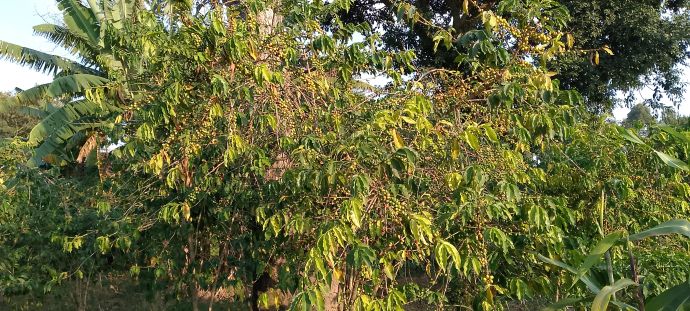
ZOMBO, July 1, 2026 — Small-scale commercial farmers in Zombo district in the West Nile Subregion of Uganda are counting heavy losses after a prolonged dry spell and intense heat severely damaged crops across the area, raising fears of reduced harvests and food insecurity.
Farmers who had anticipated bumper first-season harvests say their expectations have been shattered as prolonged sunshine and limited rainfall continue to devastate gardens.
Like many farmers across Uganda, those in Zombo largely depend on rain-fed agriculture and traditional weather prediction patterns. However, the prolonged dry conditions have left both seasonal and perennial crops struggling.
“This is the reality of climate change affecting us,” said a farmer who identified himself only as Onyona from Athuma Subcounty.
Farmers reported significant losses among late-planted, short-season crops including maize, beans, tomatoes, Irish potatoes, sweet potatoes, yams, millet and sorghum. Perennial crops such as coffee and bananas have also been severely affected by the scorching heat.
Aol Ajoga Chrisanto, a farmer in Arwinyi Village, Kigezi Parish, Zeu Subcounty, recounted his experience, saying he transplanted 2,260 coffee seedlings in mid-May 2026 at an investment of more than Shs2 million, but a large number of them dried up.
“In this garden I am not using irrigation, but where I am irrigating food crops, I am harvesting,” Ajoga said.
Henry Kakonge Unungawun, a farmer in Cana Cell, Abira West Ward in Zombo Town Council, said he lost an entire acre of coffee seedlings planted under a government initiative implemented through the Ministry of Agriculture, Animal Industry and Fisheries [MAAIF].
Unungawun expressed concern that the impact of the heatwave could worsen food insecurity in the district this year.
Grace Pacunaga of Abalatei Village, Anyola Parish in Atyak Subcounty said she lost about 50 coffee plants out of the one-acre coffee garden she established this year.
Pacunaga explained that she had planted coffee in phases over the last three years but suffered the greatest losses this season despite receiving support through the government’s coffee seedling distribution programme.
She said she plans to establish a 3,000-tree coffee plantation to support her family and pay school fees for her three children.
“My children are still in primary school. I am planting coffee to pay their school fees,” she said.
MAAIF, with support from the World Bank, is promoting adoption of irrigation systems through a co-funding arrangement under the Micro-scale Irrigation Programme to reduce dependence on rainfall.
According to the ministry, more than 6,000 irrigation systems have been installed across the country as part of efforts to promote sustainable commercial agriculture and strengthen food security ahead of Phase II of the Uganda Intergovernmental Fiscal Transfer [UgIFT] programme expected to commence in September 2026.
Zombo District Production Officer Dr Walter Kumakech said that under the five-year UgIFT implementation framework, the district has installed 41 irrigation systems for committed commercial farmers through a co-financing arrangement aimed at supplementing rain-fed farming.
Speaking at the opening of the Micro-scale Irrigation Annual Sector Coordination Meeting under the Uganda Intergovernmental Fiscal Transfer programme at Imperial Royale Hotel in Kampala over the weekend, MAAIF Head of Planning Collins Amanya urged programme implementers to accelerate the transition from subsistence to commercial agriculture through irrigation.
Amanya, who represented the ministry’s Permanent Secretary, said irrigation remains central to government efforts to transform agriculture and reduce poverty.
He cited President Yoweri Museveni’s recent State of the Nation Address, noting that agricultural modernisation and irrigation remain key priorities.
The coordination meeting brought together District Agricultural Engineers [DAEs], District Production Officers [DPOs], District Communication Officers [DCOs] and Chief Administrative Officers [CAOs].
Engineer James Kasozi Tondo, National Coordinator for Micro-scale Irrigation, confirmed that government funding for Phase II of the programme had been secured following the completion of the first phase.
Buvuma District Chief Administrative Officer Isaac Mwebe, who is also a beneficiary of the programme, said Uganda’s National Development Plan IV places strong emphasis on increasing agricultural productivity through irrigation.
Meanwhile, concerns over the effects of extreme weather remain high nationally.
During a parliamentary sitting in March 2025, the Chairperson of Parliament’s Committee on Climate Change, Lawrence Biyika, warned that prolonged heat conditions could later trigger heavy rainfall and flooding if mitigation measures were not implemented.
“At the end of the dry season, there will be a lot of rain and floods. Because of evaporation on open water bodies such as Lake Victoria, we must be disaster-prepared rather than waiting to respond after disasters occur,” Biyika said.
Responding to a ministerial statement on weather patterns presented by the Minister of Water and Environment, Beatrice Anywar, Biyika cautioned that prolonged dry conditions would continue affecting agriculture and the wider economy.
He called for stronger climate adaptation measures, including action against deforestation and wetland degradation.
https://thecooperator.news/two-schools-established-in-zombo-to-expand-access-to-secondary-education/
Buy your copy of thecooperator magazine from one of our country-wide vending points or an e-copy on emag.thecooperator.news


