
KAMULI, November 7, 2026 – Kamuli Farmers’ Cooperative Society Limited has resolved to increase its cassava production to meet growing demand from vaccine manufacturer Dei BioPharma.
Dei BioPharma operates a multi-million-dollar cassava processing plant in Namasagali, Kamuli district, which was inaugurated by President Yoweri Museveni in late 2025.
The plant produces pharmaceutical-grade starch and industrial sugars for the company’s pharmaceutical manufacturing facility in Matugga, Wakiso district.
The cooperative leadership says it intends to capitalise on the growing demand for cassava to improve members’ incomes and strengthen the society’s financial position.
In a recent interview with theCooperator News, the cooperative’s Chairman, Yokana Musenze, said the society plans to convert its farmland into cassava plantations and increase supplies to the Namasagali plant.
“Our cooperative land had been rented out to some individual farmers to do production, but we have resolved to turn it wholly into a cassava farm. This will enable us to increase supplies to Dei BioPharma and reap more,” he said.
Musenze said the cooperative was also encouraging members to grow more cassava on their individual plots, bulk their harvests through the society and supply the factory collectively.
“Let all of us use our little land to grow more cassava, which we shall sell collectively under the association. This will enable us to make more profits without allowing the buyer to exploit us,” he said.
He added that the cooperative owns three separate parcels of land in Kamuli district, covering more than 800 acres combined.
The society also plans to rely on out-growers, most of whom are its members, to supplement production from its own farms.
Kisaakye Magoona, one of the farmers expected to benefit from the arrangement said he had a nine-acre cassava plantation in Kanyange, along the banks of the River Nile in Kamuli.
Magoona said many farmers had abandoned cassava production because of unreliable markets and exploitation by middlemen.
“Our farmers were discouraged by the lack of market for the root tuber, while the middlemen who access the farms were offering very low exploitative prices over a long time,” he said.
In May 2026, a kilogramme of raw cassava was selling for Shs 300 before the cooperative negotiated with the buyer to raise the price to at least Shs 500.
The two parties also agreed that the price would increase by a further Shs 200 per kilogramme once the factory secured a reliable electricity supply, provided the cooperative maintained a steady supply of cassava.
Power supply to boost production
The Cassava Project Coordinator at Dei BioPharma, Dr Michael Mugabira, said the initiative could help transform farming households in the Busoga, Teso and Lango sub-regions from subsistence production to participation in the cash economy, while providing an alternative to sugarcane growing.
The Namasagali processing plant had previously operated below capacity because it lacked a dedicated electricity supply line to power its machinery.
It had been running at half capacity using diesel-powered generators while awaiting a reliable electricity connection.
According to Dei BioPharma Founder, Dr Mathias Magoola, the company will now redirect money previously spent on fuel towards purchasing cassava from farmers.
“People are going to see the boom of production. The price of cassava is also going to go up, because the money we have been putting in fuel shall be used in buying cassava,” he said.
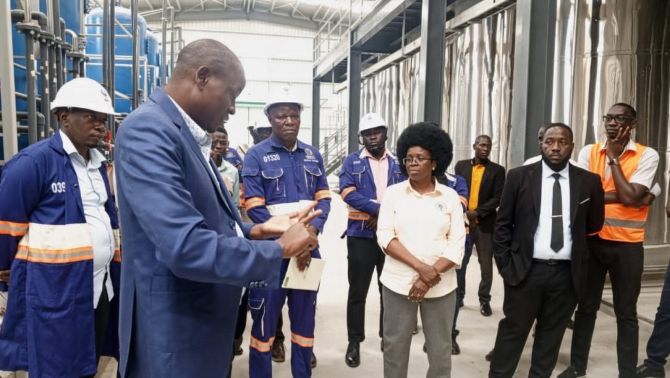
Magoola was speaking during a recent visit by a Ministry of Energy delegation led by the Minister of Energy and Mineral Development, Dr Monica Musenero, who was inspecting various industrial facilities in the Busoga region.
He said Uganda could become the first African country to manufacture human vaccines and related products, adding that local production would save the government billions of shillings currently spent on imports.
Magoola said the company also plans to manufacture vaccines and medicines for sickle-cell disease, construct a 1,000-bed hospital for people living with the condition and venture into biofuel production for vehicles.
Minister Musenero said major works to address the factory’s electricity supply challenges had been completed and that the new arrangements would be commissioned.
“We came here with my team from UEDCL to fix all the power challenges, and ensure work progresses well because Dei BioPharma is a high-capacity plant,” she said.
Uganda Electricity Distribution Company Limited [UEDCL] Manager for the North Eastern Region, Paul Sempiira, said the utility had installed a separate transformer at the Kamuli substation to serve the Namasagali power line, which also supplies the BioPharma plant.
“This arrangement is meant to isolate the plant from faults on other lines and to improve the quality and reliability of supply,” he said.
He added that the arrangement would protect the factory from disruptions affecting other distribution lines while improving the quality of electricity supplied to the facility.
The plant is also expected to source cassava from other regions, including Teso, Bukedi and Lango, where the company has attracted interest from farmers.
Several factories in Uganda, particularly sugar manufacturers in the Busoga and Bunyoro sub-regions, use cassava-derived biofuels to power their processing machinery, partly in response to inadequate and costly electricity supplies.
https://thecooperator.news/mps-warn-dei-biopharma-against-unfair-competition/
Buy your copy of thecooperator magazine from one of our country-wide vending points or an e-copy on emag.thecooperator.news


