
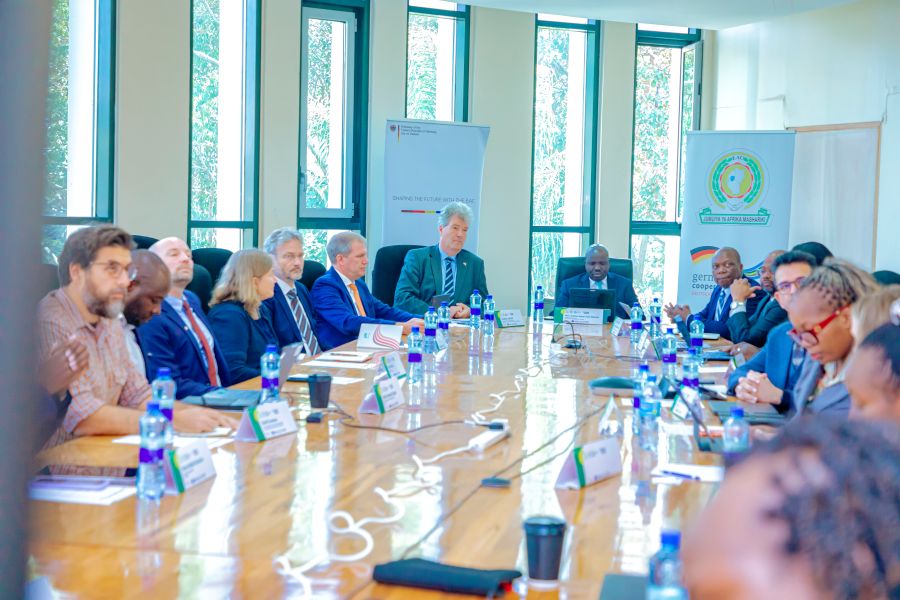
KAMPALA, August 13, 2026 — The East African Community [EAC] and the Government of Germany have launched the second edition of the EAC Artificial Intelligence Innovation Challenge, seeking to equip 20,000 East Africans with artificial intelligence [AI] skills and support the development of technology-driven solutions to regional challenges.
Dubbed AI4EAC, the initiative targets students, researchers and entrepreneurs across the EAC Partner States, providing training and opportunities to develop practical AI applications in areas including health, agriculture, finance and education.
The second edition has also attracted new strategic partners, including Equity Group Holdings and the Karlsruhe Institute of Technology [KIT], to strengthen collaboration in AI research, digital skills development and innovation.
The Challenge will offer US$ 50,000 in prize funding to winning teams developing AI-powered solutions to challenges facing the region.
A new Ebola Response Challenge will also be introduced, giving researchers, students and innovators an opportunity to develop AI models to support disease outbreak detection, preparedness and response.
The initiative was launched following a high-level AI Roundtable at the EAC Headquarters in Arusha, Tanzania, attended by representatives of the EAC Secretariat, the Inter-University Council for East Africa [IUCEA], the East African Science and Technology Commission [EASTECO], Germany’s Federal Ministry for Economic Cooperation and Development [BMZ], the German Federal Foreign Office and German Embassy.
Representatives from development partners, academia and the private sector, including Equity Group Holdings, Bayer, Cassava Technologies and Zindi, also attended the meeting.
Speaking on behalf of the EAC Secretary General, Deputy Secretary General in charge of Infrastructure, Productive, Social and Political Sectors, Aguer Ariik Malueth, said the initiative would help prepare East Africans to take advantage of opportunities created by AI.
“Our priority is to ensure East Africans have the skills, knowledge and partnerships to harness AI to create jobs, improve public services and develop solutions to our region’s challenges,” Malueth said.
He said the EAC was investing in people while building a regional innovation ecosystem capable of positioning East Africa to compete in the global digital economy.
Joachim Schmitt, Head of Division for East and Central Africa at BMZ, said Germany’s support for the EAC AI Alliance was intended to promote a coordinated regional approach to AI development.
“Since 2019, Africa has attracted US$ 1.25 billion in AI investment, but 80 percent has gone to just four countries,” Schmitt said.
He added that Africa has less than one percent of global data-centre capacity despite being home to about 18 percent of the world’s population.
“No single country can close this gap alone,” Schmitt said, adding that Germany was supporting a regional approach focused on practical AI skills, applied research and policies tailored to East Africa’s needs.
Equity Group Director of Innovation and Technology Winnie Mangeni said the partnership would support the development of practical and inclusive AI solutions for the financial sector.
“We want participants to work on real-world challenges, benefit from the experience and develop solutions that can progress beyond the competition,” Mangeni said.
The inaugural AI4EAC Innovation Challenge, held in 2025 and delivered by Zindi in partnership with IUCEA, EASTECO, GIZ, UNESCO Campus Africa and JICA, attracted 3,891 participants from 57 universities across Burundi, the Democratic Republic of the Congo, Kenya, Rwanda, Somalia, South Sudan, Tanzania and Uganda.
The six-month programme combined courses, webinars and hands-on training, with participants developing AI solutions targeting challenges in health, agriculture, finance and education. Top-performing participants also secured internship opportunities with leading organisations.
The EAC AI Alliance is commissioned by Germany’s BMZ and implemented by GIZ in partnership with EASTECO and IUCEA.
The Alliance is seeking to expand its institutional and private-sector partnerships to modernise university teaching and research, address regional digital skills gaps and advance a harmonised, gender-responsive regional AI policy framework across the eight EAC Partner States.
Buy your copy of theCooperator magazine from one of our countrywide vending points or an e-copy on emag.thecooperator.news


