
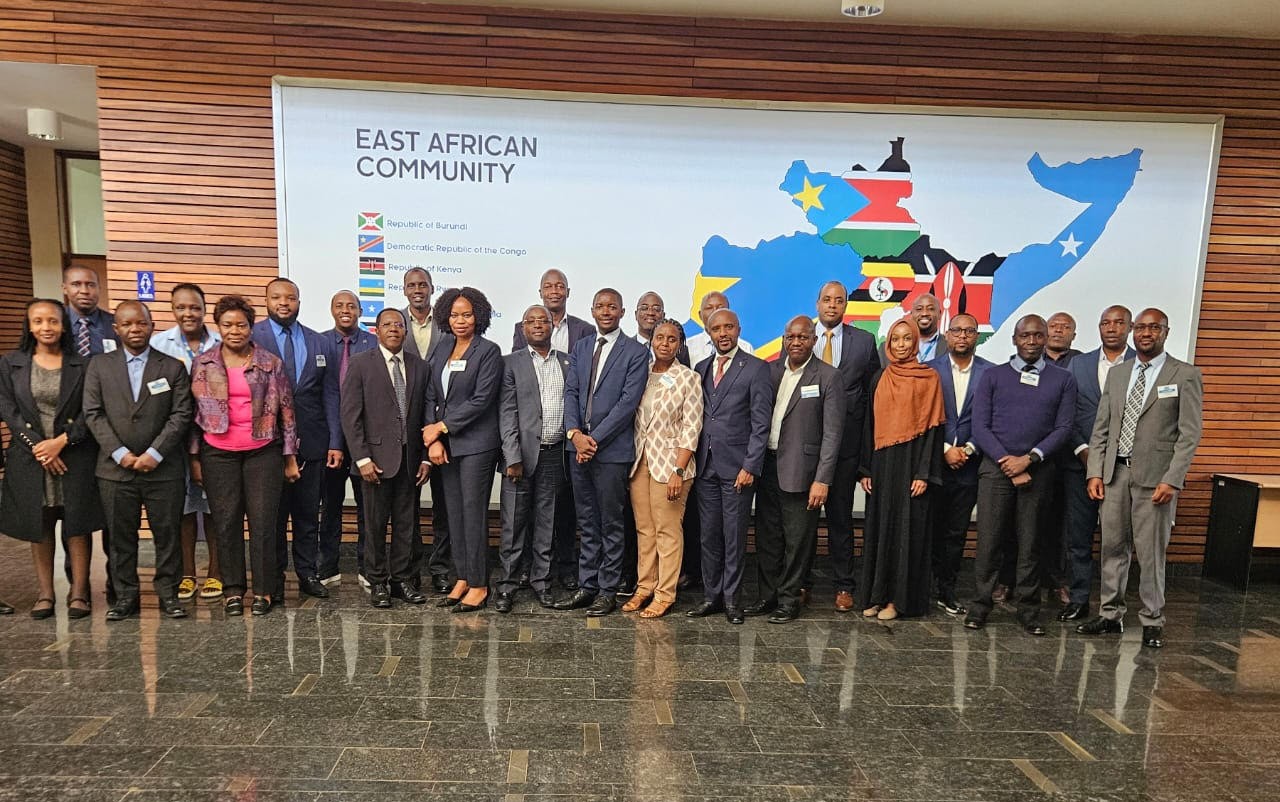
NAIROBI, February 12, 2026 — The East African Community [EAC] Secretariat has taken a significant step towards deepening regional financial integration following the expansion of the EAC Capital Markets Infrastructure [CMI] to onboard new stakeholders and prepare for a second phase of implementation.
The EAC Secretariat recently convened a meeting of the CMI Technical Working Group and executive representatives from capital markets institutions in Arusha, Tanzania. The meeting brought together representatives from the Burundi Securities Exchange (BSE), Dar es Salaam Stock Exchange [DSE], Nairobi Securities Exchange [NSE], and National Securities Exchange of Somalia [NSES].
Others at the meeting were representatives of Rwanda Stock Exchange [RSE], Somali Stock Exchange [SSE], and Uganda Securities Exchange [USE], with the Ethiopia Stock Exchange [ESX] attending as observers. Representatives from capital markets authorities, depositories, central bank financial markets departments, and the EAC Secretariat also participated.
The CMI is a regional technology platform aimed at integrating capital markets across EAC Partner States by linking stock exchanges and central securities depositories. The initiative supports the objectives of the EAC Common Market Protocol, particularly the free movement of capital, by expanding investment opportunities and strengthening access to financing for companies and governments across the region.
In his opening remarks, the Chief Executive Officer of the Nairobi Securities Exchange and Chairperson of the meeting, Frank Mwiti, noted, “While EAC capital markets are at different stages of development, Partner States share a strong and collective commitment to achieving meaningful regional integration.”
“We now have a timely opportunity to operationalise the long-standing vision of a single integrated regional market through the second phase of the Capital Markets Infrastructure. Key priorities include strengthening interoperability, enabling seamless cross-border investment, deepening market liquidity, and ensuring the inclusion of brokerage firms and other critical stakeholders,” he added.
Speaking on behalf of the EAC Secretariat, the Director of Planning, Aime Uwase, noted, “The growing participation in the Capital Markets Infrastructure, now bringing together all eight EAC Partner States, reflects the region’s strong commitment to deeper financial integration.”
“We commend the East Africa Stock Exchanges Association [EASEA] for fostering collaboration among regional exchanges and encourage stakeholders to develop innovative products and services that directly benefit EAC citizens while complementing the region’s expanding digital financial services ecosystem,” added the Director.
The CMI Technical Working Group will apply lessons learned from Phase I to address any gaps in infrastructure, interoperability, governance, stakeholder engagement, regulatory harmonization, standards alignment, and capacity building.
In planning for CMI Phase II, the meeting emphasised the need for each Partner State to identify its specific business and technical requirements, considering the varying levels of market development across the region. This approach will help ensure that the enhanced CMI system effectively responds to both national priorities and regional integration objectives.
The Partner States further agreed that CMI Phase II should be aligned with broader regional integration priorities, including the harmonisation of rules and regulatory frameworks, targeted capacity building for market participants, and strengthened integration with regional and national payment systems to maximise the impact, efficiency, and long-term sustainability of the infrastructure.
In addition, the meeting resolved to explore sustainable operational and financing models for the CMI beyond the implementation phase. It was agreed that clear sustainability options and institutional arrangements should be communicated and agreed upon by all Partner States prior to the commencement of Phase II implementation.
As a next step, the Partner States will undertake national consultations to identify business requirements for the CMI Phase II, while the EAC Secretariat will coordinate the consolidation of these requirements and convene periodic regional engagements to guide the planning, implementation and accelerate progress towards a fully integrated East African capital market.
The meeting concluded with a collective commitment from stakeholders across EAC Partner States and Ethiopia to strengthen regional capital markets integration.
Background
The first phase of the CMI commenced in 2015 with support from an IDA World Bank Grant under the EAC Financial Sector Development Regionalisation Project [FSDRP], with Rwanda, Tanzania, and Uganda as participating Partner States. Burundi participated despite not having established a capital market. While the World Bank support concluded in December 2020, the EAC Secretariat retained the CMI platform and continues to coordinate its operations and regional stakeholder engagement.
Since the completion of Phase I, the EAC has expanded to eight Partner States, with South Sudan joining in 2016, the Democratic Republic of the Congo in 2022, and Somalia in 2024. In parallel, regional capital markets have evolved with new exchanges, diverse levels of market maturity, and advances in financial technology, necessitating renewed stakeholder engagement to advance the regional integration agenda.
https://thecooperator.news/uganda-ranks-third-in-africa-financial-markets-index/
Buy your copy of thecooperator magazine from one of our country-wide vending points or an e-copy on emag.thecooperator.news


