
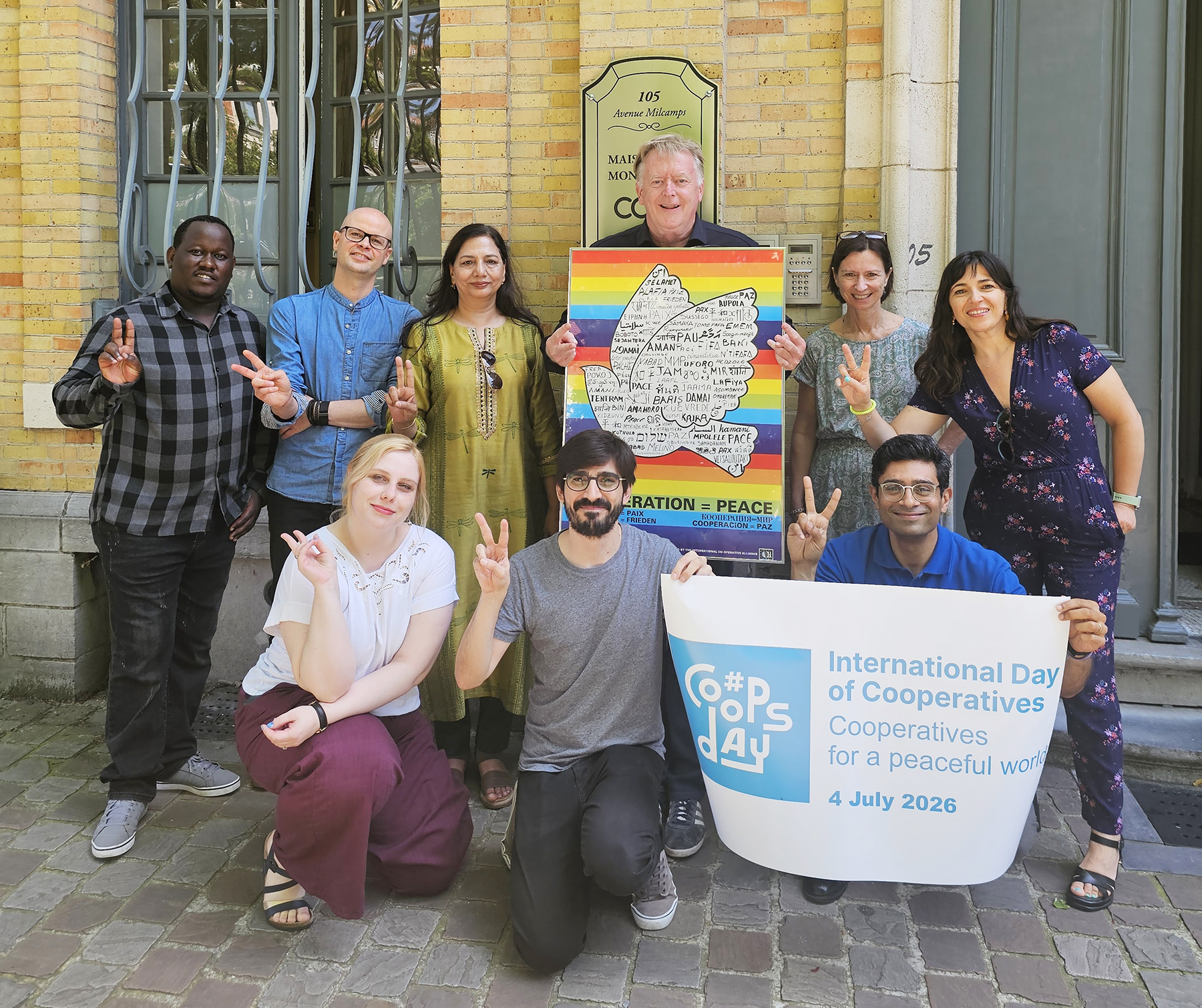
BRUSSELS, July 5, 2026 — More than one billion cooperative members around the world marked the United Nations International Day of Cooperatives [#CoopsDay] on Saturday under the theme “Cooperatives for a Peaceful World”, highlighting the cooperative movement’s contribution to building more peaceful, inclusive and resilient societies.
At a time when conflict and violence continue to affect many parts of the world, the global cooperative movement used the annual celebration to call for greater solidarity, democratic participation and shared prosperity as foundations for lasting peace.
Putting people at the centre of development, cooperatives offer a proven model for bringing communities together through trust, inclusion and collective action. Operating across every sector of the economy—including agriculture, finance, retail, housing, healthcare, education, energy, industry and services—cooperatives employ around 10 per cent of the world’s workforce while advancing social justice, economic democracy and environmental sustainability. There are an estimated three million cooperatives worldwide, with the world’s top 300 generating a combined annual turnover of US$2.8 trillion.
In his #CoopsDay message, International Cooperative Alliance (ICA) President, Dr Ariel Guarco, drew attention to the growing number of global conflicts and their devastating humanitarian consequences.
“More than 120 armed conflicts are currently affecting millions of people across our planet, pushing countless civilians deeper into poverty,” he said.
“Global military spending has reached US$ 2.89 trillion, representing a 2.9 per cent increase and marking the eleventh consecutive year of growth. Meanwhile, more than 830 million people live in extreme poverty, surviving on less than US$ 2.15 a day.
“But as schools for peace, cooperatives promote dialogue, transparency and fraternal exchange among people from the most diverse cultural, ethnic and geographical backgrounds. For all these reasons, we believe that the social, cultural and environmental harmony produced by the cooperative economy is an indispensable requirement for achieving positive peace.”
The cooperative model has long been associated with peaceful development, grounded in the values of self-help, democracy, equality, equity and solidarity. It promotes the principle that progress can best be achieved through collective and peaceful action.
ICA Director General Jeroen Douglas said cooperatives made important contributions before, during and after conflicts, crises and natural disasters.
“Before conflict, they build communities of trust and wellbeing, creating resilience that helps mitigate potential hostilities and bring societies together,” he said.
“During conflict, they become agents of support, supplying and distributing essential goods and services while also facilitating mediation. After conflict, they help rebuild people, places and communities.”
In June, the ICA and the Committee for the Promotion and Advancement of Cooperatives [COPAC] published a policy brief examining how the cooperative model can accelerate progress towards Sustainable Development Goal [SDG] 16, which promotes peaceful and inclusive societies for sustainable development. The publication forms part of an ongoing joint initiative highlighting cooperative contributions across all Sustainable Development Goals.
The brief showcased examples from Ukraine, Rwanda, Argentina and Nepal, demonstrating how cooperatives have contributed to post-conflict reconciliation, women’s empowerment, the prevention of gender-based violence and the protection of livelihoods during times of crisis.
In Rwanda, cooperatives served as platforms for reconciliation, with organisations such as the Koakaka Cooperative bringing together farmers from previously divided communities. In Argentina, the Cooperative Pact for Non-Violence on Gender, led by the Confederación Cooperativa de la República Argentina [COOPERAR], united cooperatives across Latin America and the Caribbean in preventing and addressing gender-based violence.
The publication also highlighted how Ukraine’s women-led Molochna Rika dairy cooperative-maintained production despite disruptions caused by Russia’s 2022 invasion. In Nepal, the Kalika Cooperative enabled women from Dalit, Rana Tharu and other minority communities to overcome discrimination, improve infrastructure, expand livelihoods and strengthen land rights through collective organisation.
The cooperative movement’s peacebuilding role has evolved over several decades, from discussions at the 1984 ICA Congress in Hamburg and subsequent reflections on cooperative values in Stockholm and Tokyo, to the 2019 ICA Kigali Declaration on Positive Peace, which recognised cooperatives as contributors not only to the absence of conflict but also to justice, inclusion and trust—the essential foundations of peaceful and resilient societies.
Building positive peace will remain a key focus at the joint ICA and Cooperatives of the Americas conference in Panama in September under the theme “Building Bridges: Cooperative Contributions for a Peaceful World.”
Dr Guarco urged cooperative members worldwide to continue promoting peace through their daily work.
“On this International Day of Cooperatives, let us recognise the daily contribution we make, together with our members and our communities, towards building a peaceful world,” he said.
“Humanity urgently needs to move towards a future founded on solidarity, inclusion and social justice. Let us continue building together the future we want and deserve—for ourselves and for the generations that follow.”
With only four years remaining to achieve the Sustainable Development Goals, the cooperative movement also called on governments, the United Nations and development partners to strengthen policy and legal frameworks that support cooperatives and to recognise them as essential partners in implementing the 2030 Agenda.
As communities continue to face conflict, inequality and climate change, cooperatives were presented as practical examples of how lasting peace can be built through democratic participation, shared prosperity and locally driven action.
About the International Day of Cooperatives
Officially recognised by the United Nations since 1995, the International Day of Cooperatives provides an opportunity for cooperatives to engage with governments and the international community while demonstrating their contribution to achieving the Sustainable Development Goals (SDGs).
The International Cooperative Alliance has celebrated CoopsDay on the first Saturday of July since 1923. In 2026, the event marked the 104th International Cooperative Day and the 32nd United Nations International Day of Cooperatives. The annual theme is selected jointly by the ICA and the Committee for the Promotion and Advancement of Cooperatives (COPAC) in consultation with United Nations partners and the global cooperative movement.
About the International Cooperative Alliance
Founded in 1895, the International Cooperative Alliance [ICA] is one of the world’s oldest non-governmental organisations. It unites, represents and serves cooperatives globally, representing an estimated one billion cooperative members and around three million cooperatives worldwide. The ICA serves as the global voice of the cooperative movement, promoting knowledge sharing, expertise and coordinated action across the sector.
Buy your copy of thecooperator magazine from one of our country-wide vending points or an e-copy on emag.thecooperator.news
-

-

-

-


