
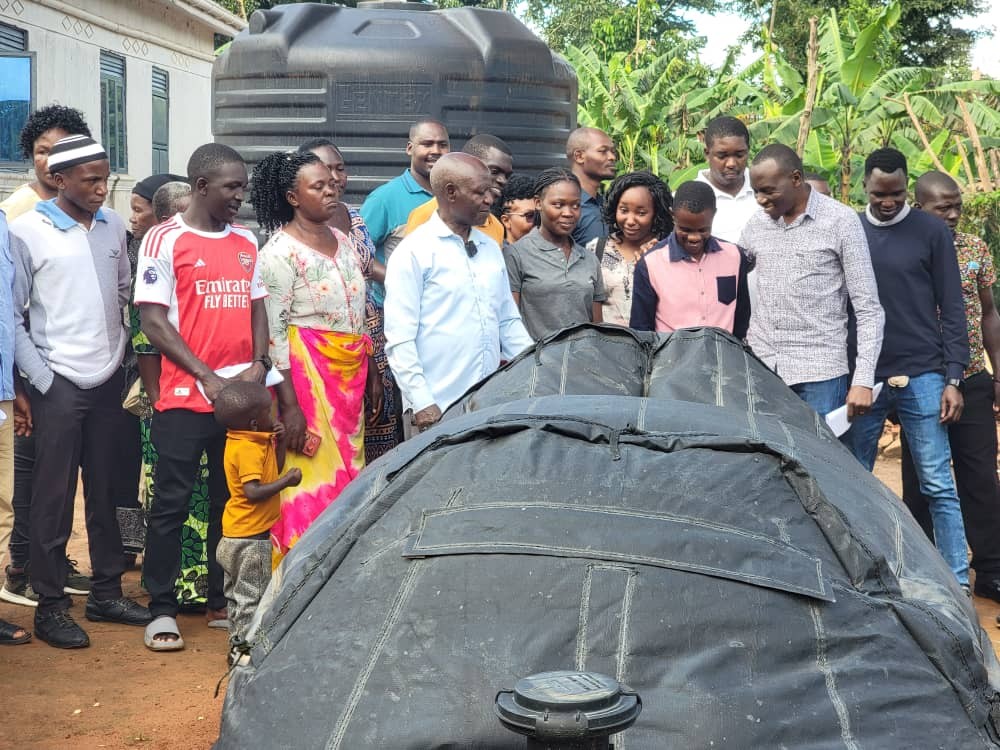
LUWEERO, January 15, 2026 – Makerere University has established a pilot Living Lab in a rural homestead in Luweero district as part of its intensified efforts to combat greenhouse gas emissions. The initiative seeks to empower communities to better understand climate change challenges while promoting practical, low-emission solutions at household level.
A Living Lab is a user-centred, open innovation ecosystem that tests new ideas, products and services in real-life settings through collaboration between users, researchers, companies and public institutions. Unlike conventional laboratories, Living Labs operate in everyday environments such as homes, farms or villages, placing end-users at the centre of innovation to ensure solutions are relevant, practical and sustainable.
The Living Lab established in Luweero aims to reduce emissions from a typical rural homestead to near zero. Through this approach, the university envisions embedding green economy principles within communities and promoting inclusive green growth.
The pilot site is located at the home of David Kayanja, a resident of Kawumu village in Luweero district, who has adopted clean energy and climate-smart practices in his household.
Kayanja, a family man living in a rural setting, keeps three Friesian cows, several goats and poultry, which generate significant organic waste. Instead of releasing harmful gases into the environment, the waste is collected and fed into a biogas system that produces fuel for domestic cooking and lighting.
The by-product of the biogas system, which is odourless, is used as organic manure in the garden, particularly in a spear-grass plot that feeds the livestock. This creates a continuous cycle in which animal waste generates energy, and farm produce sustains livestock.
As a result, Kayanja’s household has significantly reduced its reliance on firewood, helping to preserve trees while also cutting emissions associated with biomass fuel use.
“This has helped us reduce the amount of firewood we use, save trees, and also given us reliable energy for cooking and lighting,” Kayanja said.
Makerere University plans to establish additional Living Laboratories in selected areas, each designed as a user-friendly learning space within an open innovation ecosystem. These centres will foster co-creation, collective innovation, real-life experimentation and interactive prototyping.
The facilities will also bridge the gap between communities, researchers and academia, enabling direct feedback, shared learning and tangible social impact.
According to Dr Patrick Musinguzi, the Principal Investigator of the research, the Living Lab concept accelerates innovation by testing ideas directly within communities while encouraging ownership of new technologies and generating evidence for policy development.
“A Living Lab is a space where different stakeholders come together at homestead level to discuss how best to practise climate-smart agriculture, adopt solar technologies, deploy energy-efficient systems, use water-saving technologies and implement other practices that reduce greenhouse gas emissions,” Musinguzi explained.
At least three additional Living Labs will be established in Nakaseke District in central Uganda, Kabale District in the south-west, and Kamuli and Kumi districts in eastern Uganda. Each site will comprise a knowledge hub and a field-based learning centre to demonstrate affordable and reliable green technologies within rural communities.
Through these Living Labs, communities are expected to benefit from climate-smart farming practices, biogas generation, energy-efficient cooking stoves, reforestation and agroforestry initiatives, as well as landfill gas capture – all aimed at reducing greenhouse gas emissions.
Dr Musinguzi added that the initiative seeks to close knowledge gaps around climate change, green growth and sustainable energy transitions, both within academia and at community level.
“Green growth goes beyond theory. This project integrates universities with communities to empower people to understand greenhouse gas emissions and how they can reduce them at homestead, farm and energy-use levels,” he said.
Researchers involved in the project will also foster business partnerships with small and medium-sized enterprises offering climate-smart technologies and services, strengthen community leadership for sustainability, and create collaborative ecosystems for real-world experimentation.
The project, known as TORCH [Towards a Clean Energy and Zero-Emission Society in East Africa], is being implemented by Makerere University’s Department of Soil Science and Land Use Management under the College of Agricultural and Environmental Sciences [CAES]. It aims to help communities understand and adopt the Living Lab model as part of a regional green-growth strategy.
TORCH is funded by OeAD-GmbH under the Austrian Partnership Programme in Higher Education and Research for Development [APPEAR]. The two-year project spans Uganda, South Sudan and other partner institutions, strengthening collaboration between universities, farmers and households to accelerate climate-smart innovation.
In Uganda, the project is implemented by Makerere University, Busitema University, Kabale University, Ndejje University and University of Juba.
Despite the growing threat of climate change to Uganda’s agriculture, food systems and livelihoods, public awareness of its causes and solutions remains low. The Living Labs aim to strengthen teaching, promote practical research and expand community outreach to nurture environmentally conscious citizens.
At the Kawumu Living Lab, crop production, livestock management, energy use, soil and water conservation, and waste recycling are integrated into a single, functioning ecosystem that improves livelihoods while reducing emissions.
“This is how nature should function – with every component playing a critical and balanced role,” Dr Musinguzi said. “At homestead level, emissions can be reduced through better soil management, improved livestock systems, clean energy such as biogas, and efficient cooking and waste-management practices. Living Labs allow us to co-create solutions with the people most affected.”
https://thecooperator.news/ucda-coffee-laboratory-awarded-q-venue-certification/
Buy your copy of thecooperator magazine from one of our country-wide vending points or an e-copy on emag.thecooperator.news
-

-

-

-


