
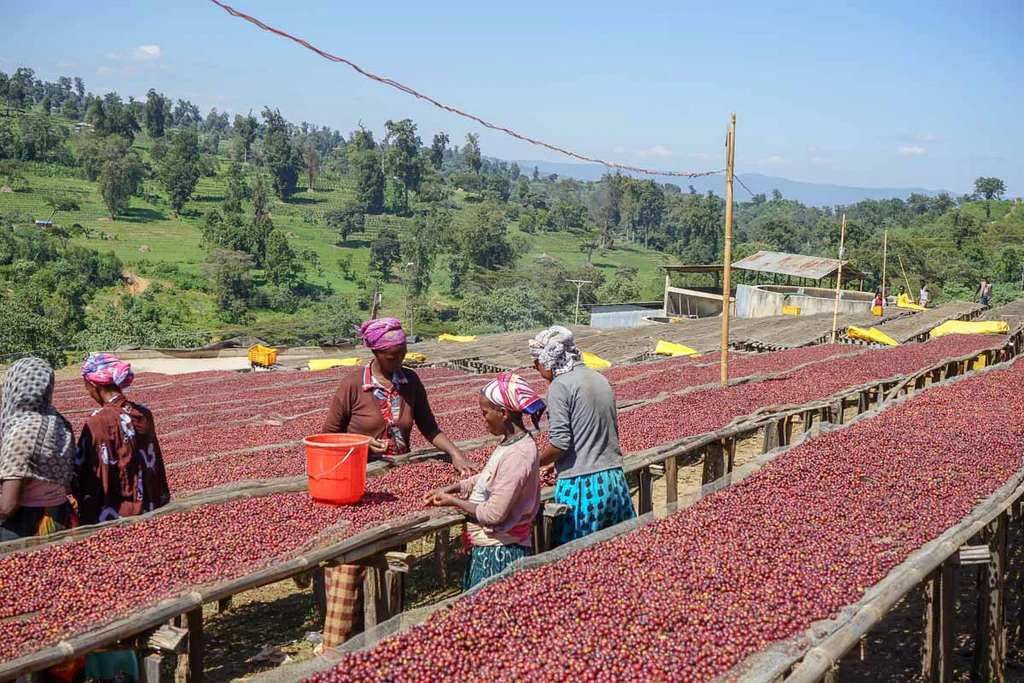
ADDIS ABABA — In Ethiopia, the birthplace of coffee, more than four million households rely on the crop as their primary source of income, accounting for nearly one-third of national export earnings. However, this vital sector is under growing threat as climate change drives increasingly severe heat conditions that are disrupting coffee cultivation.
Dejene Dadi, general manager of the Oromia Coffee Farmers’ Cooperatives Union (OCFCU), said growers are already experiencing the damaging effects of extreme temperatures on their harvests.
A recent analysis by Climate Central found that the world’s five leading coffee-producing countries — which together account for 75 percent of global supply — have experienced an average of 57 additional days of heat each year that are harmful to coffee cultivation as a result of climate change.
Coffee plants, particularly the highly prized arabica variety, thrive within a narrow range of temperature and rainfall. They struggle when temperatures exceed 30°C, leading to reduced yields and increased vulnerability to disease.
About two billion cups of coffee are consumed globally every day, yet the industry faces mounting pressures. The World Bank reported that between 2023 and 2025, prices for arabica and robusta beans nearly doubled, reaching record highs in February 2025.
Research by Climate Central tracked the number of days above 30°C in coffee-growing regions between 2021 and 2025, comparing the data with a scenario without carbon emissions. El Salvador was identified as the most severely affected, with an additional 99 days of extreme heat.
Brazil, the world’s largest coffee producer, responsible for 37 percent of global output, recorded 70 extra days. Ethiopia, which accounts for 6.4 percent of global production, experienced 34 additional days of damaging heat.
Ethiopian arabica coffee is particularly sensitive to direct sunlight. Excessive exposure increases the risk of disease and reduces bean yields where adequate shade is lacking.
To tackle deforestation and preserve natural canopy cover for coffee plants, the Oromia cooperative has begun distributing energy-efficient cookstoves to its members, helping to reduce reliance on firewood.
Despite the urgent need for funding to support climate adaptation, smallholder farmers — who produce between 60 percent and 80 percent of the world’s coffee — received just 0.36 percent of the climate finance required in 2021. Dadi warned that without meaningful government action to address climate change, the long-term sustainability of global coffee supplies will be increasingly at risk.
Meanwhile, farmers from various regions are expressing urgent needs for governmental action and investment in sustainable practices. In Ethiopia, Dejene Dadi of the Oromia Coffee Farmers Cooperatives Union emphasizes the necessity for shaded growing conditions and the distribution of energy-efficient cookstoves to protect forest areas essential for coffee cultivation.
Similarly, Colombian coffee farmer Eugenio Cifuentes advocates for a reduction in monoculture farming practices in favor of diversification to increase resilience against climate fluctuations.
In India, the impact of erratic weather patterns is also apparent. Sohan Shetty, managing biodiversity-rich shaded coffee farms, describes how premature flowering results in poor cherry quality and inconsistent harvests.
Akshay Dashrath from South India Coffee Company details the daily measurements of rising temperatures and soil moisture loss, stressing the need for improved shade management and water resilience in coffee farming.
Overall, the ongoing climate crisis underscores the urgent need for collaborative efforts to support coffee farmers in adapting to these changes, ensuring the sustainability of coffee crops and the livelihoods dependent on them.
https://thecooperator.news/coffee-farmers-in-west-acholi-count-losses-as-drought-grips-region/
Buy your copy of thecooperator magazine from one of our country-wide vending points or an e-copy on emag.thecooperator.news


