
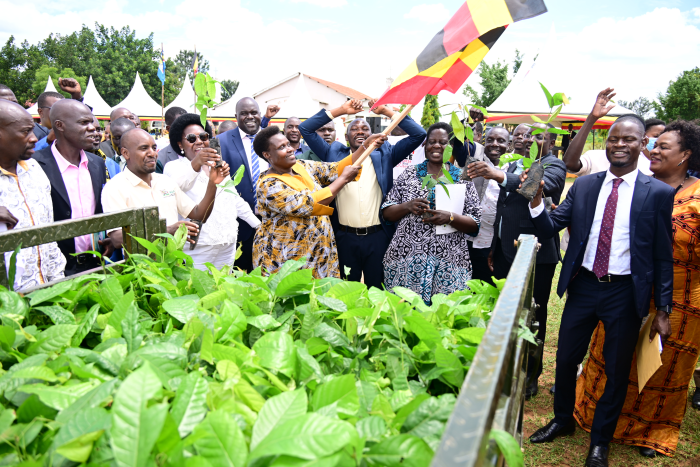
BUDAKA, May 6, 2026 — The Government has distributed more than two million coffee and cocoa seedlings to farmers in the Bukedi Sub-region, in a bid to promote the cultivation of the two cash crops and tackle poverty in the region.
The initiative, dubbed the Kibalo Campaign, is aimed at transitioning households into the money economy. It is expected to be rolled out nationwide, with at least 80 million seedlings set for distribution across different regions.
Launching the campaign at Kamonkoli College in Budaka district, Vice President Jessica Alupo urged farmers to embrace irrigation to ensure the survival of seedlings, particularly during prolonged dry spells.
“You are being told that you can produce throughout the year, but that requires a reliable source of water,” she said, adding that irrigation should be complemented by improved agronomic practices.
Rauben Keimusya, Assistant Commissioner for Coffee Production at the Ministry of Agriculture, Animal Industry and Fisheries [MAAIF], described the initiative as a critical intervention to address persistent poverty in Bukedi.
He noted that coffee is a highly lucrative crop, explaining that while cassava, commonly grown in the region as a key cash crop, can earn a farmer about Shs 900,000 per acre, coffee, if properly managed using recommended agronomic practices, can generate between Shs 16 million and Shs 18 million annually.
The introduction of coffee in the region follows feasibility studies conducted by the National Agricultural Research Organisation and the Ministry of Agriculture, confirming Bukedi’s suitability for the crop and its potential to attract large-scale investment.
The rollout aligns with the Bukedi Sub-region Strategic Plan for Accelerated Wealth Creation [2024–2040], launched by the President in August 2024 and spearheaded by Science, Technology and Innovation Minister Monica Musenero.
Local leaders also unveiled plans for a Bukedi coffee development scheme, including the establishment of seedling multiplication centres, subsidised distribution, and partnerships with private sector players.
Alupo further encouraged farmers to take advantage of complementary government programmes such as the Parish Development Model and Emyooga to boost household incomes.
Budaka County Member of Parliament, Arthur Mboizi, welcomed the initiative, urging farmers to strictly follow recommended agronomic practices in order to benefit from coffee production.
“If we are to benefit from coffee and compete with other regions, we must listen to extension workers, apply what we are taught, and invest time and resources where possible,” he said.
Mboizi also called on the MAAIF to deploy more extension workers to the district, noting that coffee remains a new crop for many farmers in the area.
Despite widespread poverty, Bukedi has been slow to adopt modern agricultural practices, including diversification into new crops, the use of improved technologies, and climate-smart farming methods.
The region also faces challenges such as poor soils and prolonged droughts, which have depleted vital water resources and undermined livelihoods. Many farmers rely on rice growing, small-scale fishing and cassava cultivation, activities that often yield low and unreliable incomes.
https://thecooperator.news/budaka-cooperative-members-trained-in-financial-management/
Buy your copy of thecooperator magazine from one of our country-wide vending points or an e-copy on emag.thecooperator.news
-

-

-

-


