
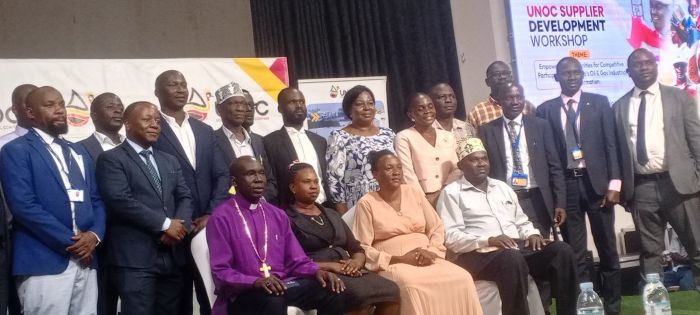
HOIMA CITY, August 3, 2026 — Leaders in the oil-rich Bunyoro Sub-region have criticised key players in Uganda’s oil and gas sector for failing to unveil more business and job opportunities for local communities so that they can be able to participate and benefit more from the nascent industry.
During a charged engagement held days ago in Hoima City and involving oil companies, political leaders, religious leaders, community representatives, and representatives of Bunyoro Kitara Kingdom, participants argued that people in Bunyoro had not been adequately supported to compete for jobs and service contracts in the petroleum sector.
They noted that many contracts in the industry require highly specialised technical skills, yet local residents and businesses have limited access to the training and opportunities needed to meet such requirements.
The concerns were raised during a Supplier Development engagement convened by the government-owned Uganda National Oil Company [UNOC].
Participants observed that, despite years of oil and gas exploration and development in the Albertine region, only a small number of local residents have secured employment and business opportunities in the sector.
The District LCV Chairman, Uthman Mubarak, pointed to several local contractors who continue to struggle to meet industry requirements.
“Many of our local contractors have been sidelined from available business opportunities. This is painful, especially after investing so many resources to meet the requirements,” he said.
Mubarak called for continued engagement with local contractors in areas where they have the capacity to perform, saying stronger collaboration would create pathways for greater local participation in the oil and gas industry.
Bunyoro Kitara Kingdom lawyer Denis Kiiza urged UNOC and other oil and gas companies in the area to work more closely with local government leaders, who, he said, could help connect companies with communities that are adequately prepared to contribute to the sector.
“Local leaders have a better understanding of the communities that you need. Collaboration with them would be handy in ending such complaints,” Kiiza said.
He urged UNOC to work with other oil and gas companies and sector stakeholders to create more opportunities for local residents. He also called for greater support to local governments through corporate social responsibility initiatives, particularly in addressing challenges such as waste management.
The Hoima District Woman Member of Parliament, Beatrice Wembabazi, expressed concern over what she described as inadequate involvement of local leaders in the oil and gas industry.
“We have not been sufficiently involved as leaders, yet our people are eager to participate in the oil and gas sector. More information and opportunities should be made available to local communities,” Wembabazi said.
She urged oil and gas companies to strengthen local content initiatives by giving priority to local businesses and individuals when awarding contracts.
Responding to the concerns, UNOC National Content Specialist Jessica Kyeyune acknowledged that while the oil and gas industry in the area may not provide direct employment for everyone, it offers numerous indirect opportunities that local communities can take advantage of.
She urged residents to participate in training programmes designed to equip them with the skills needed to compete for jobs and business opportunities in the sector.
“These training opportunities are available, and many people have become competitive after such training. I kindly urge leaders to mobilise the people to take part,” she said.
Kyeyune also highlighted the investment potential of the Kabalega Industrial Park, saying it offers a wide range of opportunities for both local and international investors.
She advised the people of Bunyoro to position themselves to benefit from the industrial park and the broader economic opportunities expected to arise from Uganda’s oil and gas industry.
On her part, Lyoidah Kiconco, UNOC’s head of exploration and new ventures, urged the business community to build the technical capabilities needed to compete for contracts in the petroleum sector.
“We appeal to Ugandans, especially the business community in the Bunyoro sub-region intending to supply the oil and gas industry, to prepare early by building the necessary skills and capabilities to take advantage of the opportunities in the sector,” Kiconco said.
She also encouraged the public to maintain a positive attitude toward the petroleum industry and to appreciate its contribution to Uganda’s economic development.
The Petroleum Authority of Uganda [PAU] economist Eric Odongo urged job seekers to focus on acquiring technical, trade, digital and support-service skills required by the industry.
He advised prospective employees to create and regularly update their profiles on the National Oil and Gas Talent Register [NOGTR] to improve their chances of securing employment.
Odongo also encouraged businesses seeking to supply goods and services to the petroleum sector to register on the National Suppliers’ Database [NSD], describing registration as the first requirement for participating in procurement opportunities.
He noted that accreditation on the National Suppliers’ Database remains valid for three years and allows companies to compete for contracts in Uganda’s growing oil and gas industry.
Oil activities in the Bunyoro Sub-region centre on major infrastructure and extraction projects in the Albertine Graben, including the US$6.7 billion to US$ 7blnTilenga and Kingfisher Development Project, alongside the East African Crude Oil Pipeline [EACOP] with an estimated total investment value of US$ 3.5bln to US$ 5bln. These operations bring heavy construction, new roads, and economic changes to districts like Hoima and Buliisa.
Although Uganda has seen substantial success and considerable achievements in the growth of the oil and gas sector, marked by an increase in discovered oil and gas resources from 300 million barrels in 2006 to 6.5 billion barrels in 2014, this discovery has since attracted a number of debates. These include whether oil is a benefit or a resource curse.
The engagement in Hoima City was part of UNOC’s efforts to promote supplier development and increase local participation in Uganda’s petroleum sector, in line with the country’s local content policy.
https://thecooperator.news/unoc-records-shs-37bln-profit-in-financial-year-ended-june-30-2023/
Buy your copy of thecooperator magazine from one of our country-wide vending points or an e-copy on emag.thecooperator.news
-

-

-

-


