
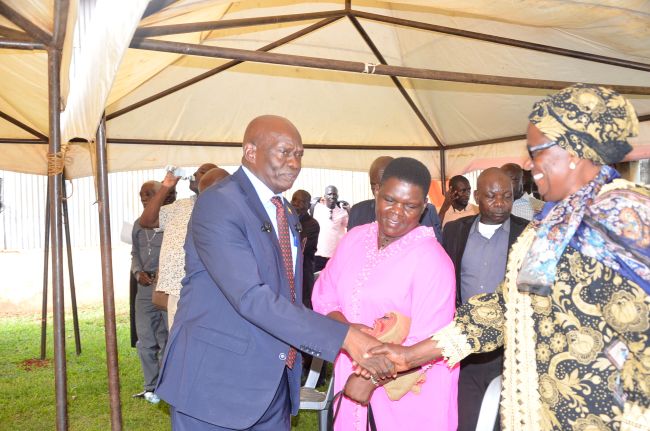
MASINDI, November 4, 2026 – Bunyoro Growers Cooperative Union Limited has appealed to the State Minister for Cooperatives, Tom Alero Aza, to help secure the outstanding Shs 2.3 billion balance of compensation owed to the union by the Government for losses suffered during the 1986 liberation war and subsequent insurgencies.
The union, based in Masindi district, was initially assessed for compensation amounting to Shs 4.8 billion, of which the Government of Uganda has so far paid Shs 2bln.
Wilson Byaruhanga, the union’s Chairperson, made the appeal during Minister Aza’s recent visit to the cooperative to assess its progress and operational challenges.
Byaruhanga said a government war losses verification committee visited the union on April 4, 2018, to verify its compensation claim, assess the current value of the lost assets and advise on strategic business plans for utilising the funds once released.
“On April 4, 2018, a war losses verification committee from the government visited Bunyoro Growers Cooperative Union Limited to ascertain the validity of the claim, guide the union on the actual current price value considering the period when the losses were incurred, and advise on formulating strategic business plans for fund utilisation if received. The exercise was conducted, relevant sites visited, and personnel contacted,” Byaruhanga said.
He explained that the union had initially submitted a war losses claim of Shs 5.2bln covering destroyed or looted assets, property, stocks, vehicles and livestock. However, following verification, the committee approved compensation of Shs 4.8bln.
Byaruhanga said that despite several follow-ups, the union had failed to secure payment until its board resolved, during a meeting held on August 1, 2019 [Minute 24/2019], to appoint M/s Kabega, Bogezi & Bukenya Advocates to pursue the claim on its behalf.
“Subsequently, substantial progress was realised, and in November 2020, the government paid Shs 2bln out of Shs 4.8bln to the union through our appointed law firm, which we have awaited in vain,” he told the minister.
He added that several primary cooperative societies affiliated with the union, including Bulima Cooperative Society Limited, Akumulikire Growers Cooperative Society, Kabarole Growers Cooperative Society Limited and Mutajwaha Growers Cooperative Society Limited, had also submitted related war losses claims, but these had not been considered.
According to Byaruhanga, the failure to compensate the societies had further constrained their operations and undermined their recovery efforts.
How the compensation was utilised
Byaruhanga said the Shs 2bln received from the Government had been invested in restoring and expanding the union’s productive capacity.
The funds were used to purchase and install a coffee processing factory in Masindi, a maize mill and an animal feed processing plant in Hoima City.
The union also acquired a double-cabin pick-up and a three-tonne truck, renovated its head office buildings in Masindi and Hoima, conducted sensitisation and capacity-building training, settled outstanding debts and restocked Kokoitwa Ranch, among other activities.
Minister pledges support
In response, Minister Aza commended the current union leadership for its efforts to keep the cooperative operational despite the challenges it faces.
He pledged to follow up on the outstanding compensation claim but challenged the leadership to prioritise the revival of the union and its affiliated primary societies.
“I am leaving you with assignments to fulfil. Ensure that you organise a special meeting within 60 days involving all primary society members. You need to make sure that these primary societies are revived. All the machinery should work again,” he said.
The minister also pledged to link the union to the Uganda Development Corporation [UDC] to help repair its non-functional machinery.
“I promise to link you to Uganda Development Corporation to repair your machines,” he said.
Aza further promised to deploy a ministry official to the union to provide technical support, adding that access to the Government’s Cooperative Revival Fund would depend on proper governance and accountability.
“Government has created the Cooperative Revival Fund, but I will not give this money to disorganised cooperatives. If you have a clean audit and a clean board, we shall give you this money,” he said.
He added that he would personally monitor the implementation of the assignments given to the union and return within 90 days to assess progress.
The minister said his nationwide visits were intended to sensitise communities about the importance of savings and credit cooperative organisations [SACCOs] and cooperatives, while identifying challenges affecting the cooperative movement.
“I am traversing the whole country, gathering all the issues so that we can forge a way forward on how to revive the cooperatives. As a cooperative minister, I am not supposed to be an armchair politician but to go to the people and tell them about the cooperative movement,” he said.
About Bunyoro Growers Cooperative Union
Bunyoro Growers Cooperative Union Limited, located about two kilometres from Masindi town, was established and registered in 1954 to improve the marketing of agricultural produce, including coffee, cotton and tobacco, and protect farmers from exploitation by middlemen.
The union performed well until 1975, when it was among the leading agricultural marketing organisations in the region. Its success enabled it to establish a factory in Hoima District, cotton ginneries in Hoima and Masindi, and a cattle ranch at Kokoitwa in Kimengo Subcounty.
However, the union suffered significant losses during the regime of former President Idi Amin, which severely disrupted its operations. Its fortunes deteriorated further during the 1986 liberation war, when the National Resistance Movement [NRM] came to power.
During the conflict, several of its lorries were commandeered for military operations, while cotton and seed cotton were destroyed and coffee stocks and other assets looted.
The losses left the union struggling to service loans acquired to finance its operations, meet staff obligations and purchase members’ agricultural produce, including coffee and cotton.
The financial difficulties eventually forced the union to sell some of its assets to sustain operations and repay loans whose interest continued to accumulate.
https://thecooperator.news/mps-call-for-compensation-of-cooperatives-for-war-loss/
Buy your copy of thecooperator magazine from one of our country-wide vending points or an e-copy on emag.thecooperator.news


