
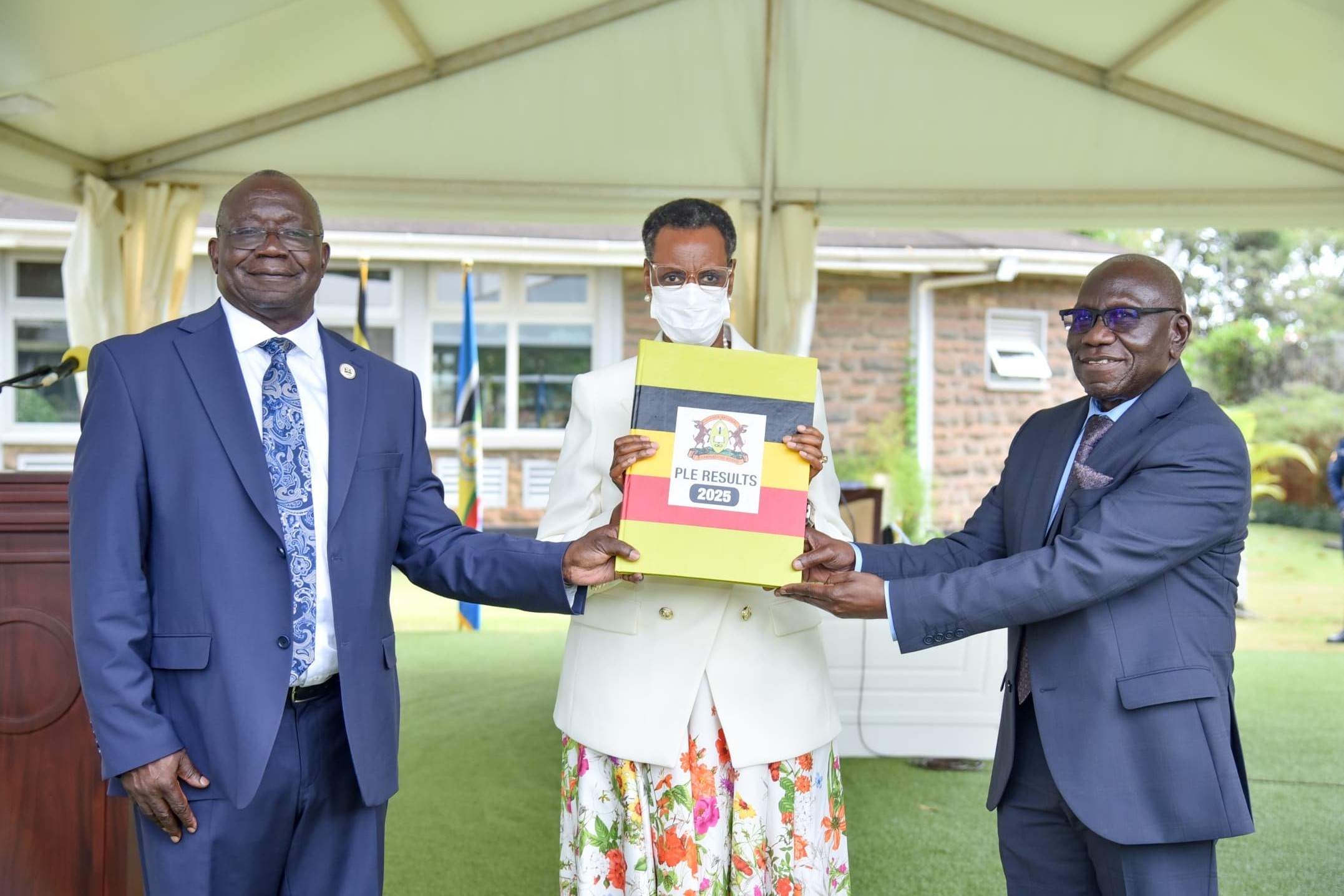
KAMPALA, January 30, 2026 — The First Lady and Minister of Education and Sports, Janet Kataaha Museveni, has officially released the 2025 Primary Leaving Examinations [PLE] results at State House Nakasero, saying, “With the renewal of the mandate of the NRM government by the people of Uganda, UPE shall continue to play its role in expanding access to basic Education for all.”
An analysis of the examination results shows that boys performed better than girls, although more girls registered for the examinations than boys, indicating more girls than boys completed this level of education cycle.
Speaking during the release of the results, UNEB Executive Director Dan Odongo said that in terms of percentages, males performed better than females and also recorded a lower failure rate.
In 2025, candidates performed best in English [91.9 percent], followed by Integrated Science [90.5 percent], Mathematics [88.9 percent], and Social Studies [86.7 percent].


Odongo noted that examination malpractice has taken on a more brazen and troubling form. In some instances, scouts and invigilators were reportedly bribed or threatened with physical harm by school directors and headteachers to allow teachers to assist candidates directly within examination rooms.
“It is regrettable that some officers within District Education Offices, who should be key partners in safeguarding examination integrity, have become complicit in these and other unprofessional acts. I wish to express my sincere appreciation to the dedicated Security Team, which has worked tirelessly to investigate and manage cases of examination malpractice,” he said.
He added: “In accordance with Section 52 of the UNEB Act, Cap. 259, the Board will withhold the results of affected candidates pending the completion of investigations. Where a prima facie case is established, the Board’s Tribunal, also known as the Examinations Security Committee, will accord all affected candidates a fair hearing before final decisions are made.”
This year, Odongo noted, most of the withheld cases originated from the districts of Kisoro, Kampala, Mukono, Namutumba, Kassanda, Buyende, and Kaliro, among others. “I would, however, like to commend the leadership of Kyenjojo, Kabarole, and Bundibugyo districts, where a notable improvement has been observed. In particular, due to firm action taken by the Chief Administrative Officer of Kyenjojo in 2024, no cases of examination malpractice have been reported from the district this year,” he said.
He further stated that examiners and curriculum specialists commended the overall quality of the examination papers administered. “The papers clearly reflected the paradigm shift towards competency-based learning, with questions designed to assess learners’ ability to apply knowledge and skills. However, it was noted that some teachers—particularly in social studies and religious education—have not fully adjusted their teaching approaches to align with this shift.”


“As a result, many candidates experienced difficulty responding to questions that required the application of knowledge, especially in relation to their communities and the country at large. This partly explains the decline in performance in these subjects compared to 2024. Examiners also highlighted the negative impact of materials developed and circulated by so-called examination bureaus shortly before the examination. Such materials were misleading and adversely affected candidates’ preparedness and performance,” he added.
On his part, UNEB Chairperson Prof. Celestino Obua noted that candidature has continued to rise, while absenteeism has remained steady at 1.3 percent over the last two years. “However, as you rightly noted in your statement last year, any drop-out is a cause for concern. I trust that the Permanent Secretary and her team have since been able to establish some of the underlying causes, as was promised,” he said.


Prof. Obua said performance at the Grade One pass level has improved compared to the 2024 examination, noting that more candidates have qualified to proceed to the next level or cycle of education than was the case in 2024. “I have no doubt that, given the government’s continued efforts to expand access to post-primary education, all the 730,000 learners who were graded and passed will secure placement in secondary and vocational institutions,” he said.
He explained that for the second consecutive year, UNEB conducted an item analysis of the four examination papers offered at this level to establish the proficiency levels attained by learners. “This initiative aligns well with the country’s paradigm shift towards a Competency-Based Curriculum and assessment. The analysis will henceforth be conducted and reported annually,” he said.
“From the findings, the Board has formed the view that teachers require substantial capacity-building support to enable them to effectively interpret the curriculum and adapt their teaching approaches accordingly,” he added. “Over the last two years, the Board identified two Local Governments with the lowest levels of achievement and provided targeted capacity-building support to selected teachers. Subject to the availability of funds, this intervention—modest as it may be—will be sustained as a contribution to complementary initiatives undertaken by the Ministry through its various agencies.”
Analysis
A total of 817,883 candidates from 15,388 examination centres registered for the 2025 PLE, marking an increase from 797,444 candidates in 2024, according to official figures released by the examination board.
Of the total candidature, 522,036 learners [63.8 percent] from 11,525 centres were UPE beneficiaries, while 295,847 candidates [36.2 percent] from 3,863 centres were registered under the Non-UPE category.
Gender distribution
Analysis by gender shows that 389,469 boys [47.6 percent) were registered, compared to 428,324 girls [52.4 percent], indicating that more girls than boys completed the primary education cycle in 2025. This trend mirrors recent years, with girls consistently outnumbering boys. In 2024, girls accounted for 52.5 percent of the total candidature, while boys made up 47.5 percent.
Candidates with special needs
UNEB also registered 3,636 learners with Special Needs, including candidates who are blind, deaf, physically challenged, and dyslexic. This represents an increase from 3,328 candidates in 2024, reflecting growing efforts toward inclusive education.
Prison inmate candidates
In a notable development, UNEB registered 101 prison inmate candidates. Of these, 61 candidates [54 males and 7 females] were registered from Uganda Government Upper Prison, Luzira, while 40 candidates [39 males and 1 female] were registered from Mbarara Main Prison.
Collection of results
Results for each examination centre are uploaded to the Centre Portal and can be downloaded. District, Municipal, and City Inspectors of Schools will collect hard copies from UNEB offices in Ntinda starting Monday, 2 February 2026.


https://thecooperator.news/uneb-welcomes-eprc-study-on-new-o-level-curriculum/
Buy your copy of theCooperator magazine from one of our countrywide vending points or an e-copy on emag.thecooperator.news


