
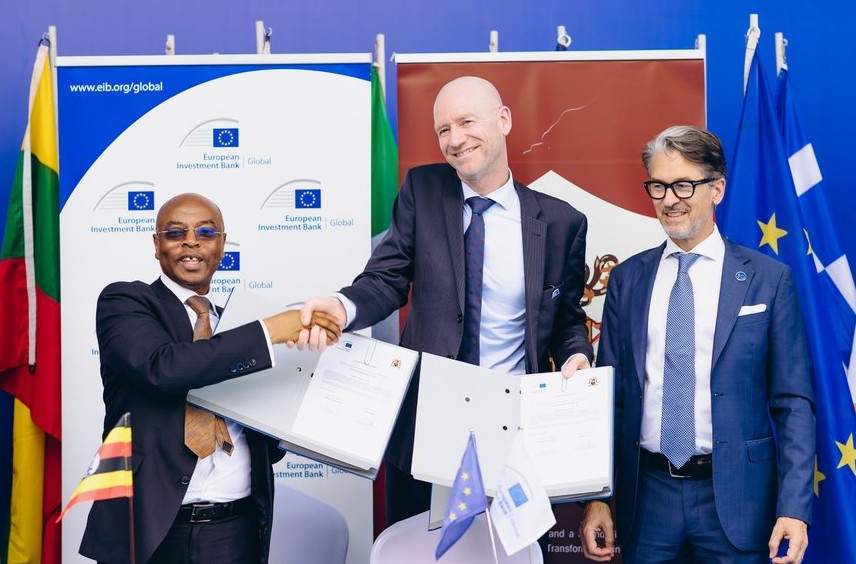
KAMPALA, October 22, 2026 — The Bank of Uganda [BoU] and EIB Global, the international development arm of the European Investment Bank [EIB] Group, have signed a cooperation agreement aimed at strengthening Uganda’s financial sector capacity to manage climate-related risks and promote sustainable investment in the country being pounded by the effect of climate change.
The agreement, signed on Wednesday at the Kampala Serena Hotel under the Greening Financial Systems Technical Assistance [GFS TA] Programme, will support BoU in strengthening the capacity of selected supervised financial institutions to identify, assess, manage and disclose climate-related risks.
Speaking at the signing ceremony, BoU Deputy Governor Prof Augustus Nuwagaba said the initiative would help Uganda mobilise the estimated US$ 28.1 billion required to finance climate action by 2030.
“This partnership fits within the Bank of Uganda’s mandate and will strengthen the capacity of our financial institutions, drawing on the EIB’s technical expertise, experience in other countries and the wider support of our European partners,” Nuwagaba said.
He said climate change was increasingly being viewed as a core macroeconomic and financial-stability risk, making it necessary for Uganda to build a financial system capable of responding to emerging climate-related challenges.
Uganda’s National Climate Finance Strategy 2025–2030 seeks to strengthen the resilience and transparency of the financial system while attracting more investment to support climate action and sustainable development.
Nuwagaba urged financial institutions, energy-sector stakeholders, private-sector actors and development partners to view the initiative as more than a regulatory requirement.
“I encourage financial institutions, energy-sector stakeholders, private-sector actors and development partners to see this initiative not merely as a regulatory requirement, but as an opportunity to promote greening and sustainability of the financial sector and strengthen the resilience and competitiveness of Uganda’s economy,” he said.
He said a greener financial system should not only manage climate risks but also unlock investment, support businesses and promote sustainable economic growth.
“A greener financial system must not only manage climate risks better; it must also help unlock investment, support enterprise and contribute to sustainable economic growth,” Nuwagaba said.
He said the initiative would have practical benefits for financial institutions, businesses, investors and development partners, particularly in sectors such as energy, agriculture, transport and infrastructure.
“For financial institutions, this means better understanding climate risks in their portfolios and making more informed lending decisions. For businesses and investors, especially in energy, agriculture, transport and infrastructure, this translates into improved access to finance for credible sustainable projects,” he said.
Nuwagaba said Uganda needed to strengthen the resilience of its financial system without restricting access to credit for productive economic activities.
“We must strengthen resilience without unnecessarily constraining access to finance. Our objective is a financial system that understands emerging risks, allocates capital effectively and continues to finance productive activity,” he said.
He added that achieving this would require collaboration across sectors, technical expertise, reliable information and sustained implementation.
“Our climate-action financing requirement is approximately US$28.1 billion by 2030 and will require coordinated public and private resources,” Nuwagaba said.
Under the agreement, EIB Global will provide technical assistance to help BoU develop a roadmap for greening Uganda’s financial sector, strengthen its climate-risk disclosure framework and improve reporting by financial institutions.
The support will also facilitate the practical implementation of Uganda’s National Green Taxonomy, launched in 2025 to provide a common definition of environmentally sustainable economic activities.
EIB Global will further support BoU in building its capacity to supervise climate-related financial risks and help financial institutions meet regulatory requirements.
“Banks can’t manage a risk they can’t see,” said EIB Vice-President Marko Primorac. “Our partnership with the Bank of Uganda will help the country’s financial sector identify and manage climate risk, so banks can lend to green projects with more confidence. That confidence helps attract the private capital Uganda needs for stronger climate action.”
The technical assistance is being provided through the EIB Group’s GFS TA Programme, managed by EIB Advisory. The programme is financed by the governments of Germany and Luxembourg through the Greening Financial Systems Fund, in close coordination with the NDC Partnership, a global coalition of more than 270 countries and institutions working to advance the Paris Agreement.
“Mobilising climate finance at the scale required depends on strong institutions and financial systems equipped to manage climate-related risks,” said Pablo Vieira, Global Director of the NDC Partnership.
“Strengthening how financial institutions understand and manage climate risks is essential to building a financial system that can mobilise investment at the scale Uganda’s climate and development priorities demand,” he said.
The support will extend beyond BoU to selected Ugandan commercial banks, helping them strengthen climate-risk management and disclosure while developing policies and processes to expand green lending.
Housing Finance Bank is the first Ugandan commercial lender set to benefit from the technical assistance.
The cooperation also reinforces the European Union’s support for Uganda’s green transition through its Global Gateway strategy, under which the EU and its Member States combine technical assistance, grants, loans and guarantees to improve investment conditions and mobilise public and private capital for sustainable infrastructure and climate action.
“In the EU, we are committed to climate action because protecting our planet is ultimately about protecting people, their livelihoods and the future of generations to come,” said EU Ambassador to Uganda Jan Sadek.
“Ensuring that the financial sector can channel resources towards sustainable, climate-friendly solutions is essential to turning this ambition into real change in people’s lives. The operation signed today is an important step in that direction,” he said.
Uganda joins Albania, Armenia, Bosnia and Herzegovina, Ethiopia, Georgia, Jordan, Kenya, Nigeria, North Macedonia, Rwanda and Vietnam among countries receiving support under the GFS TA Programme.
The initiative is expected to strengthen Uganda’s financial sector’s ability to assess and manage climate-related risks and channel financing towards sustainable projects while maintaining access to credit for productive economic activities.
Nuwagaba thanked the EIB, the European Union and the governments of Germany and Luxembourg for supporting Uganda’s efforts to build a greener and more resilient financial system.
“On behalf of the Bank of Uganda, I want to take this opportunity to once again thank the European Investment Bank, the European Union, the Governments of Germany and Luxembourg, and all our partners for their commitment,” he said.
“We look forward to translating this partnership into stronger institutions and meaningful benefits for Uganda’s economy, our people and the world,” he added.
Buy your copy of thecooperator magazine from one of our country-wide vending points or an e-copy on emag.thecooperator.news
-

-

-

-


