
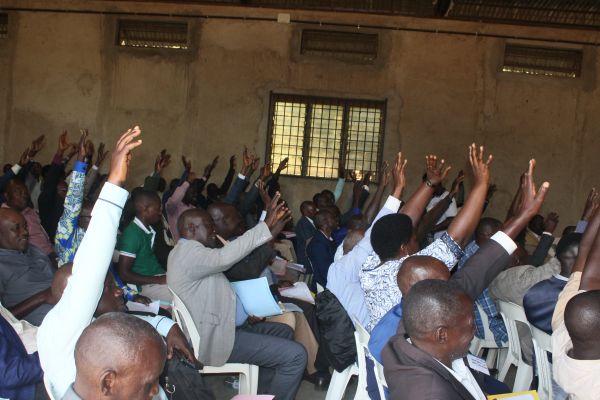
MBARARA CITY, June 24, 2026 — The historic Banyankole Kweterana Co-operative Union [BKCU] has elected a new board of directors to steer Western Uganda’s agricultural cooperative for the next four years.
The transition was formalised during a notably peaceful 53rd Annual General Meeting [AGM] held last week at the union’s headquarters in Kakoba, Mbarara City, a marked contrast to previous assemblies that were often characterised by disputes and heightened security deployment.
Joseph Muganga Twine, Chairperson of the Vetting Committee, said adherence to the Cooperative Societies Amendment Act, 2020 and the union’s internal bylaws ensured a transparent and legally compliant election process.
“Members, thank you for trusting us and giving us the mandate to vet credible leaders for Banyankore Kweterana Co-operative Union,” Twine said.
“We used the Cooperative Societies Act to vet the delegates who offered themselves to lead the union for the next four years.”
Twine said the committee undertook a thorough assessment process, reviewing candidates against audited financial records, supervisory reports and management performance indicators across regional coffee-buying centres.
The elections concluded peacefully, with all board positions filled unopposed.
Those elected were Abaasa Ainamani Rubaromba [Chairperson], Annah Ashaba [Vice Chairperson], Jones Asingwire [Treasurer], Peninah Mworozi Kempaka, Harriet Kentore Kahumba, Johnson Bashaija, Stephen Bongonzya, Betty Musiime and Dickson Nabihurira as board members.
Delegates also returned Alex Tugume Tumuhimbise, Mohammoud Ganjo and Julius Atwijukye as supervisory board members.
The AGM further approved the appointment of BMR Associates as auditors for the next four years following the expiry of Obed Associates’ contract.
Following his re-election, Rubaromba outlined an agenda centred on income generation, market expansion and strengthening the union’s long-term financial sustainability.
“In the next four years, we shall place more emphasis on income generation because that is where sustainability comes from,” Rubaromba said.
“Once the institution generates more income, it becomes easier to sustain. We expect improved performance through income-generating projects, better markets and improved prices for coffee.”
He said BKCU intends to expand direct export arrangements to reduce dependence on intermediaries and improve returns to farmers.
“Previously, we sold largely to the local market, but we have secured some contracts in Turkey and Europe and have also explored opportunities in China,” he said.
“We believe these export markets will enable us to secure fair prices and pay farmers better as we purchase their coffee.”
Rubaromba said the union plans to introduce a second-payment system for farmers as export opportunities improve.
Recovery from crisis
Rubaromba said the union’s current progress reflects recovery efforts following years of financial and governance challenges.
He recalled joining BKCU leadership as a youth representative from Mitooma and later serving as Chairperson of the Supervisory Committee before assuming the top office after investigations into alleged financial mismanagement.
According to Rubaromba, BKCU inherited heavy debts, limited operating capital, multiple legal disputes and mortgaged assets.
He said support from government through compensation payments helped the union settle outstanding obligations, recover key assets and restore operations.
Management subsequently invested in value addition, including acquiring a coffee roasting machine and obtaining certification to supply processed coffee products to formal markets.
The union also established a SACCO aimed at extending affordable credit to farmers to discourage distress sales of coffee.
“I want to thank all delegates of Banyankole Kweterana for once again trusting me with leadership,” Rubaromba said.
“We shall focus on production and marketing. We need premium markets so members can benefit.”
Internal divisions remain a concern
Despite recent gains, Rubaromba warned that internal divisions had previously affected the union’s growth prospects.
He claimed disagreements within former leadership structures contributed to the loss of a proposed Shs 900 million development grant and disrupted governance processes.
“We had divisions within the board and because of that we lost opportunities,” he said.
“What is important now is unity and speaking with one voice.”
Delegates later recommended establishing an arbitration committee to address internal disputes and strengthen cohesion.
Calls for quality and accountability
Joseline Komujuni, BKCU General Manager, thanked the delegates and member societies for maintaining confidence in the union despite past instability.
Muhwezi Timiseho, a delegate, requested a modest increase in coffee buying prices from Shs 11,800 to Shs 12,000 per kilogram to offset rising production costs linked to fertilisers, mulching and climate adaptation.
Ivan Asiimwe, General Secretary of the Uganda Cooperative Alliance [UCA], praised the peaceful conduct of the AGM and urged members to avoid internal conflict.
“When I last came here it was a battle,” Asiimwe said.
“I thank the leadership for revitalising the union. Now that progress has begun, avoid confusion and remain united.”
Mbarara City Commercial Officer Allan Buhanda Karakure called on the leadership to strengthen accountability and ensure the union’s land and property generate economic value.
“It does not make sense to own extensive land and remain cash-constrained,” Karakure said.
He also urged farmers to improve post-harvest handling and avoid harvesting immature coffee.
“Our coffee market is driven by quality, quantity and consistency,” he said.
Sedrack Muhangi, Senior Agriculture Officer for Western Region at the Ministry of Agriculture, Animal Industry and Fisheries [MAAIF], encouraged BKCU to align with national coffee production targets and strengthen certified seedling production.
Founded on May 7, 1958, BKCU has reduced from a historical peak of 350 primary societies to 73 active societies.
Union leaders say that with debts cleared and investments in value addition underway, BKCU is positioning itself for renewed growth in South-Western Uganda, with total assets valued at more than Shs 7.9 billion.
https://thecooperator.news/banyankole-kweterana-finally-receives-shs-9bln-for-ranch-compensation/
Buy your copy of thecooperator magazine from one of our country- wide vending points or an e-copy on emag.thecooperator.news


