
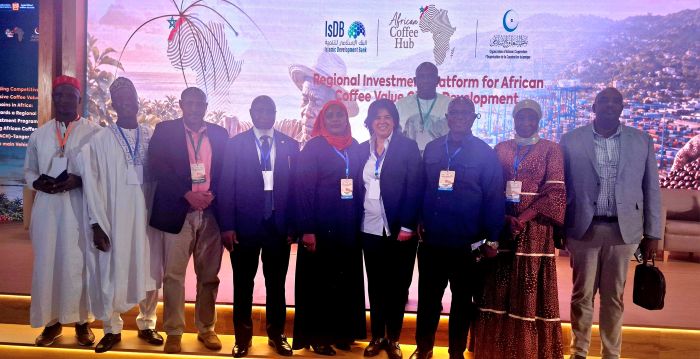
MARRAKECH, May 7, 2026 — African coffee-producing countries have renewed calls for greater investment in value addition and regional cooperation as stakeholders gathered in Morocco for the Regional Investment Platform for African Coffee Value Chain Development.
Held on May 5-6 with support from Morocco’s Ministry of Industry and Trade, the meeting brought together ministers, financial institutions, exporters and development partners to explore ways of strengthening investment, improving competitiveness and increasing Africa’s share in the global coffee market.
The initiative is backed by the Islamic Development Bank, the Organisation of Islamic Cooperation, UN Women and OCP Group, among other partners, and focuses on developing the coffee sector from production and processing to logistics and exports.
Speaking during the forum, the Executive Director of the African Coffee Hub, Sanae Benabdelkhalek, said Africa currently contributes nearly 15 per cent of global coffee production, but much of the continent’s potential remains untapped.
She said investment in the coffee sector must move beyond resource extraction towards strengthening value chains and building sustainable markets.
“African Coffee Hub positions itself as an actor aiming to support this transformation, promoting a vision focused on sustainability, competitiveness, and the integration of African producers into higher value-added circuits,” she said.
The Director of the Islamic Development Bank Group, Ahmed Aboubacrine, said the financing strategy for the sector would focus on integrated financing systems, support for export companies, microfinance, and greater inclusion of women and farmers in the coffee economy.
Uganda’s State Minister for Agriculture, Fred Kyakulaga Bwino, said ministers and representatives from leading African coffee-producing countries had gathered to lay the foundation for a regional coffee value chain capable of delivering greater economic returns for the continent.
“This meeting expressed our collective resolve, our shared vision and our deep commitment to the sustainable development of the coffee sector as a pillar of agricultural prosperity, enhancement of rural livelihoods and regional economic integration in Africa,” he posted on X, formerly Twitter.
Delegates at the meeting noted that although Africa produces a significant share of the world’s coffee, the continent still captures only a small portion of the value due to the continued export of unprocessed green coffee.
They observed that weak traceability systems, limited standardisation and lack of recognised certification continue to restrict access to premium international markets.
“It’s time we hold hands as Africans to fully exploit the potential in this green gold,” Kyakulaga said.
The discussions also highlighted the growing role of the African Coffee Hub, which Morocco launched in November 2025 within the Tanger Med Port complex.
The facility was established to position Morocco as a gateway for African coffee exports to Europe, the United States and Asia.
Under the initiative, coffee beans sourced directly from producers across Africa are consolidated in Morocco for quality control, grading and pre-export preparation before shipment through Tanger Med, one of the world’s busiest and most connected ports.
The model seeks to reduce reliance on intermediary-heavy supply chains, lower transport costs and shorten delivery timelines while retaining more value within Africa.
The hub also promises full traceability “from farm to cup”, with digital tracking systems documenting the origin, handling and transportation of coffee lots.
Supporters of the initiative say the system could improve price stability for farmers while meeting rising international demand for traceable and sustainably sourced coffee.
Countries expected to benefit include Ethiopia, Kenya, Rwanda, Tanzania and Uganda, all recognised globally for high-quality coffee origins.
Beyond exports, organisers say the project is expected to create skilled jobs in logistics, quality assurance and supply chain management, while strengthening local expertise in grading, blending and post-harvest handling.
“We want African coffee to reach the world without intermediaries, while guaranteeing quality, traceability, and economic fairness for producers,” Benabdelkhalek said, describing Tanger Med as “the ideal environment to lead this major shift”.
Meanwhile, Ugandan coffee is set to be showcased alongside other global coffee profiles at Coffex 2026 in Istanbul on Friday.
Buy your copy of thecooperator magazine from one of our country-wide vending points or an e-copy on emag.thecooperator.news


