
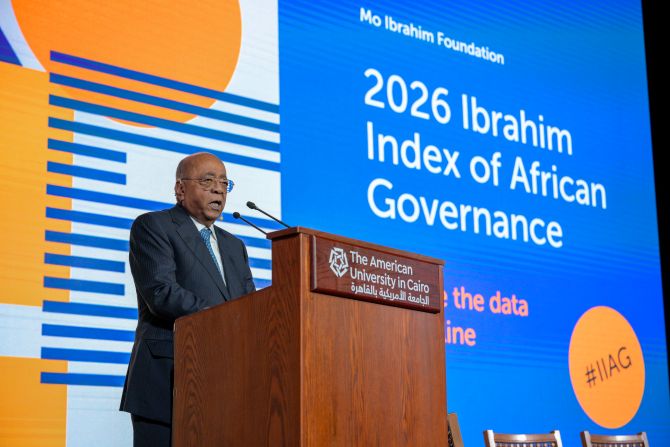
KAMPALA, November 2, 2026 — Governance across Africa has made slight progress over the past decade, driven largely by improvements in economic and human development, although deteriorating security, rule of law and participation continue to undermine sustainable progress, a new report says.
The 2026 Ibrahim Index of African Governance [IIAG], released on Saturday by the Mo Ibrahim Foundation, shows that overall governance improved between 2016 and 2025 despite a series of global shocks, including the COVID-19 pandemic, the Russia-Ukraine war and declining development aid.
The index, which assesses governance performance across all 54 African countries, combines data from four dimensions: Security and Rule of Law; Participation, Rights and Inclusion; Foundations for Economic Opportunity; and Human Development.
It draws on 96 indicators from 51 data sources across 16 sub-categories.
According to the report, improvements in governance at continental level were largely driven by gains in Foundations for Economic Opportunity and Human Development, particularly in infrastructure, health and education.
Foundations for Economic Opportunity improved in 44 countries, representing 68 per cent of Africa’s population, highlighting the continent’s resilience despite the multiple challenges experienced during the decade.
Infrastructure recorded the largest improvement among the 16 sub-categories, with progress registered in 52 countries, covering 84 per cent of the continent’s population.


The report attributed the infrastructure gains largely to improvements in mobile connectivity, access to energy and internet services.
Education also improved in 34 countries, representing 75 per cent of Africa’s population, while health improved in 40 countries, covering 87 per cent of the continent’s population.
However, the gains were offset by deterioration in security, rule of law and participation.
Security and Rule of Law declined in 34 countries, representing 78 per cent of the continent’s population, while Participation, Rights and Inclusion deteriorated in 31 countries, home to 60 per cent of Africa’s population.
The report, however, noted that the deterioration in security has slowed since 2022, with improvements beginning to emerge in 27 countries.
It also found that 25 countries, representing almost 47 per cent of Africa’s population, managed to make economic progress despite deteriorating security over the decade.
However, countries that recorded improvements in both security and rule of law generally achieved stronger economic progress.
The report said 20 countries, representing 22 per cent of the continent’s population, recorded improvements in both Foundations for Economic Opportunity and Security and Rule of Law.
At the end of the period under review, Seychelles ranked first in overall governance, while Morocco entered the top 10, replacing Tunisia.
South Africa remained among the top 10 countries, ranking fifth, but the report warned of a concerning trend of increasing deterioration in its governance performance.
The report also highlighted deterioration in four of Africa’s most populous countries — Nigeria, the Democratic Republic of Congo, South Africa and Sudan.
Angola and the Republic of Congo moved out of the bottom 10, while Libya and Guinea-Bissau entered the group.
Sudan, the Central African Republic and Guinea-Bissau were identified as countries experiencing a worsening trend of deterioration in governance.
Commenting on the findings, Mo Ibrahim, Chair and Founder of the Mo Ibrahim Foundation, said the results demonstrate Africa’s resilience but also highlight the risks of relying on economic and social gains without improvements in governance and security.
“The 2026 IIAG results highlight Africa’s resilience in a challenging global environment,” Ibrahim said.
“They also show that many countries manage to achieve economic and human development despite deterioration in security and rule of law.”
“But this is not a sustainable trade-off. Economic and social gains will not last, and will anyway always be weaker, without progress in security, rule of law and participation,” he added.
The findings suggest that while Africa has made progress in improving the conditions underpinning economic and human development, sustaining those gains will depend increasingly on reversing deteriorating trends in security, rule of law and citizen participation.


Buy your copy of thecooperator magazine from one of our country-wide vending points or an e-copy on emag.thecooperator.news
-

-

-

-


