
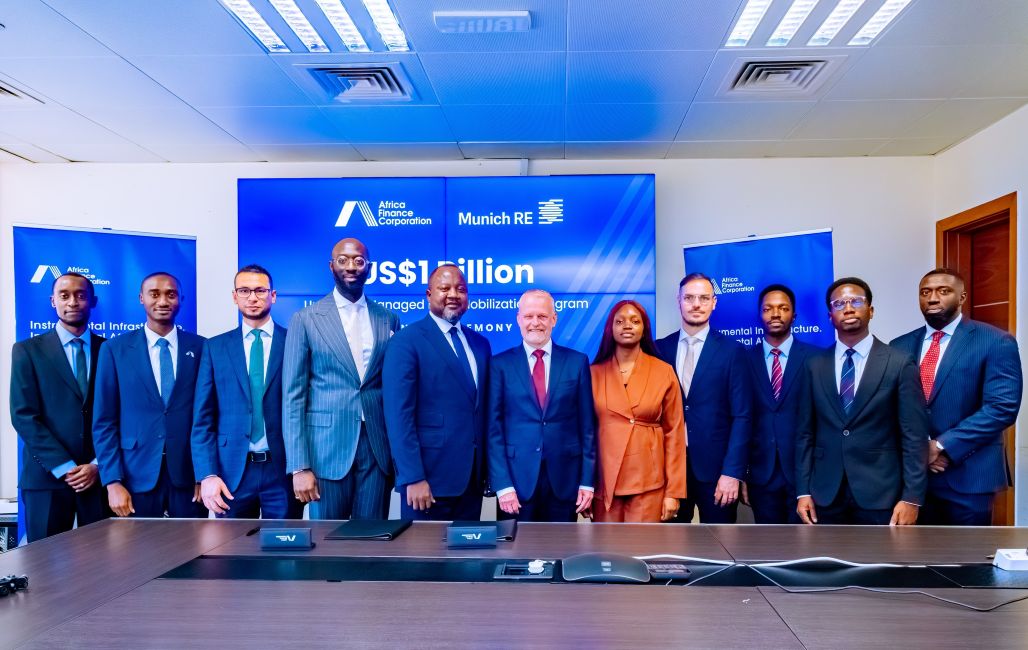
KAMPALA, October 27, 2026 – Africa Finance Corporation [AFC] and global reinsurer Munich Re have signed a US$ 1 billion risk-sharing agreement aimed at expanding trade finance for African banks and boosting intra-African and international trade.
The agreement, structured as an Unfunded Managed Debt Mobilisation Programme [UMDMP], will provide US$1 billion in committed risk-sharing support for AFC’s trade finance lending to African financial institutions, helping banks overcome financing constraints that have limited their ability to support imports and exports.
Under the arrangement, Munich Re will automatically assume a share of the risk on eligible AFC trade finance transactions, based on pre-agreed parameters and limits, while AFC will retain part of the risk on each transaction.
The arrangement is expected to accelerate financing decisions, increase lending capacity and enable African banks to provide more trade finance to businesses engaged in domestic, regional and international trade.
According to AFC, the programme’s financing capacity will be replenished as existing transactions mature, allowing the institutions to support new transactions without requiring fresh commitments for each deal.
The first phase will cover commercial letters of credit, trade loans and trade guarantees, which are essential instruments used by African banks to finance their clients’ imports and exports.
The programme will initially involve 38 financial institutions across 11 African countries, with AFC and Munich Re agreeing to review its scope to accommodate additional financial instruments and sectors over time.
Banji Fehintola, Executive Board Member and Head of Financial Services at AFC, said the agreement represents a significant shift in how development finance institutions mobilise capital to address Africa’s growing financing needs.
“Across the development finance landscape, there is a growing recognition that the scale of Africa’s financing needs cannot be met through traditional balance sheet lending alone. Multilateral development banks like AFC are increasingly embracing an originate-to-distribute model, with private capital mobilisation becoming central to how we deliver greater development impact,” Fehintola said.
He explained that managed debt mobilisation enables development finance institutions to leverage their expertise in originating and structuring transactions to attract institutional capital while managing financial risks.
“Managed debt mobilisation sits at the heart of this transition, enabling institutions like AFC to leverage our origination capabilities, structuring expertise and risk management frameworks to attract institutional capital at scale,” he said.
Fehintola added that the partnership would strengthen AFC’s capacity to finance African development, particularly as the African Continental Free Trade Area [AfCFTA] continues to promote trade among African economies.
“As the African Continental Free Trade Area deepens trade between African economies, the programme helps to solve committed capacity constraints for banks that finance that trade and strengthens AFC’s ability to be more instrumental in financing Africa’s development,” he said.
Wola Asase, Deputy Director and Head of Syndications and AFC Captive Insurance Company Ltd, said the new arrangement builds on a partnership between the two institutions that began in 2018.
“Munich Re has shared risk on AFC loans since 2018, one transaction at a time. This programme replaces that with pre-agreed risk parameters, so eligible trade finance transactions are covered automatically and banks get faster decisions,” Asase said.
She explained that the short-term nature of trade finance transactions would allow the programme’s capacity to be recycled continuously, increasing the volume of financing that can be supported.
“Because the transactions are short-dated, the capacity is recycled as they mature, and the wider Managed Debt Mobilisation Program it anchors gives us a framework to bring in further institutional investors, whether as funders or risk partners,” she added.
Herbert Müller, Head of Global Credit Solutions at Munich Re, said the agreement would enable both institutions to capitalise on their respective strengths while expanding support for African financial institutions.
“Munich Re benefits from the strong pan-African footprint of AFC while AFC benefits from the strong capacity of Munich Re,” Müller said.
He noted that the trust established through their cooperation since 2018 had enabled the institutions to move from individual transactions to a more structured and scalable partnership.
“The trust built between our two organizations through our cooperation since 2018 has allowed us to move from a transactional to a programmatic approach which allows us to support African financial institutions efficiently at scale,” he said.
Müller described African trade as a long-term business opportunity, adding that the programme would enable Munich Re to expand its operations while diversifying its risk exposure.
The agreement comes amid growing efforts by African development finance institutions to mobilise private capital and address persistent trade financing gaps across the continent.
Insurance and reinsurance arrangements have increasingly become important tools for expanding lending capacity by allowing financial institutions to share potential losses and support transactions that would otherwise exceed their risk limits.
Through such arrangements, lenders can extend additional financing to businesses and projects, supporting industrialisation, trade expansion and job creation.
AFC said its partnership with Munich Re has resulted in several risk-sharing transactions since 2018, including two completed in 2026. The new programme transforms that transaction-by-transaction cooperation into a standing arrangement.
The US$1 billion initiative will also serve as a foundation for AFC’s broader Managed Debt Mobilisation Programme [MDMP], which is designed to attract additional institutional investors to participate in financing African development.
Under the broader platform, investors will be able to participate either by providing direct funding or sharing financial risks alongside AFC.
The corporation said discussions were already under way with other African and international institutional investors interested in providing funding through the platform.
The latest agreement follows AFC’s establishment in August 2026 of AFC Captive Insurance Company, a wholly owned subsidiary based in Bermuda and backed by up to US$ 30 million in equity capital.
The subsidiary was established to enable AFC to retain and manage more financial risk internally, while improving the efficiency with which it deploys capital.
AFC said the captive insurance company and the Munich Re risk-sharing programme complement each other, with the former strengthening internal risk management and the latter transferring part of the corporation’s risk exposure to an established global reinsurer.
Together, the initiatives are expected to strengthen AFC’s financing capacity and support increased investment in trade, infrastructure and economic development across Africa.
Buy your copy of thecooperator magazine from one of our country-wide vending points or an e-copy on emag.thecooperator.news
-

-

-

-


