
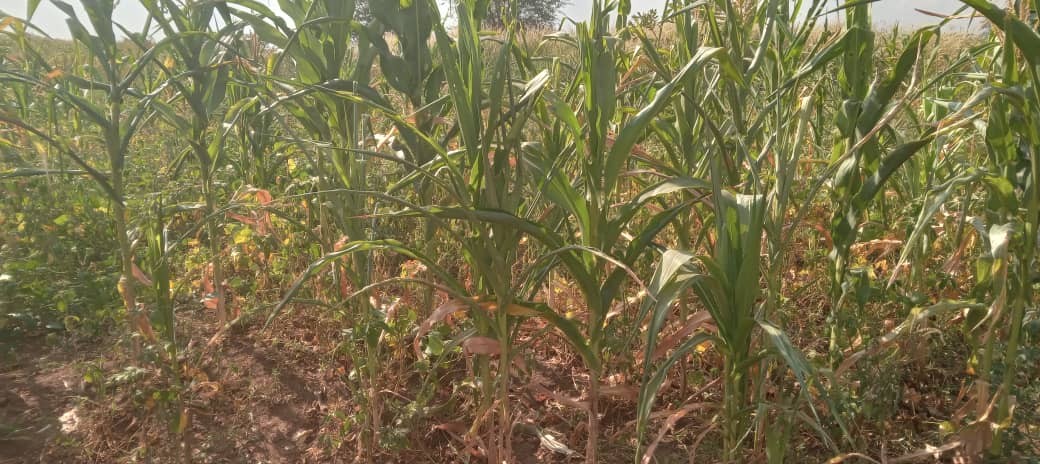
GULU CITY, December 8, 2025 — The early arrival of the dry season has left many farmers across the Acholi Subregion counting heavy losses, as acres of maize, groundnuts and beans, wither in their gardens.
Typically, second-season rains last until early December. This year, however, the rains disappeared by mid-November, leaving farmers unprepared and their crops exposed.
Winnie Atim, a farmer in Koro Subcounty, Omoro district, planted maize and beans in late September, expecting the rains to continue into December.
“I planted an acre of maize and another of beans in late September, but they have all withered,” she said. “I don’t know what I will feed my family on because I know the price of flour will definitely go up.”
Walter Ocen, a farmer in Omel Subcounty, Gulu district, who planted two acres of maize, says all his crops have dried up.
“I used to plant maize around the same time and it would yield highly,” he said. “The maize I grow in the second season always helps me feed my family and pay school fees for my children in first term.” He added that the sudden shift in weather patterns caught him completely unaware.
In Patiko Subcounty also in Gulu district, LCIII Chairperson Patrick Komakech said there is growing panic among residents over the widespread losses.
“We have not had rain for close to a month,” he said. “Many farmers are worried because they injected a lot of money this season. Some planted two to three acres of groundnuts, others maize, and all of it is withering very fast. We are really praying for the rains to return.”
Moses Uma, a member of Paicho Area Cooperative Enterprise in Gulu district, said the group planted over 100 acres of maize, most of which has now withered.
“We have not seen rain for over three weeks,” he said. “Even if the rains return now, the damage has already been done.” Uma warned that the early onset of the dry season could lead to food insecurity and urged the government to support affected farmers. Paicho ACE has more than 120 members.
The Uganda National Meteorological Authority [UNMA], in its September–December seasonal forecast, predicted that Central Northern Uganda, including Gulu, Omoro, Lamwo, Nwoya and Amuru districts — would receive near-average to below-average rainfall. It further warned that the rains might not adequately support usual socio-economic activities such as crop farming, and advised farmers to plant early-maturing crop varieties.
Michael Lakony, the Amuru District LCV Chairperson, said UNMA should decentralise weather information to ensure it reaches farmers.
“There is limited awareness of weather forecasts. If we don’t guide our farmers, they will keep making losses every year,” he said. “Many are stuck because they planted a lot of groundnuts expecting to harvest between November and early December, but they can’t because the ground is too hard. They now have to incur extra costs to dig them up, and some had not planned for this expense.”
Lakony also noted that the shortage of extension workers is worsening the situation. “We have only three extension workers in the district. It’s impossible for them to reach all 13 subcounties.”
Agronomist James Ogwal from Seed Co, an agro-inputs company, said farmers should embrace early-maturing and drought-resistant seed varieties.
“There is nothing farmers can do now,” he said. “We advise them to plant early and use fast-maturing varieties. The maize that is withering is what was planted late, between late September and October. Farmers who planted in July and August are not suffering these losses.”
He also encouraged farmers to use fertilisers, explaining that they can shorten the maturity period by up to two weeks.
Crop insurance not popular among the farmers
This reporter established that most farmers in Acholi do not take insurance for their crops against weather vagaries and therefore expect no compensation from the loss of their crops.
Further, a feasibility study on agricultural insurance for oilseed says although government allocated Shs 5 billion to subsidse agricultural insurance for farmers at 30‑80 percent of the cost of premiums depending on farm scale and location, insurance uptake has been lowest in the northern and eastern regions of Uganda.
To ensure that more farmers take up insurance for their crops against weather vagaries like drought, the study calls for more training, especially to educate the farmers about insurance, to build trust that it will pay out, and to clarify the benefits and the limits of insurance.
https://thecooperator.news/kotido-pdm-farmers-struggle-as-drought-persists-despite-recent-showers/
Buy your copy of thecooperator magazine from one of our country-wide vending points or an e-copy on emag.thecooperator.news


